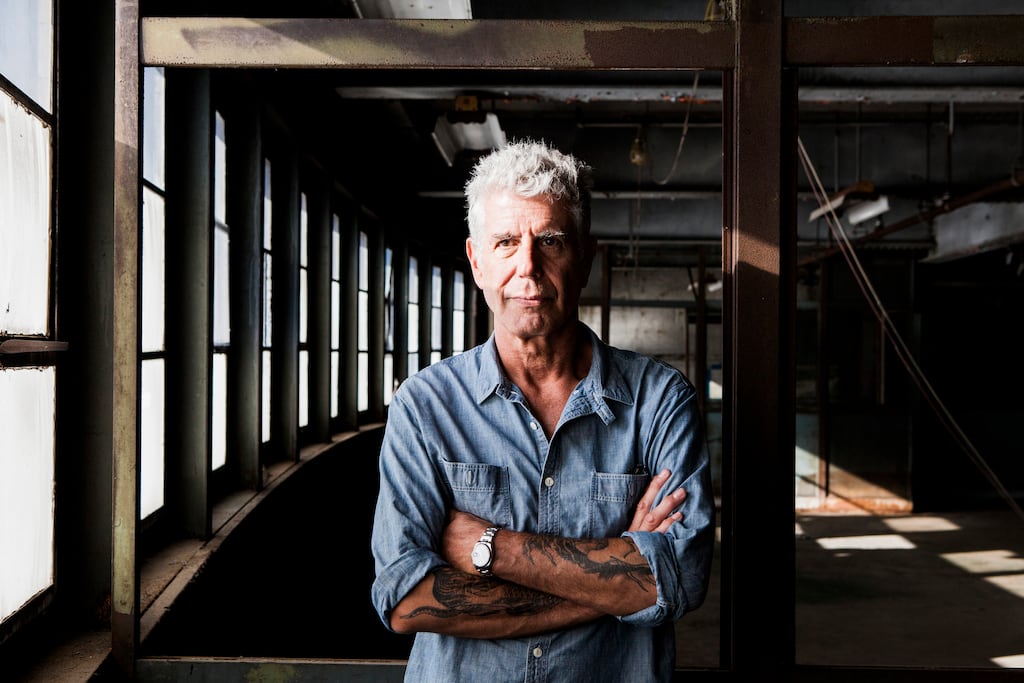
The globe-trotting Anthony Bourdain, who first swaggered into our popular awareness with his culinary tell-all, Kitchen Confidential, was not a chef who became a writer, but the other way around. As the preface of The Anthony Bourdain Reader, a new collection of his work, explains: “It was in his writing more than anything else that Tony expressed the whole gamut of his talents, ideals, and personality.”
Since his death in 2018, there has been much written about him, including an unauthorised biography, an oral history and memoirs by those who worked with him. The Bourdain Reader, however, presents the man in his own gravelly words.
There’s a wealth of material, which, along with his better-known work, includes plays, an unfinished novel, comic strips and high-school short stories. Writing was a craft Bourdain practised relentlessly. “What I planned as a lovely time in Florence living the life of Hemingway,” he jots in his diary at 18, already aware he has an audience to amuse, “has turned out to be living on a train living the life and observing the diet of Ghandi (sic).”
In Bourdain’s youth, being a chef was not cool but “untrustworthy, unpleasant, and more often than not, unhealthy”. Still, it was not surprising that he gravitated towards the kitchen, given that its seaminess had attracted one of his literary heroes, George Orwell, whose Down and Out in Paris and London was an inspiration.
READ MORE


Bourdain remains one of the most entertaining reads, the plaints of a chain-smoking hero mixed with geeky mensch. His respect for women doesn’t hinder the occasional ogle (about Russian women: “That they are about as soft and cuddly as a fistful of quarters is beside the point – they’re gorgeous”), and he’s old-fashioned, but profane. (His “Grandma Rule” for hungry travellers: “You may not like Grandma’s Thanksgiving turkey ... But it’s Grandma’s turkey. And you are in Grandma’s house. So shut the fuck up and eat it.”)
But what distinguished Bourdain was his extraordinary sensitivity towards the world, an identification with the marginal and disenfranchised, and an almost quixotic commitment to fight alongside them.
The best of the Reader shows him firing breathlessly on all cylinders, bringing to the table his obsessiveness about a panoply of topics, such as his description of a bookshelf: “Montaigne’s essays – in French – sat next to a military history of the Congo. A trashy crime novel leaned against Pépin’s La Technique.” He was neither a bad speller nor a lazy grammarian; facsimiles of carefully corrected proofs point to a meticulous mind. His penmanship, duplicated here, is astonishingly legible. “I was going to spend every cent on crack” is spelled out in a round, schoolboy script.
For Bourdain, food writing was as much about the mood as the meal, its anticipation and aftermath, like the screams of a slaughtered pig that “penetrated my fillings, echoing through the valley,” and a Vietnamese pho shop “strewn with tissues, the spent expressions of human lust”.
His anger, for which he’s famous, is infectious, but although he rants about vegetarians and nonsmokers, it’s his statement, “Once you’ve been to Cambodia, you’ll never stop wanting to beat Henry Kissinger to death with your bare hands” that packs the rawest punch. We’re reminded of his hidebound regard for professionalism, as with “Typhoid” Mary Mallon, the 19th-century Irish cook. “(C)ooks work sick,” he explains, “It’s a point of pride, working through pain and illness.”
Finally, there are beautiful, wistful meditations we might have overlooked or forgotten – his daughter eating an anchovy; a Bon Appetit article about his gentle, classical-music loving father, a man who viewed the world as “full of marvels”.
Not all of the Bourdain Reader is good, such as the sloppy, opening essay Lust and especially his fiction with its existential, heroin-shooting chefs. However, although its editor, his longtime agent Kimberly Witherspoon, intended that the book be “imperfect, (mostly) unapologetic, brilliantly messy”, I think that Bourdain – who, despite his laconic exterior, was a notoriously temperamental perfectionist – might have issues with some of its material.
I also wish there were more of Bourdain writing about others, such as his moving profile of the Dominican-born Justo Thomas, fish cutter of the legendary Manhattan seafood restaurant Le Bernadin, which is not included. Bourdain was determined to honour his immigrant kitchen colleagues, and although some of what he wrote might sound a little tone-deaf now (Segundo, “a mean looking bastard ... I don’t care if he killed Kennedy; the man is the greatest prep cook I have ever had”), his attitude was in many ways unprecedented.
The Reader ends on lines from his play, The Exquisite Corpse – “We don’t exist. We weren’t even here” – which echoes off his other sentences elsewhere: “I’m still here.” “We did well. We’re still here.” “I’ll give it all up someday.” The effect is haunting, but I wonder whether this touch of eulogy is necessary for this man, whose magnificence will outlive his TikTok tributes.
Perhaps in the future, there will be another Bourdain compendium, in which his critical significance can be considered apart from the pain of his loss. In the meantime, this volume does him justice as a portrait of a man that, while purporting to be warts-and-all, is nevertheless curated with care.