
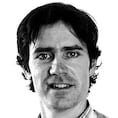
Things are busy in the hotel lobby where Ben Healy is waiting for me. People are coming and going, and it seems no one else recognises the Tour de France stage winner and wearer of the yellow jersey from last July.
Except for his mum and dad, obviously, sitting on the couch opposite. Lisa and Bryan are proud parents and his biggest fans, and it turns out Bryan still gets all the credit for introducing his son to the joys of cycling.
Healy appears a little smaller and a lot younger than expected. Smartly dressed in a turtleneck jumper and loose cords, his trademark dark floppy curls are well trimmed, the silver-stud earrings keeping to his style.
He’s also chirpy from the go and thoroughly engaging. His gentle demeanour is somewhat at odds with his swashbuckling and aggressive tactics on the bike, which Healy displayed multiple times this year. Most successfully with his 42km solo breakaway win on stage six of the Tour, followed by a similar breakaway four days later, which saw him take the leader’s yellow jersey from Tadej Pogacar.
READ MORE


Though the hardest ride by far, he says, was at the World Championships in September, the 267km around the high-altitude landscape of Rwanda’s capital Kigali. Only the strongest survived, and Healy won bronze behind Pogacar and Remco Evenepoel. With that medal, Healy also joined the three previous Irish medal winners who likewise wore the yellow jersey; Shay Elliott, Seán Kelly and Stephen Roche.
“I was actually struggling all that week, with the air pollution, all the travel,” he says. “That made me race more passively, but I think that paid me back in the end. I just kept the powder dry, which is kind of weird for me. But that was a different sort of hard. Just a slow, long, grinding it out.”
Later when our conversation turns to pain and suffering on the bike, Healy smiles as if relishing the mere prospect. “I love the satisfaction of overcoming it. Maybe you can lean into the pain more on the bike. But it always hurts when you’re going full gas, and I was proper suffering the last 5km of stage six on the Tour, after being out front for so long.”
Healy is in Dublin with his parents to attend the Cycling Ireland awards, the obvious recipient of rider of the year. It’s five years since we first met, when Healy raced the National Championships around the south Limerick hillside village of Knockaderry. Just turned 20, he began pushing the pace on the second of nine 17km laps, soon breaking clear of far more seasoned riders, including two-time former champion Nicolas Roche.
By then he’d already committed to riding for Ireland. His dad Bryan is the youngest of three siblings, and the only one born in England after his Waterford and Cork-born parents moved to London in the 1960s. From there they settled in the village Wordsley, near Stourbridge, about 20km west of Birmingham.

The area is affectionately known as the Black Country, and Healy retains his soft West Midlands accent. Although home for him now is Andorra, in the Pyrenees mountains, he’s no doubt that without the support of Cycling Ireland, he might never have made it in professional cycling.
He willingly traces the trail: his first memory of any sport is watching riders at the Manchester Velodrome on TV, at age six, telling his dad he’d like to try that.
“My dad is still so passionate about cycling, and first took me down to the local outdoor track in Halesowen, at age six, and it all started from there.
“I was pretty awful on the track, so went to mountain biking from there. Was okay at that. I think I always wanted to race on the road, but my dad held me back a little, keeping it fun and local, and it only kicked off proper at 16 or 17.”
One of his first breakthroughs came at the Halesowen Road Race in 2017, when still only 16, Healy producing a late breakaway in the 100km race in the exact same style he’s now famous for. He’d also been part of the British mountain bike academy around that time, only to be dropped without any explanation. Which is exactly when his Irish side came calling.
“It was just an email, like ‘we don’t want you any more’. I don’t really know why, to be honest. So you definitely feel a little let down, a bit bitter. But it’s extra motivation too, 100 per cent. And it actually kick-started all my career really. Because if I didn’t declare for Ireland, I don’t know ... Because Ireland has given me so many opportunities and chances, that’s helped my breakthrough. I’ll be forever grateful.”
He already held his Irish passport, reaching out to Irish cycling coach Martin O’Loughlin in 2018: “Martin basically said come to Irish nationals, show us what you got.”
So Healy did show up, getting the ferry to the National Championships in Collooney in Sligo, winning the junior time trial. Within weeks he made his Irish debut at the European and World Championships.
He was also picked up by Irish cycling agent, Andrew McQuaid. Healy first showed his pro potential at 18 when becoming the youngest winner of a stage in Tour de l’Avenir (Tour of the Future) in 2019.

“So many things fell into place for me which were pure luck,” he says. “For sure, I have a bit of talent, I’ve clung on to that. But I’ve always just loved riding my bike, which in turn made me work pretty hard for it.
“Then getting on to the right teams. As a junior I was proactive, sending my CV to every email I could get hold of. Then it was getting into the right races to win something.
“I’ve also been quite lucky in terms of crashes. The biggest panic I had was after Covid. I think for my generation that was a massive deal. I was lucky to have the stage win in l’Avenir, I was still kind of on the map, but without that I think it would have been a real struggle to get back out there to race.”
For the 2022 season he signed his first pro contract with EF Education-EasyPost, the US-based team founded and still run by Jonathan Vaughters, known for its strong stance on anti-doping.
Healy has also retained Jacob Tipper as his cycling coach for the last 10 years. Together they realised Healy needed to start remeasuring his bold and too often reckless breakaways, especially after the potential shown when winning stage eight in the 2023 Giro d’Italia.
“For sure, I’d describe my racing style before as a bit of a mad dog. Going here, there and everywhere. Not really being present in the moment of a race. Or thinking about the energy I’m expending. That catches up with you at some point. I got away with it in the lower ranks, but at the top level every bit of energy matters.
“So a lot of time was spent with my coach, reviewing races, all the little mistakes. Thinking ‘how could we turn this great form into more results?’ The big part was trying to figure out how to win.”
Two more near misses last year – on stage nine of his Tour de France debut, then at Paris Olympics – convinced Healy he was getting close. Before it all came to plan on the roads on Normandy last July.
“For this year’s Tour we sat down a few days before, really fine-combing the stages, and stage six was right up there for me. It’s a big fight for the breakaway, as always, and I managed that, without too much energy. It’s a really strong group, that means picking a point on the route that was inconspicuous, and we earmarked a bit of a descent, then a kick, on a twisty, narrow road. I managed to time it perfectly.

“Then it’s just about doing the fastest effort to the finish. You can’t go full gas into the first climb, or you’ll blow. At the same time you need to be mindful of the gap behind. It’s a bit of a mental game. They think the gap might be closing, then you rip it open again.”
Winning the yellow jersey, four days later, wasn’t planned, but again magnificently grasped: “So many things have to align for that to happen. On paper, stage 10 was the best for me, so we always had an eye on the break. But then UAE let a massive break go, which is so uncharacteristic of them. I was just in the perfect position in GC [general classification] that they weren’t worried about me.
“Being in yellow, it’s so overwhelming, also so stressful. You really want to hold on to it, which I managed to do for one day, so just an amazing couple of days.”
Healy came close to a second win on stage 16, on its iconic summit finish on Mont Ventoux, nipped on the line by French rider Valentin Paret-Peintre. He finished ninth overall in the Tour, with the award as the most competitive rider.
He turned 25 in September, with big goals again for next year. He also got engaged to girlfriend Martha during an off-season safari in South Africa.
“The GC races are so hard. I kind of backdoored it this year, was never racing in the front every day with all the top guys. But I think racing for the stage wins, taking chances, that’s what I really enjoy. I just want to focus on trying to win another stage, experience another Tour like I did this year.”
He’s open, too, about the science around keeping his 62kg, 5ft 8in frame in check: “I’ve always kept it pretty lighthearted. Watts, power output, for sure it’s important, but you also need to be in touch with your body, listen to that. It’s about getting there the right way. Nutrition on EF is massive now. It’s vital, because as soon as you do it the wrong way, that can affect your body, and long-lasting.
“I’d always been maybe on the chubbier side of cycling, that’s how people viewed me, but that’s one of the big gains I made, losing weight, but losing weight correctly.
“When you see me at the Tour, I am super skinny. But that’s not sustainable for a very long time. It’s a slow process. It’s never starving. Because you have to enjoy it. Cycling is a very hard sport if you don’t enjoy it.”


