

Not since 1989 and its invasion of Panama has the United States so ostentatiously wielded its “big stick” in the Caribbean.
In recent months Washington has amassed a fleet led by the aircraft carrier USS Gerald R Ford – billed by its navy as the world’s most lethal combat platform – in the sea that has been nicknamed “America’s Lake” because of US dominance over it.
Along with 15,000 troops the flotilla has been deployed to target drug cartels as part of Operation Southern Spear.
Since US president Donald Trump declared his country to be in a “non-international armed conflict” with traffickers, the US has carried out at least 21 strikes on boats in the Caribbean and eastern Pacific that its officials allege were smuggling drugs, in a campaign that has embroiled US defence secretary Pete Hegseth in accusations of possible war crimes.
READ MORE


The ultimate target of this supposed policing operation is Venezuela’s dictator Nicolás Maduro, for years the principal antagonist of the US in the western hemisphere. After several previous failed attempts to eject the Chavista socialist from power, Washington once again has the former bus driver in its crosshairs.
Last month, it designated the Cartel de los Soles a foreign terrorist organisation identifying Maduro as the group’s leader.
Named after the sun-shaped insignia worn by Venezuelan military officials, the Cartel of the Suns refers to the various networks within the country’s security and military apparatus involved in drug trafficking.
Many observers contest the US claim the groups constitute a properly structured cartel or are headed by Maduro rather than just operate with his connivance. But the designation has ratcheted up the pressure on the Venezuelan regime which has been deeply implicated in criminality.

Trump has already confirmed he has authorised the CIA to conduct covert operations in Venezuela and that he was considering land-based strikes there. After reportedly offering Maduro safe passage to leave the country he told reporters, “if we can do things the easy way that’s fine, and if we have to do it the hard way, that’s fine too”.
This psychological pressure campaign against Maduro is just the latest sign that under Trump, Washington has adopted a new more muscular interpretation of its interests in the western hemisphere.
[ Is Trump starting a war with Venezuela?Opens in new window ]
For decades the region was largely ignored by US policymakers focused on the Middle East and the challenge posed in Asia by a resurgent China. But since Trump’s return to the Oval Office he has as well as drug cartels also targeted Greenland for acquisition from Denmark, called for the retaking of the Panama Canal which the US relinquished sovereignty over in 1999 and even suggested Canada should join the US as its 51st state.
Trump has presented his new approach in America First terms as necessary to confront the drug and migrant traffickers that fuelled the twin domestic crises that helped propel him from reality television into the White House.
But senior members of his administration have framed the policy more broadly. In an article published just after taking up his role, secretary of state Marco Rubio lamented that Washington’s years of neglect of the region had allowed problems such as the migrant and drug crises to fester, adding these were “intentionally” amplified by leftist regimes such as Cuba, Nicaragua and Venezuela.

All the while, he said China was using its growing economic leverage to turn regional nations into “vassal states”. “That ends now,” he wrote.
“We have ignored our own hemisphere for a very long time and by turning our back on it we left the door open for China, Russia, Iran and other not so friendly powers to expand their influence,” says Melissa Ford Maldonado, director of the Western Hemisphere Initiative at the America First Policy Institute.
“Now what we see is that with his actions, president Trump wants to change that and have the US lead the western hemisphere again.”
In his article, Rubio noted that while many countries would co-operate enthusiastically with the new US presence, others would not.
“The former will be rewarded. As for the latter, Trump has already shown that he is more than willing to use America’s considerable leverage to protect our interests,” he warned.
Many have called this new posture a revival of the Monroe Doctrine. One of the oldest pillars of US strategic thinking, this is named after president James Monroe who in 1823 declared the western hemisphere closed to further colonisation by European powers.
Since then the doctrine has been interpreted as an expression of US primacy in the region especially after president Theodore Roosevelt – he of the “big stick” – said in 1904 the Monroe Doctrine imposed on the US the obligations of an “international police power” within its own hemisphere.

“It is too soon to say how the world is going to evolve. The post-second world War era is over but it is not certain what comes next. One possibility is the US agrees three spheres of influence with Russia and China and Europe becomes somewhat orphaned. But there is going to be a new configuration and clearly the US once again sees the Americas as its backyard, reviving the Monroe Doctrine,” says Rubens Barbosa, Brazil’s former ambassador in Washington.
But while the campaign against Maduro has been framed as a counter-narcotics policing operation, some see old Cold War antagonisms still at play. Central to this view is the role of Rubio, the administration’s acknowledged Latin American expert.
“Since its start, the Trump administration has taken a strong ideological position against leftist governments in the region such as Cuba, Nicaragua, Venezuela and Colombia,” says Barbosa. “This has been especially true of Secretary of State Rubio. An ultraconservative former senator from Florida whose family fled to the US from Cuba, he knows the region and has a very strong position against the left.”
While Maduro has been designated the head of a drug trafficking organisation and targeted by a military build-up, the US administration has taken a more benevolent approach towards right-wing politicians in the region linked to the drugs trade.
Last week, former Honduras president Juan Orlando Hernández walked free from a US prison after receiving a pardon from president Trump one year into his 45-year sentence for drug trafficking. He had been convicted of using his office to facilitate the importation of over 400 tonnes of cocaine into the US.
One witness claimed the convicted president boasted about stuffing cocaine “right up the noses of the gringos”. In freeing him, Trump said Hernández had been “set up” by the Biden administration.

The pardon follows the decision in October to drop US sanctions on Paraguay’s former president Horacio Cartes.
These had been imposed after authorities accused him of obstructing international efforts against transnational crime in order to protect himself from investigation. In 2010, Cartes was identified in a US state department cable leaked by WikiLeaks as the head of a drug trafficking organisation.
Cartes was Paraguay’s president from 2013 to 2018 and remains the leader of the country’s ruling Colorado party which has sought to align itself with Trump’s Maga movement. Paraguay’s current president Santiago Peña, a protégée of Cartes, described the re-election of Trump as “a dream come true”.
If Trump’s campaign targeting states involved in the drugs trade so far only extends to those run by leftists, this is not to say it is unpopular in the region. The political emergence of a new hard right across Latin America that is openly admiring of Trump and his Maga movement means many in the western hemisphere are not opposed to what has almost inevitably been labelled the “Donroe Doctrine”.
A recent poll across Latin America for Bloomberg found that 53 per cent of respondents supported a US military intervention in Venezuela against 35 per cent who opposed it. “A lot of people hear Monroe Doctrine and they associate it with something very negative. But the national interests of the US actually align very well with those of our neighbours in the western hemisphere,” says Maldonado on the America First Policy Institute, pointing to shared concerns about the violence caused by drug cartels.
Though Trump’s popularity across the region varies, it is consistently higher than that of Maduro. He is blamed for Latin America’s biggest ever refugee crisis as eight million Venezuelans have fled their country’s economic implosion under his watch.
Now many hard right candidates are seeking to emulate Trump and link the presence of these refugees with rising crime rates, despite no evidence for this. “If Trump manages to kick out Maduro by any means and somehow restores democracy in Venezuela there is no way he is not going to be liked on this continent,” says Marta Lagos, director of Latinobarómetro, a regional research group based in Chile.
“Drug trafficking, organised crime and migration have taken over the whole region’s agenda and things like education or health now take second or third place. It is not an ideological question. People blame Maduro for the eight million Venezuelans going around the continent looking for jobs. Venezuela is visible everywhere.”
The migration crisis is partly the result of the expansion of organised crime across Latin America. Traffickers have reinvested drug profits into other criminal activities including people smuggling. Exacerbation among voters at the failure by leaders of both left and right to tackle these criminal networks has opened a window for a new generation of Trump-aligned politicians.
The region’s most popular president is Trump ally Nayib Bukele, of El Salvador, whose hard line stance against his country’s previously rampant gangs has trampled on constitutional protections but brought about a collapse in what was one of the world’s highest murder rates.
In Chile, fear of rising crime has driven the hard right to the verge of power for the first time since the end of the Pinochet dictatorship. Running on a law-and-order platform José Antonio Kast is the overwhelming favourite to defeat his communist rival Jeannette Jara in next Sunday’s (December 14th) presidential run-off.
An admirer of Trump, he has promised to seal his country’s borders and evict the hundreds of thousands of Venezuelans who fled to Chile following the implosion of their country’s economy and whom many Chileans blame for the dramatic rise in crime.
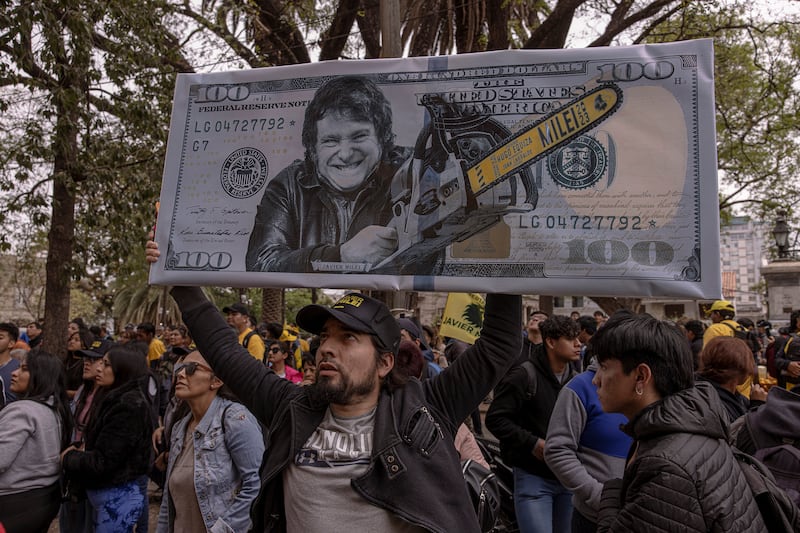
But whatever the fate of Maduro or the region’s Trump-inspired law-and-order crackdown, it is not clear how much the US can offer the region on the economic front in order to raise living standards and lower inequality. There was a US$20 billion bailout for Trump’s Argentinian ally president Javier Milei that helped ease a run on the peso ahead of crucial midterm elections he won.
But the aid to a direct competitor provoked intense hostility from US farmers in Trump-voting states back home.
While China has emerged in recent decades as a key commercial ally right across the Americas, the Trump administration has slapped tariffs on many states, raising questions about how reliable a partner it can be under an America First president.
Chinese investment in major infrastructure projects in Latin America has garnered the hostility of the Trump team. But how much an administration that has mandated allies such as Japan, South Korea and the European Union to invest in the US economy would itself be willing to invest across the western hemisphere in order to push out vital Chinese financing remains to be seen.


