“Good fences make good neighbours” – so goes the old saying goes.
That’s generally deemed to be good advice for people living next door to one another – but what if “Coco the cat” doesn’t respect fences?
Coco rose to fame last month when a District Court heard how his actions had brought neighbours into dispute in leafy south Dublin.
Coco’s persistent defecation in the garden of one neighbour led to a drawn-out dispute and a bitter legal action.
READ MORE



The Nugents of Mountain View Road in Ranelagh sought damages after claiming Coco had been using their property as a toilet – and for the cat to be placed under restraint by its owner, Geraldine Kennedy.
Kennedy countersued, claiming Michael Nugent had harassed her by repeatedly knocking on her door.
The Nugents were initially awarded €6,000 while Kennedy’s counterclaim was thrown out. Kennedy appealed to the Circuit Court and the judgment was annulled. She said she felt she had little option but to rehome the unfortunate Coco.
“A court of law is the last place a dispute between neighbours should end up,” Judge James McCourt said as he struck out the case.
That may well be true, but the courts have seen a rash of neighbourly disputes recently. Up and down the country, solicitors and barristers report having to deal with more rows about property boundaries, noise and antisocial behaviour.
Many legal practitioners report a general change in culture around litigation – with more people increasingly insistent on going to court – and avoiding efforts to reach some sort of mutually acceptable compromise.
Another case that has featured in much reporting recently relates to a property dispute in Sutton, north Co Dublin.
Judicially favoured “peace talks” failed to arrive at an amicable outcome last month in a case that has been running for six years.
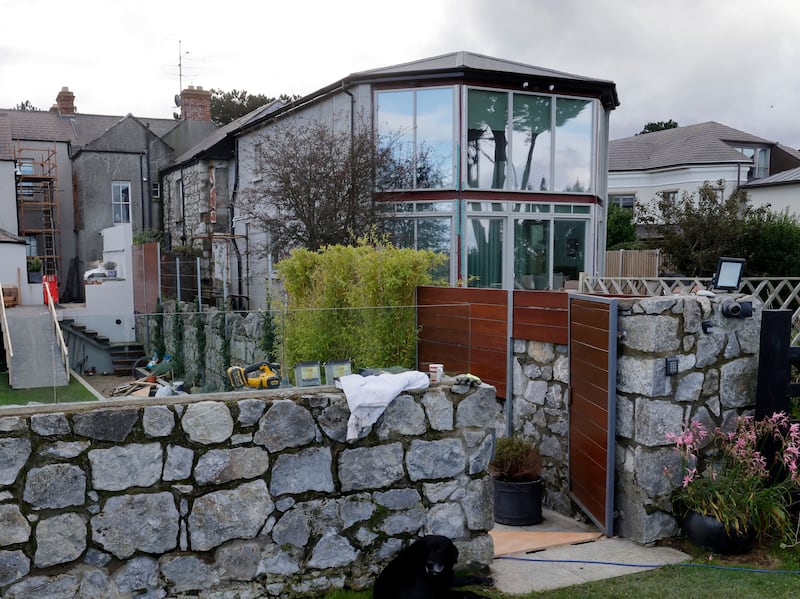
Dublin businessman Philip Farrelly of Burrow Road faces an order to demolish almost half his home as a result of an alleged breach of planning laws.
Fingal County Council ordered Farrelly to demolish a two-storey extension to his home. At the same time, 17 of his neighbours have made submissions of concern about the work; some labelling it a “monstrosity”.
One neighbour, Simon Revill, a property manager whose mother, Jackie Revill, bought the house in the 1970s with her husband, has been involved a long-running dispute over the new building at the rear and side of Farrelly’s home.
The structure overlooks the back of Revill’s home by Burrow Beach near Howth and throws his garden and the rear of his house into shadow.
The dispute ended up in court, which heard that the talks could not find a solution and the case is due back in the new year. Farrelly’s lawyers claim if he did make a mistake in building the extension, it was a genuine one.
Co Clare-based solicitor John Casey says he has seen a dramatic increase in disputes between neighbours over the past couple of years. Speaking generally about disputes – and not about a specific case – he attributes the increase, in part, to legislation governing harassment that was changed in 2023.
“Previously, if you believed somebody was threatening you, you would go to the guards and they would decide whether to prosecute or not,” he says.
“But now people can bring a civil application. If a client had come in to me in the past, I would have said, ‘Go to the guards’ – but now the guards say, ‘Go to your solicitor.’”
He says there is a “deluge” of such cases now coming to court in Clare.
“In court today, the list had maybe five or six of them – and they generally take a considerable period of time too. By their very nature, everyone is in court giving their evidence.”
Casey’s general advice to rowing neighbours is to avoid court if they can.
“Once you go to court, then whatever sort of relationship there was there with your neighbour is gone – and you are left still looking over the fence at each other.
“In right-of-way disputes, for example, we say to them: sure, you can go to court, but when it is finally listed the judge will say: ‘Have you tried to settle this?’
“He could end up making an order that doesn’t suit anybody – and the costs could be substantial. I like to say you could build a section of the M50 for what it costs.
“I always try to talk people out of it. But sometimes it becomes an obsession for them. People want their day in court, despite our advice.”
Casey says such cases consume a huge amount of a solicitor’s time and are priced accordingly.
“Even if you are getting paid, it is hard-earned money,” he says. “There are endless emails, phone calls and meetings.”
Legal observers believe the number of neighbourly disputes ending up before the courts could well increase due to the increased publicity around them.
Media reports from the courts draw general attention to the ability of people to seek restraining orders through the legal system.
Before the updating of the law around harassment and restraining orders, home extensions and property boundaries traditionally had been the source of much animosity between neighbours.
And they still account for a big portion of disputes.
Barrister Oisin Collins has represented clients in a number of cases covering these types of complaints.
“People are a lot more aware of their environment and more empowered by social media for remedies,” he says.
“They are able to find out quite quickly, through Google searches and websites like Reddit, what the experience of others has been. In a lot of cases people’s biggest assets are their homes – and when things start happening that might affect the value of their home, they are more keen to protect it.”
Collins says there has been an increase in these disputes over recent years – in tandem with rising property prices and a dysfunctional property market.
“People are more willing to come to law to protect their property rights,” he says.
“It could involve an extension, or the playing of music all night by neighbours – and they feel it is taking value off their home. They don’t have the same flexibility with property they used to have; they can’t just go and buy another house.”
He says judges are “very unhappy” with the growth in these cases and they are the “worst kind” historically for courts to have to deal with.
“That said, if somebody comes along with a bona-fide action, the case has to be disposed of. Courts just have to get on with it.”
Solicitor and senior counsel Bill Holohan has mediated on numerous neighbourly disputes over the years.
He notes that, by law, solicitors must now advise their clients of the benefits and cost savings that the mediation path offers – but they don’t always listen.
He finds people are increasingly quick to anger over “things like hanging branches and dumping grass cuttings” and puts this down to a “cultural shift”.
“Years ago – in our parents’ generation – you got on with people. Now we have this American-induced psychology of ‘me and my rights’,” he says.
“Because of this growing ‘me, myself and I’ attitude, there is a lack of community spirit, a lack of willingness to make allowances for others.”
On top of this, he says, is the traditional Irish attachment to property – and an inclination to want to argue.
“We are a rebellious bunch of so-and-sos – just ask the British. We just feel very territorial. It is in our psychological make-up to have a fight,” says Holohan.
“Sometimes you just have to let people vent – let them talk to the point of exhaustion. The problem with a court is that it is an inquest into what happened and is focused on identifying blame. The whole purpose of mediation is to focus on solutions for the future.
“They might not be entirely overjoyed or hugging going out the door, but it’s their agreement. Whereas you can come out of court and one side is unhappy – or both sides are unhappy.”
So what is likely to draw a halt to this “deluge” of cases?
Oisin Collins detects that judges are increasingly willing to call out people for being unreasonable in their insistence on taking cases to the bitter end.
And Holohan points to some recent examples of judges penalising solicitors who have not advised clients as to the availability of mediation in advance of litigation.
“Only when judges apply penalties will people sit up and pay notice,” he says.