

Main points
- Former Sinn Féin leader Gerry Adams is testifying at the Royal Courts of Justice in London today in a case alleging he is liable for IRA bombs between 1973 and 1996.
- John Clark, Jonathan Ganesh and Barry Laycock, who were injured in IRA bombings in London and Manchester in 1973 and 1996, are suing Adams for “vindicatory” damages of £1 alleging he was “directly responsible” for the attacks.
- Adams (77) strongly denies any involvement and has repeatedly rejected claims he was ever in the IRA.
- This is a civil trial before a judge of the High Court, so a ruling will be reached based on the “balance of probabilities”.
Key reads
- Voice from the grave fills courtroom at Gerry Adams civil action in London, writes Mark Hennessy
- Adams was the IRA’s leader until the mid-2000s, and it was “only then that he took a backwards step”, a senior former Police Service of Northern Ireland officer told the court last Thursday.
The hearing is adjourned for the evening and will resume at 10.30am tomorrow. Mr Justice Jonathan Swift warns Adams not to speak to anyone about the case as he remains under oath while in the middle of cross-examination.
Hill spends a significant amount of time asking Adams about his arrest in 1978. Adams was charged with IRA membership in 1978, but that case fell because of insufficient evidence.
Hill asks why Adams did not disclose in his written witness statement that he was arrested alongside Brendan Hughes and Tom Cahill, who are both now deceased. He suggests it was because Adams was trying to hide that he was arrested among a “group of IRA men”.
Adams says he did not try to hide that he was arrested with them. If Hill is seriously reading into this, Adams adds, the omission was a “mistake or a typo or a mismemory”.
Hill says this was part of Adams attempting, over four decades, to “rewrite history”.
Adams rejects the contentions, saying the information is “all there”.
Adams is questioned about his family’s history.
Max Hill, for three bomb victims, says Adams’s father, also Gerard Adams, was charged with the attempted murder of two police officers in Belfast in 1942.
“You were born into, not only a republican family, but one with active members of the IRA,” says Hill.
Adams says he has already given evidence explaining that his father asked him to distribute republican election material when he was 16. The former Sinn Féin leader says he knows lots of people born into republican families who are not themselves republican.
“You were the son of an IRA operative ... and you were one yourself,” Hill says.
“Of all the things we have to take responsibility for, we don’t have to take responsibility for our fathers,” Adams responds.
Hill, representing three IRA bomb victims, suggests a black beret was a “symbol of membership of the IRA” during the formation of a guard of honour. He earlier questioned Adams on his wearing of such a beret.
Adams says he has been “very patient” and has answered questions to this effect “at least 10 times”.
“So you don’t accept that?” Hill asks.
“No I don’t,” Adams replies.
Adams will ‘go to grave content’ he played a role in united Ireland
Hill suggests Adams shows “disdain” for Major’s government of 1995-1996.
Adams says: “Well, it is done; it is gone. I have learned that you have to live in the now; you cannot live in the past; you have to live in the future, and that is where I live.”
A united Ireland is “not inevitable” within his lifetime, he says. “I hope to live in a united Ireland but if I do not, I will go to my grave content that I played a role in a united Ireland.”
“We have peace. I look at what is happening in other parts of the world in God’s name... We have peace on the island of Ireland because people made a big effort,” he says.
A summary of this morning’s evidence is available here.
Ireland and Britain Editor Mark Hennessy writes: Former Sinn Féin president Gerry Adams has repeatedly rejected charges that he was an IRA volunteer during testy exchanges in the High Court in London, where he is facing a civil action from three victims of IRA bombings in England.
Having sat in the witness box, Adams (77) wished Mr Justice Jonathan Swift “a very happy St Patrick’s Day" before his lawyer, Edward Craven, asked him about his early membership of Sinn Féin from 1964.
“Bombing Britain worked for you,” Hill tells Adams.
“No, we had put together a peace process,” Adams responds, saying a proposal was given to then-prime minister John Major’s government “on a plate”.
“There is no reason whatsoever ... why the people who live on the island of Ireland cannot be free from British rule ... We don’t want the neighbour sleeping in our home.”
Hills, representing three bomb victims, says Adams has said that the Belfast Agreement provides a mechnaism to end the “partition of Ireland”. “That is a cause to which you have always been devoted,” says Hill.
Adams says he hopes for a good relationship between the two islands. “I like English people; I just don’t like the ones who come in uniform.”
“I don’t see why we cannot work together on many issues of common interest to the people who live here,” he says.
Hill says it has been Adams’s “lifetime” goal to “split Northern Ireland from the remainder of Britain”. Adams says Northern Ireland is not part of Britain, but is part of the United Kingdom.
Hill says Adams “pushed the mainland bombing campaign” in the 1990s because it would give a critical push to the British government in further Adams’s goals.
“No, that is not true,” Adams replies.
“You wanted to get the British government to the table,” says Hill. Adams says he wanted peace.
Hill directs attention to the bombings in Britain in the 1990s.
Adams says he was at this time “focused on the peace process” and ensuring it would bring about a “permanent end to the conflict”.
He asks Hill to stop referring to Britain as “the mainland”.
“I live on the mainland ... This [Britain] is our nearest offshore island,” Adams says.
Adams is questioned about the July 1972 Cheyne Walk secret talks in London between the British government and an alleged “IRA delegation” including Adams and McGuinness.
Hill, representing three bombing victims, suggests Adams is “rewriting history” by contending it was not an IRA delegation, of which he was a part.
“I don’t accept that,” Adams responds.
Hill asks: “You were in London for the Cheyne Walk meeting in London as a representative of the IRA, were you not?”
“No,” Adams responds, later saying he was there in his capacity as a Sinn Féin member.
Hill says former chief of staff of the Provisional IRA, the late Seán Mac Stíofáin, confirmed the Cheyne Walk talks comprised “exclusively” IRA members on the Irish side.
Adams says that, if that is a “true record” of what Mac Stíofáin said, he is “mistaken”.
Adams ‘never took any oath of allegience’ to IRA
Hill says: “You and Mr McGuinness were, I suggest, both IRA volunteers turned politicians.”
Responding, Adams says: “Well, I was always a political activist ... I joined Sinn Féin when I was 16 or thereabouts and I have been a political activist for 60 years now. I never turned politician; I was always politically engaged and I am not and was not a volunteer of the IRA.”
Hill puts it to him that one cannot associate with IRA leaders without first passing security clearance involving taking an oath of allegiance to the organisation. He said this oath requirement was outlined to the court last week by former IRA man Shane Paul O’Doherty.
Adams says he “never took any oath of allegience” and does not put “any weight” on O’Doherty’s testimony.
Court has resumed. Adams corrects the claimants’ barrister, Max Hill, on his pronunciation of “Óglaigh na hÉireann”.
Does it say “Óglach” on Martin McGuinness’s gravestone? Hills suggests this pronounces him as a volunteer, meaning an IRA man.
Adams says McGuinness has acknowledged he was in the IRA.
He denied it for a long time but “ultimately” accepted it, says Hill.
Adams says he “wouldn’t use that terminology”.
What do the three claimants want?
John Clark, Jonathan Ganesh and Barry Laycock, who initiated their civil case in 2022, seek £1 “vindicatory” damages from Adams.
They say their case is not focused on their injuries and their considerable losses but aims to “shine a light” upon Adams’s alleged involvement in the Provisional IRA during the Troubles.
They want to prove, on the balance of probabilities, he was “so intrinsically involved” in the organisation that he is “as culpable for the assault … as the individuals who planted and detonated the bombs”.

If you are just joining us, the court is taking a lunch break, after which Gerry Adams will be under continued cross-examination by the claimants’ barrister, Max Hill, the former British director of public prosecutions.
So far, Adams has repeatedly denied he was ever a member of the IRA or its Army Council.
Hill has asked him numerous times about his knowledge of the IRA memberships of various named individuals. Adams has each time conveyed that he would not know whether these people were members.
The former Sinn Féin leader has sworn a written statement denying “categorically” that he had any involvment in the three bombings at the heart of this case: the 1973 Old Bailey bomb, the 1996 Canary Wharf attack and the Machester Arndale explosion later that year. Claimants John Clark, Jonathan Ganesh and Barry Laycock were, respectively, injured in these three attacks, for which they allege Adams is liable.
Adams has said: “I was not involved in any way in the planning, preparation or conduct of any of the bombing incidents which this claim concerns.”
Adams asks to take a break. The judge calls an early lunch, saying the hearing will resume at 1.50pm.
‘I was never a member of the IRA or its Army Council,’ says Adams
Continuing in his written witness statement, Adams said: “I have been a member of the political party, Sinn Féin, from 1964, and am still a member. Sinn Féin was a banned or proscribed organisation under the Special Powers Act, and remained so until May 1974. I was therefore a member of a proscribed organisation, Sinn Féin, until the ban was lifted.
“However ... I was never a member of the IRA or its Army Council, and I never held any role or rank within the IRA. I repeat that I had no involvement whatsoever, in the authorisation, planning or conduct of the bombings in which the claimants were sadly injured.
“My political work, from the late 1960s until today, is a matter of public record, and widely reported. I worked with many others over many years to bring the conflict in the north of Ireland to an end. Although I am retired from front line politics, I remain committed to assisting all efforts to cement the peace process and to promote Irish unity.
“I have sought, in national and international meetings and negotiations, over many years, the establishment of a truth and reconciliation process that would allow all victims of the conflict to achieve truth and accountability. I will continue to urge for the establishment of such a truth and reconciliation process so that all victims of the conflict can achieve truth and some measure of closure for the hurt they have suffered.”
Hill questions Adams about a photo of him at a funeral in which he is wearing a black beret. Hill suggests he is standing “immediately” behind two IRA volunteers, who are also wearing black berets.
Adams says this was part of a republican guard of honour, of which he was “honoured” to be a part. He has done this a number of times. Rather than “resile” from partaking in these, he says, it is “an honour”.
He says he also took part in the guard of honour at the funeral of former South African president Nelson Mandela, which was “also a great honour, but there is no suggestion I was a member of the ANC” (African National Congress).
The photo was taken at the funeral of an IRA commander, Hill says. Adams says he cannot comment on that.
‘I don’t distance myself from the IRA," says Adams
In court, Hill puts it to Adams that he “stands by” the IRA.
Adams says: “Well I don’t stand by everything that they did, but these were my neighbours.” He says “some people may have an absurd idea about this”, but if one’s neighbourhood was “invaded and occupied” there may be some form of a resistance movement.
“I’m glad the IRA has left the State ... that they are not killing ... I’m glad there is a peace process, but I don’t distance myself from the IRA.”
He wants to be “very very clear that there were dastardly things that were done that should never have been done”.
Hills says: “You stand by the IRA because you were one of them.”
Adams disagrees, saying he stands by the Palestinian people but “there is no suggestion I’m a member of the PLO” (Palestine Liberation Organization).
Continuing his witness statement, Adams said he was never a member of the IRA or its Army Council and was never a “senior, let alone most senior figure”, in the organisation.
These allegations are “untrue”, he said.
“I have no knowledge, beyond what has been widely reported in the public domain, as to the structure or decision-making processes of the IRA.”
Adams ‘categorically’ denies involvement in three bombings at centre of case
In his witness statement, Adams denied “categorically” he had any involvement in the three bombings around which the legal claims are centred.
“I wish to emphasise that I am very conscious that the claimants have suffered significantly as a result of bombings in England in 1973 and 1996, in which they were innocent victims,” he said.
“Although I deny categorically the allegations made by the claimants of my involvement in those bombings in any way, nothing in this statement should be taken as criticism of the claimants, or as any attempt to deny or diminish their awful experiences.
“To be clear, I had no involvement in or advance knowledge of the Old Bailey bombing (1973), the Canary Wharf bombing (1996) or the Manchester bombing (1996). I have never been charged, prosecuted or convicted of any offence in connection with any of the bombing incidents in which the claimants were injured.”
He said he does not dispute the claimants’ experiences or personal injuries, but he had “no involvement in the events that led to those injuries”.
Hill asks Adams: “Are you prepared to talk now about your long alleged involvement in the IRA?”
Adams responds: “Well I cannot talk about my ‘long alleged involvement in the IRA’ because I wasn’t involved.”
Would he talk as part of a truth and reconciliation process?
“No,” he tells Hill.
Asked whether those who carried out the 1973 Old Bailey bombing were IRA members, Adams says: “I presume they were, but I have no special insight.”

There is chuckling in the overspill court when Hill asks Adams about his long-time associate and media adviser Richard McAuley.
Hill asks if McAuley is still alive, to which Adams says: “To the best of my knowledge he is.”
Counsel asks if McAuley has not been sitting in the courtroom during the trial, including at this moment. Adams says he is.
“So you know full well,” says Hill. “And he is an IRA volunteer, isn’t he?”
Adams responds: “He was given a prison sentence for IRA membership.” He says this was some 30 years ago, and the IRA is no longer active so current membership is not an issue.
Adams is now being cross-examined by the claimants’ barrister, Max Hill, the former British director of public prosecutions.
Hill asks him if his written witness statement is truthful. Adams says it is.
Hill questions him on his claim to “have no knowledge, beyond what has been widely reported in the public domain, as to the structure or decision-making processes of the IRA”. Adams says this statement is the truth.
Adams turns to face claimant Barry Laycock, who was injured in the 1996 Manchester Arndale bombing. He says he was “extremely moved” by Laycock’s testimony during the trial.
Judge Swift tells Adams he is here to answer questions put to him. “This isn’t a public forum in any other sense other than for you to answer questions,” he says.
Adams ‘shocked’ by ‘amount of ignorance’ in Britain about Ireland
Adams tells the court he was an MP representing West Belfast trying to work out a way to bring the “conflict to an end” and to find an “alternative”.
Sinn Féin produced some documents on this and he engaged with SDLP leader John Hume to agree on the “centrality, the imperative for dialogue”.
He and Hume did outreach with members of the Unionist community.
“All of this led to the cessation in 1994 because we were able to impress there was an alternative,” he says. He begins to say what the IRA “famously” thought of the cessation, but he interrupts himself to say he is “shocked” by the “amount of ignorance” there is about Ireland in Britain.
Adams says he became vice-president of Sinn Féin in 1978 after leaving Long Kesh prison where he had been interned.
“The big focus at that time was mostly what happened in the prisons,” he says, talking about “brutality” in the H-Blocks and the Armagh women’s prison.
At this time, he says, he was “intellectually socialist” and “intellectually republican”.
“I developed my own thinking that we had to build an all-Ireland party and a radical party based on republican principles ... The war was ongoing: killings, explosions, actions by the Brits and so on.”
Sinn Féin began to explore electoral opportunities and, in the middle of this, the hunger strikes by republican prisoners started, he says.
“The hunger strikes for my generations were seismic.”
Craven says Adams joined Sinn Féin, then outlawed, in 1964. He asks Adams to explain why he joined at that time.
Adams says he was 16 and the political party was at that time banned. There was a dispute about an Irish flag that was removed. A schoolboy at the time, he knew “this was big”, but he “couldn’t figure out what all this was about”.
His father asked him to assist with political leaflets and he began to read “fairly ferociously” about the activities of the time.
“That is, for better or for worse, my first steps into activism, political activism and politics,” he says.
Adams has been sworn into the box and is being brought through his written witness statement by his barrister, Edward Craven.
Court is in session this St Patrick’s Day, with Mr Justice Jonathan Swift having entered court 16. Some housekeeping matters are being discussed ahead of Adams testifying.
Adams has arrived in court 16. He is expected to take the stand at 10.30am.

Who are the claimants?
John Clark
Clark was on duty as a police officer and was sent to the area of the Old Bailey after a warning was received from the Provisional IRA that a bomb was due to detonate at 3pm. Clark claims he was between five and 10 yards away from the vehicle containing the bomb when it exploded at 2.50pm. Shrapnel lodged in his head and hand.
More than 200 people were injured in the 1973 blast, while one man died from a heart attack.
Jonathan Ganesh
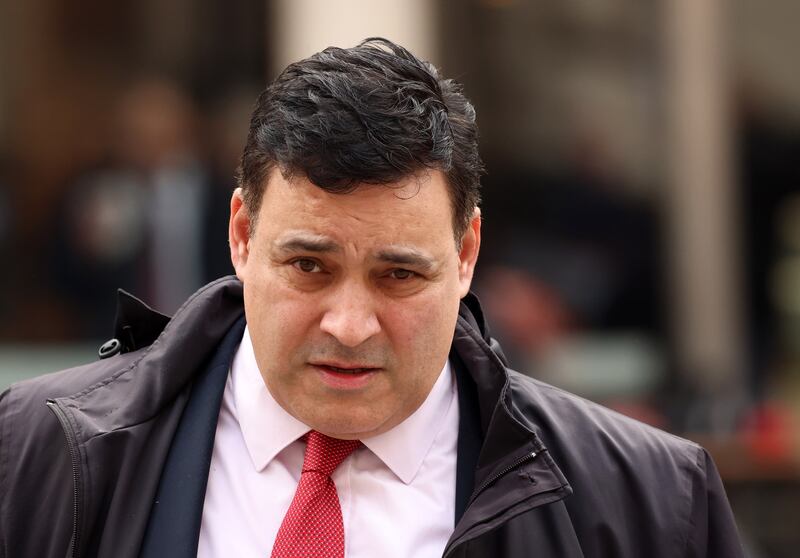
Ganesh was at work as a security guard at South Quay Docklands, outside Canary Wharf in London, when the February 9th, 1996, bomb detonated, killing two and injuring many others.
Ganesh says he recalls seeing a big orange flash and a plume of smoke before he was hit by debris and glass. The impact of the blast threw him to the ground, perforated his ear drums and he lost consciousness. Two of his friends were killed by the bomb, and he alleges he has suffered from significant post-traumatic stress disorder since.
Barry Laycock

Laycock has taken morphine-strength painkillers to dull his pain every day since he was injured in the 1996 Manchester Arndale shopping centre bombing that injured about 200 people.
He was employed by North Western Trains based at Manchester Victoria Station. On June 15th, 1996, he was supposed to be on holiday with his wife, but he decided to go to work to finish some outstanding matters.
He was in his office when he felt the blast that smashed every window and door from their frames. He was blown about six feet across the room and has suffered from degenerative and persisting back and leg injuries.
Throughout the case, Adams’s lawyers have insisted their client is facing “hearsay” evidence from witnesses, including army intelligence and former Police Service of Northern Ireland officers, without any supporting evidence to back up their claims.
In addition, they insist the case by the three men has been brought several decades too late and argue it should be subject to a three-year limitation set out in legislation in 1980.
Adams was charged with IRA membership in 1978, but that case fell because of insufficient evidence. He was twice convicted for twice attempting to escape from internment, but those were quashed in 2020. – Mark Hennessy
Former Sinn Féin president Gerry Adams will this morning take the witness stand to give testimony in the civil case being taken against him by three victims of IRA bombs in England, who allege that he was the controlling force behind them, writes Ireland and Britain Editor Mark Hennessy.
The men, John Clark, Jonathan Ganesh and Barry Laycock – injured in the 1973 Old Bailey bomb, the 1996 Canary Wharf attack and the Manchester Arndale explosion later that year – seek a High Court ruling that he is personally liable for their injuries.
Complete with bodyguards, Adams has attended every day of the case in the Royal Courts of Justice on the Strand in London, where, unusually, he has been allowed to drive into the court precinct to park.
Adams will face questioning today and into tomorrow from a former British director of public prosecutions, Max Hill before Mr Justice Jonathan Swift in court no 16 in the sprawling court complex.
Now aged 77, Adams has denied for decades that he was a member of the IRA and has long since “strenuously” denied any involvement in the planning for the bombing attacks on English cities.


