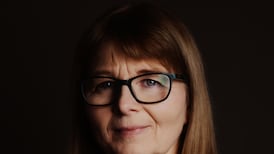
Andy Miller arrives with his cover already blown: on the way to our meeting I spotted him killing time and looking like someone putting off a shift of community service.
If you’ve ever felt that hesitation before circling a pharmacy for your first box of condoms, picking up a Debs date or entering a jobcentre, you’re in exhaustively well-read company.
If that day back in 2017 had a tone, it was already made clear: I was unprepared, untrained, unsmiling and apparently unaware of Miller’s great kindness in giving me his time in the first place. Did I thank him?
I doubt I thought of it. What was intended to be a pleasant hour with the avuncular uncle of book reviewing became a scalp-scorching lesson in how not to conduct an interview.
READ MORE


The reason I was there was that I am a fan of the Backlisted podcast and I thought that talking to one of its hosts might move me to finally write something. When audiences at book festivals ask authors about their morning routines, they already know the answers: on whatever level, they’re looking for permission to write.
So was I.
The difference being that speakers at Dingle Lit tend to leave paid, flattered and fed. I imagine that many of them also leave slightly drunk, which was more or less my only preparation for the interview. The result was so excruciating that I never published the article until now.
Andy Miller is a former bookseller, author, editor and, alongside John Mitchinson, one of the hosts of the Backlisted podcast, which has spent 10 years dusting off works of under-celebrated merit, often either lesser siblings of great books or neglected, mid-century cult favourites. The show does this extremely well, lauded by every broadsheet, and is now a major influencer in transatlantic publishing.
So much so that last month there was a live recording of the podcast from New York’s famous 92nd Street Y, in the company of Pulitzer prize-winning novelist Jennifer Egan and Deborah Treisman, fiction editor of the New Yorker magazine. For a literary broadcast that started as a kitchen-table experiment, that’s quite a journey.
The total downloads are in the millions, and the overall style is inclusive and cosily enthusiastic, like the hosts themselves. Miller’s books include an extended essay on a Kinks album, an anti-sports adventure, and a memoir about middle-aged salvation through reading the classics.
He is a welcome guest in many other pop-cultural publications, and in person he is unignorably London: his outfit is capital-curated nerd-chic (preppy cardigan, knitted tie, Alan Bennett glasses), and his home borough of Croydon is treated on the show as if it’s a long-forgotten post-industrial burg (a true Londoner’s habit, this – Croydon is 17km from Buckingham Palace).
He is also a magnificently considerate interviewee, speaking in fluent paragraphs, leading the conversation and giving well-informed takes on any subject. Seeing that I’d tucked my Dictaphone behind coffee cups and menus, he told me he knew the heartbreak of getting home to an inaudible recording. Making room for it on the edge of his side of the table, he said, “put it right here”. You don’t get that with JD Salinger.
Most generous of all was his stage management of the meeting itself, beginning with a browse together at Hatchards, the grande dame of London bookshops. It was my first visit. While there he bought a first-edition Anita Brookner, a writer he particularly champions, all of whose 24 novels he has read. As a regular listener, witnessing this was like being a competition winner. Could he have chosen the venue because he knew this was coming? I’m glad if he did.
He led us over the road to the basement cafe in the Royal Academy of Arts, which was equally well chosen: hushed, clubby and brand adjacent. Noticing that I was about to let him pay for his Earl Grey, he affably guided my hand. “This can be my fee.” Note to future interviewers – at least buy them a drink.
They say it takes 10 years to become a Londoner: I say it takes about 10 days to stop. Dwarfed by the scale, hustle and wealth of my former home, I felt somehow unqualified to be there; Fortnum’s luxurious department store was across the road. In front were limousines that had never ferried a hen party.
You’re not going to land a slice of Britain’s most influential literary podcast by denying the hosts time with their spouses
I’d not prepared a single question because I’d been up all night worrying about not doing enough preparation, but eventually I asked how his career started.
This was a happy accident as it gave him the space to monologue, the unedited transcription of which would itself make an article worth reading. He covered his unenjoyable degree, his early years with the Waterstones bookselling empire, and how Backlisted was conceived to bring to the public the kinds of conversations he remembers from the bookshop staffrooms.
There was mention of his early experience in stand-up comedy and how that led him to edit Stewart Lee’s seminal dissection of his own stand-up, How I Escaped My Certain Fate. Reader, never ever sound more impressed with your subject’s friends than the subject himself.
I wasn’t more impressed, just impressed, which is not visibly different. Similarly, if you didn’t already know that your interviewee had performed stand-up, either pretend you did (“Oh, probably on Twitter – I’ve followed you for years”) or make some link between that and his fluency and humour when broadcasting. Don’t land on finally looking glad to be there.
We enjoyably explored the kind of neglected women novelists to whom Backlisted does a service, such as Jane Gardam, Jean Rhys and Muriel Spark. This led me to ask if keeping a balance of women and men on the episodes was something they consciously managed. He said: “It’s definitely something we keep an eye on, yeah. I would be mortified if our show could in any way be considered the Top Gear of books.”
I think he also was relieved on my behalf, as he now had to spend less energy on doing my job for me
Deciding that this was the obvious cue for a laddish joke, I suggested the alternative name Top Shelf. More lessons: you’re not going to make friends with a sensitive anti-lad in a cardigan by comparing his life’s work to Derriere magazine.
I probed his thoughts on good writers who have not aged well, such as PG Wodehouse and his broadcasts from Germany during the second World War. In response, Miller tilted his head back in silence for a minute at least: “That’s a good question.”
(It wasn’t.)
“I think that you could record a whole episode on PG Wodehouse without mentioning nazism but you couldn’t do a whole episode on Ezra Pound without mentioning fascism.” Ask a bookish friend the same question: they won’t do better than that.
Such is the influence of the podcast, I wondered if he’d heard of a Backlisted effect, meaning a spike in sales for books discussed on the show. “Yeah, we have. We have.” He began to warm up in pride at their kingmaking reach, which he was pleased not to have to bring up himself.
I think he also was relieved on my behalf, as he now had to spend less energy on doing my job for me. He speculated about whether JL Carr’s novella A Month in the Country, the subject of their first episode, would be the best book they’d cover, and later was unusually unguarded in saying that their haphazard discussion of Nigel Balchin’s Darkness Falls From the Air was “not my favourite episode”. It’s actually one of mine, as the show’s early years, like those of a band, have the charm of the form being figured out as you listen.
As we talked, he gave the judicious if unhip opinion that the literary canon, however drawn, has lasting value, and a fair assessment of Martin Amis, that “he’s always been able to write great sentences; he’s always struggled with writing great books”. I was now struggling with acid reflux but, because there was finally a sense of rapport, I ignored his polite hints at the time and questions about which train I was due to catch (“Oh, whenever. I’m not doing anything.”)
Another lesson: you’re not going to land a slice of Britain’s most influential literary podcast by denying the hosts time with their spouses.
When he got up from the table, late, bored and straining manfully to remain polite, he asked a question which must have had hundreds of outings before: which book would I nominate for a Backlisted episode? The best answer would have been something like, “Just keep doing what you’re doing,” and perhaps to have given him a book as a gift.
I went for the worst possible option: suggesting an obscene short story he’d never heard of, about a necrophiliac pederast, brought to my attention by one of his professional rivals. If he hadn’t already been putting his coat on, I don’t know how the meeting would have survived.
On my way to the train, I texted Miller to thank him for his time. “It was a pleasure,” he replied (it wasn’t) and, “Brookner for the win!” I came away with renewed admiration for Miller and an outsized sense of hope which I can’t entirely explain.
It happened as we separated outside, and perhaps he was consciously trying to impart something to me – to give me permission to write. He said, “My sense of it after many years in publishing is that the best stuff rises to the top eventually.”
And I came away with an article. Eight years later, about an hour before a writing deadline, I can say that I got my permission to write.