

When Kean Kavanagh watched Paul Mescal score a goal in Normal People he almost cried.
“This is an example of why representation in a broad sense is important,” the indie-rock singer and former GAA star says from London as he prepares to return home to Ireland for a much-anticipated December tour.
“When I saw the football scene, how beautifully they shot it ... all the movement ... Honestly, I was nearly moved to tears. I’d never seen that represented. It was so beautiful.”
In the sequence early in the blockbusting television adaptation of Sally Rooney’s novel, Mescal’s champion footballer passes up the opportunity for a point and instead lofts the ball into the net. It left a deep impression on Kavanagh, who, like Mescal in Normal People, is both a keen athlete and a bit of a restless artistic soul.
READ MORE


Like Mescal, he also rocks a killer mullet. More significantly, he has followed the example of the Normal People character in moving from a mid-sized Irish town – Portlaoise in his case – to study at Trinity College Dublin, where he obtained a law degree.
“The first few years I was in college I played football for Trinity. My class was a majority of Dubliners, and then on the football team you had people from outside. That opened my eyes: there’s an underworld of people in this place who are more like myself,” he says.
“The great thing about law is it was nine or 12 classes a week. I’d say I went to about three of them. From third year I bought a sampler and was making beats. That was the initial stage of learning how to record songs. With law I had all this spare time I’d never have with another subject.”
His experiences as a GAA star who loves indie music and as a townie studying law in Dublin are poured into his astonishing recent debut album, The County Star. The name has a double meaning given that, in the Irish sense, it might signify a footballer or hurler who has made the intercounty team. (The closest Kavanagh came was sitting on the subs’ bench for the Portlaoise senior side.)
But Kavanagh was born in Houston, where the “county star” could be taken as a reference to Texas’s self-image as the Lone Star State, a place apart from both the rest of the United States and the rest of the world.
He talks about wanting to capture the “duality” of Ireland and the US in his songwriting – and his love of classic country music, that most American of genres, alongside punk, indie and hip-hop.
You can hear it in tracks such as A Cowboy Song, which features doomy Joy Division-style guitars and eerie shoegaze melodies, but with lyrics that read like something from a vintage western paperback (“Bang! Bang!/A bullet couldn’t shoot any better”).
Kavanagh grew up in Co Laois after moving back to Ireland with his family as an infant. He is wary about the way townie Ireland and GAA identity are often depicted in the media.
He cites one prominent example of the portrayal of the GAA that he’d rather not name, which he sees as cartoonish stereotyping of the culture he grew up in – its reduction to craic, pints, breakfast rolls and so on.
“It’s honestly degrading. There was something in me that very much wanted to be clear that there is culture within the midlands. There is a beauty there that hasn’t been identified.”
During his time at Trinity, Kavanagh formed the record label Soft Boy with his friend Kevin Smith, who’s better known as the rapper Kojaque. In a way, the two come from different worlds – Smith is from Cabra, in north Dublin. But their music shares a diaristic quality.
Kojaque’s first album, Deli Daydreams, which was one of Soft Boy’s first releases, in 2018, chronicled a week in the life of a minimum-wage grafter at a corner shop, making it a sort of gritty urban companion to the dreamy midlands indie of The County Star.
They were conscious, too, about the choice of name. “Soft Boy” is a repudiation of the idea that male identity should be rooted in toughness and aggression. It’s okay to have feelings, to be vulnerable, whether you’re a GAA player, a musician or anyone else.
“It’s something you would hear when you were younger,” he says. “Someone’s being a soft boy. It was a way of turning that around. That idea of men being vulnerable. At the time it felt like an important thing to do.”
Though he has no memory of Texas, back in Ireland he grew up in a household obsessed with country music. That’s partly because his Irish parents developed a love for the genre while working in the United States. But it is also because the Midlands are the heartland of country and Irish.
“It wouldn’t be the style of country music I would be into at all. There is still a huge interest [in the midlands] in modern country pop. It is so unbelievably popular. Another great midlands example: the Barack Obama Plaza,” he says, referring to the motorway service station in Co Offaly that doubles as an Obama theme park.
“It’s ridiculous, but we do love the connection that we have with this bigger, more powerful, more successful thing. I think it bolsters our own insecurities as a small Ireland – our relative lack of power and influence.”
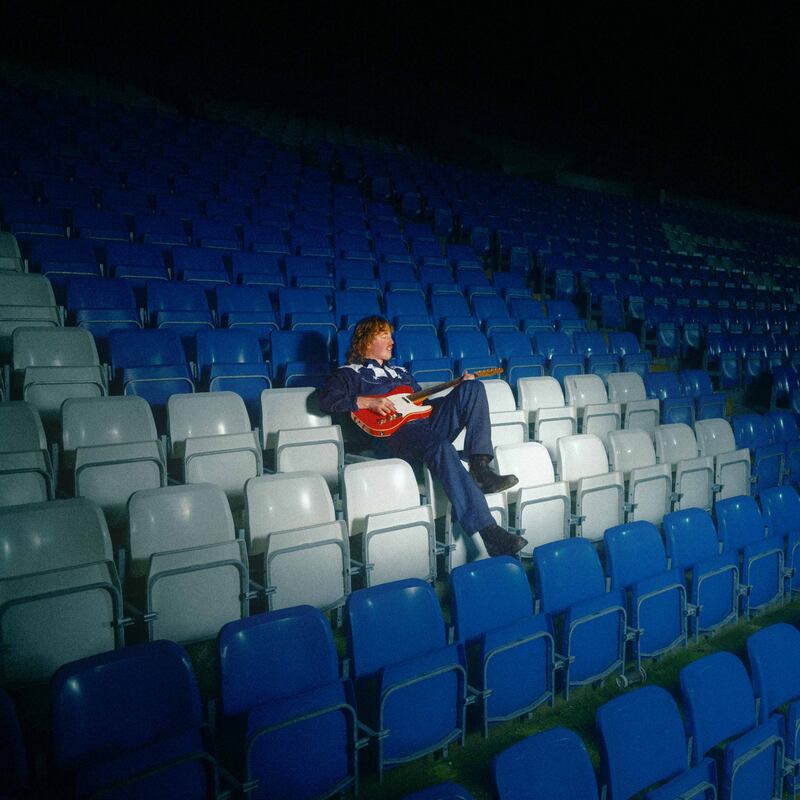
The sense of having a foot in two worlds – the old and new, the drizzling and sun-kissed – is referenced on the album’s cover, where Kavanagh appears to be sitting, under floodlights, in US-style bleacher seats. It looks evocatively American – yet the picture was in fact taken at O’Moore Park in Portlaoise, a somewhat unglamorous county ground to which Kavanagh’s album brings an air of faded romance.
“Friday Night Lights was a big influence,” he says of the Texas high-school football drama. He agrees that there are parallels between GAA culture and the American obsession with sport, especially at school. “I do think they are very similar.”
As both an artist and someone who has run a label, he has thoughts, too, on the state of the industry – and the influence of Spotify, which is soon to celebrate its 20th anniversary, for better or worse.
“I can’t see anyone except for people who are really successful making money from it. It’s more a marketing tool, where you’re giving a free sample, basically, of your music.
“I do think people in the music industry generally are obsessed with stats and stuff like that. If your numbers are good, then they’ll be interested in your music. You might get an advance because they see your numbers.
“Music industry-type people are attracted to it – that’s generally how I feel it actually functions. Is that a terrible waste of the infrastructure that it is? Of course it is. Of course people should be actively getting paid. There’s no reason why they shouldn’t.”
Kavanagh moved to London in 2021, towards the end of the pandemic, feeling that Dublin had little to offer. As an Irish person in London, what does he think about the present vogue for Irishness, be it the fashion for Bohemian FC shirts or, to quote a recent Daily Telegraph advice column, the curious case of third-generation Irish Londoners who have taken to using the Irish spelling of their names and grumbling about “the British”?
“There are two different parts. There is an interest in Irishness in a superficial sense. If you walk down Broadway Market past London Fields, I’m going to see people splitting the G for the first time. Everyone is drinking Guinness now. It’s so different to when I moved here four years ago. There is that interest in a superficial sense,” he says.
“But there is definitely also a deeper interest over here in our culture and our music. That is clear to me when I see the amount of people going to shows. A lot of the music I see here are Irish artists. There’s a deep interest in music from Ireland.
“That was amazing to see. I have English friends, and they’re always raving to me, ‘What is going on in Ireland?’ All of their favourite artists now are Irish. It’s scratching some sort of itch. There’s a depth there they’re not finding in their own artists.”
Kean Kavanagh plays Black Box, Belfast, on Monday, December 15th; Button Factory, Dublin, Wednesday, December 17th; Róisín Dubh, Galway, Thursday, December 18th; and Crane Lane, Cork, Saturday, December 20th


