
This big fella joined our turkey sandwich picnic on the top of Djouce Mountain on our Christmas hike. Is he a common raven? He was very large and light on his feet. Colin Fuller, Dublin
It is indeed a raven. Big fella is right – this is the largest of our seven crow species – reaching up to 64cm. It has a massive bill and a wedge-shaped tail in flight. Uplands and moorlands are their natural habitats, and it is rare that walkers out on hills don’t hear their characteristic flight call – which is a deep croak rather than the cawing sound that rooks and hooded crows make. They start breeding very early in the year, so now is the time to watch out for their courtship behaviour which involves spectacular aerial acrobatics – including flying upside down.

My grandsons found lots of these tiny starfish along the tide line. Some were still alive. My ‘app’ identifies them as Serpent Stars. Why were so many were washed up, and are they common? David Duggan, Donegal
Your app is on the money – they are also known as brittle-stars, echinoderms that are related to the more robust starfishes. This is most likely a common brittlestar, as its body is around 2cm. In life, the five arms are covered in spines. It moves by pulling itself along with its arms. They are usually found under stones and seaweed, often in large groups on the lower shore. It feeds by waving its arms in the water and trapping tiny particles on them. These are then carried by its tube-feet to its mouth on the underside of the central disc. These were washed up by storms.
READ MORE


I spotted this painted lady sunbathing on a hedgerow on December 16th in Arthurstown, Co Wexford. I saw several others earlier, feeding on gorse flowers. The day was bright but cold and there had been overnight frost (the verges were still frost-covered). It struck me as unusual to spot one at this time of year, close to the winter solstice, as the painted lady doesn’t hibernate here. It seems to be another indicator of climate change. Declan Lyons, Co Wexford
The National Biodiversity Data Centre does have eight records of this butterfly for the month of December over the years. Jesmond Harding in The Irish Butterfly Book states that pale, faded specimens have been seen along the south coast as late as January, indicating that the odd one hangs on here instead of making the migratory journey back to southern Europe, which the main bulk of them do in mid-September. This species has no hibernation stage in its life-cycle, but it does seem that they are able to survive late into the year if there is a supply of flowers with nectar available.

We spotted this 4ft dogfish on Seapoint Beach, Termonfeckin, on December 2nd. It appeared to be uninjured, and we assumed it died by natural causes and was washed ashore by the recent high tides. Eoin O’Flynn, Co Louth
We have two species of spotted dogfish: the nursehound, which can grow up to a metre when adult; and the lesser spotted dogfish, which attains 70cm on adulthood. Identification can be confirmed by the position of nostril grooves on the underside of the head, which is not possible from your photo. They live on sandy or muddy substrates from shallow water down to 50 metres or more.
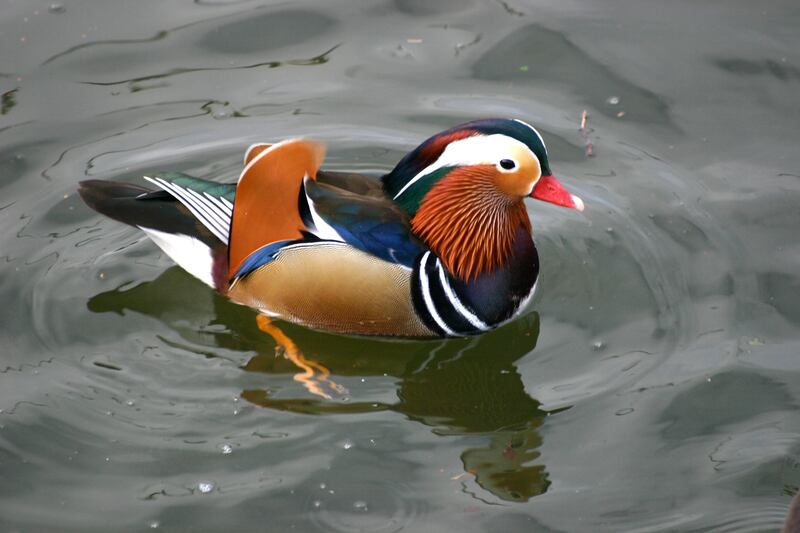
I spotted this beautiful duck in the Botanic Gardens some time ago. What was it? Sé O Toole
It was a male mandarin duck. It is not a native species, but the odd feral one sometimes becomes established in the wild.
Please submit your nature query or observation, ideally with a photo and location, via irishtimes.com/eyeonnature or by email to weekend@irishtimes.com


