

In the Microsoft data centre campus on the outskirts of Dublin, the data halls of 13 centres are voraciously devouring vast amounts of electricity.
A grizzled hum from the servers, a ghostly wail in a hot air extraction corridor and the occasional beep of a security scanner are the only indications of activity in the sprawling, grey, unexpectedly still facility.
Microsoft has granted The Irish Times and other reporters an opportunity to peek inside the workings of a data centre – a technology hub that has generated much controversy in recent years because of the amount of electricity these centres are using.
The consumption of electricity by data centres had soared in recent years; they used more electricity in 2024 than every home in an Irish city or town.
READ MORE


Within these deceptively quiet halls of Microsoft’s facility are servers that store and process the data and digital transactions of millions.
“We have every type of customer using this,” says Eoin Doherty, head of data centre operations for Microsoft in Europe, the Middle East and Africa.
“We have got governments, we have got small and medium enterprise, we have got large global companies, we have got lots of the big European companies.”
All these customers trust this high-security facility with their “crown jewels”, as Doherty calls them.
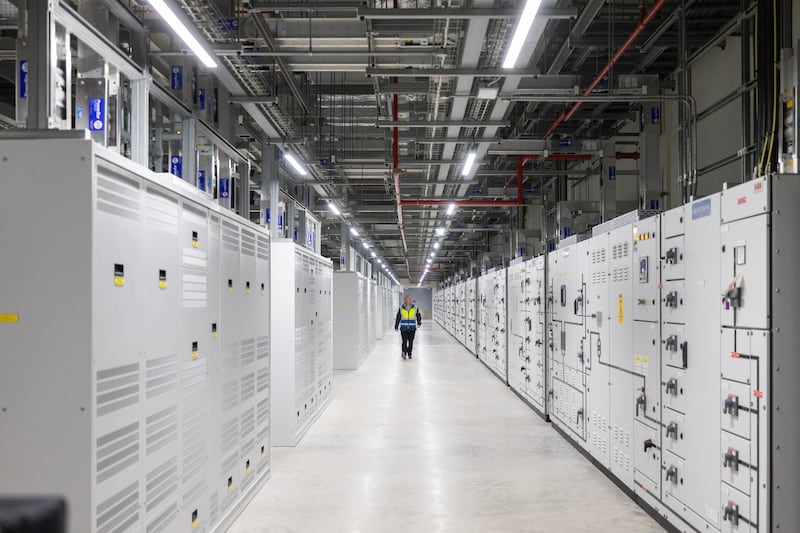
Then there are the critical services that need top speed data processing for when seconds can mean the difference between life and death.
“I always talk to my team about the importance of the work they do here because pulling that cable could disconnect the hospital; pulling that cable could mean that the emergency service can’t respond,” Doherty says.
For all its library-like hush and distinct lack of bustle, Microsoft’s Grange Castle campus has a lot going on.
It also has a lot of customers waiting, says Noelle Walsh, the US-based president of Microsoft cloud operations.
“Pent-up demand from the pause,” she explains of the recently lifted moratorium on new data centre development in areas such as Dublin where the electricity supply is strained.
Now that the pause button is off, she says Microsoft will get back to expanding.
But more data centres means more demand for electricity and the strains that led to the moratorium are still showing.
The huge amounts of electricity data centres use is a source of conflict between exponents of untrammelled growth in the tech industry, especially energy-devouring artificial intelligence (AI), and sustainable energy experts who say we need to decarbonise existing electricity use first before creating vast new sources of demand.
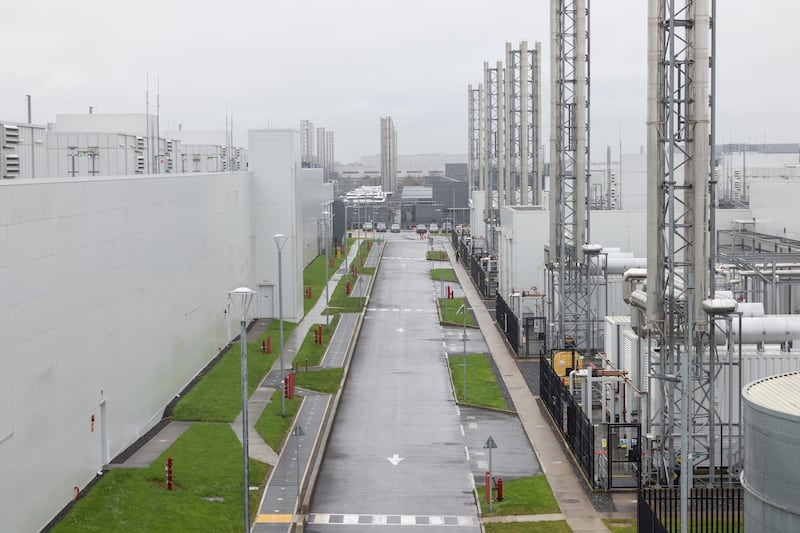
Data centres use 22 per cent of all electricity in the Republic (compared with 18 per cent used by urban households in 2024) and that is forecast to exceed 30 per cent early next decade.
Electricity consumption by data centres increased by 20 per cent between 2022 and 2023.
One unidentified data centre in west Dublin was found, according to a recently released internal Government document, to consume 10 times the electricity of a nearby pharmaceutical plant employing 2,000 people and the same amount of power that 200,000 homes would typically use.
Generating energy from renewable sources is struggling to keep pace.
Just under 40 per cent of Ireland’s electricity is generated with renewables, mainly wind and solar, while the rest comes from fossil fuels.
The Government has committed to doubling the proportion of electricity generated by renewable energy by 2030 but that is unlikely particularly as data centre demand grows.
The hosts of the visit to Microsoft’s facility have a very different perspective, insisting growth is a good thing.
They have arranged the rare inner sanctum visit for journalists to coincide with a global announcement that Microsoft has met a climate pledge to match all the electricity it uses worldwide with renewable generation.
It doesn’t mean that its 400 data centres are directly powered by renewables but rather that Microsoft pays renewable energy companies to generate an amount of electricity equal to that used by the centres and feed it into the national grids of the countries where they are located.
It has power purchase agreements (PPAs) in 26 countries for a total of 40 gigawatts (GW) of renewable power, of which 19GW is operational with the rest to come on stream in the next five years.
To put that in context, the Republic’s all-time peak electrical usage is 6GW – on a sub-zero January day in 2025.
So, based on the 100 per cent matching arrangement, Microsoft’s data centres need more power than three Republics at their most guzzling and will soon double that demand.
How is that good?
Melanie Nakagawa, Microsoft’s chief sustainability officer, says PPAs provide the price and contract certainty that enables renewable energy producers to secure bank loans to build their projects.
But if the electricity generated only matches what Microsoft uses, it appears there is no net gain for society.
“That renewable energy feeds the grid, then the grid feeds us all,” argues Noelle Walsh.
“It’s not going to data centres at the expense of residential areas.”
That still doesn’t address the fact that all new renewable energy generated in Ireland since 2017 has been eaten up by extra demand, primarily from data centres, so little extra decarbonisation of the system has taken place.
The argument isn’t going to be settled in one brief visit but the question still remains about how much electricity Microsoft’s Grange Castle campus uses.
Bobby Hollis, Microsoft’s vice-president for energy, says the company has PPAs for 1GW of renewable electricity here, of which 600 megawatts (MW) or 60 per cent, is on stream.
Asked whether Microsoft in Ireland is meeting its 100 per cent matching commitment, he says: “It’s pretty close.”
That suggests that if Microsoft at full tilt uses 600MW of electricity here, then it’s using one-tenth of the Republic at peak. And it wants more.
Microsoft won’t confirm or deny the maths. The company and its campus may be strangely quiet on the issue but it seems certain there will be more noise around it in future.


