
Bull Island is a gift from nature to the people of Dublin. Having completed the original South Bull Wall in 1786, by 1801 it was noted by the navigation authority that the “north bull has increased very much” while by 1804 “the degree of accumulation [was] so great that a considerable stripe of it remains dry at high water and has on it a growth of marine plants”.
The “stripe” kept growing until by 1819 it was 3km long and had acquired the moniker Bull Island. Its emergence from the sea was the inadvertent result of the dredging of the mouth of the Liffey to allow access to ships as far as the Custom House, something that was facilitated by the construction of “bull walls”, first to the south and subsequently to the north of the river.
The spontaneous emergence of sand dunes, salt marshes and exposed mud flats, with all their associated and specialised vegetation, quickly became a haven for wildlife and in particular wetland birds, many of which migrate long distances.
The reasons wetland areas like this are so attractive to birds is in part due to the relative protection from predators that they provide, but also because of the enormous availability of food that is concealed within the mud and intertidal sands, from worms and snails to bivalves like the cockles of Molly Malone fame.
READ MORE


This value to nature was first recognised in the Protection to Birds Act of 1930 but it was not until the 1970s that the area would receive full status as a National Nature Reserve under the Wildlife Act.
The huge flocks of wintering birds were only one aspect of the natural treasures of the island. The North Bull Island, a book published in 1977 with contributions from academics and conservationists, noted that the abundance of Irish hare was “the most visible feature of the mammal fauna” where the visitor could see “if not hosts of hares, at least groups of 5, 10 or even 20 on occasions”.
The dunes became home to communities of rare plants while birds such as ringed plovers and little terns laid their eggs on the ground, forgoing a nest and relying on the camouflage of the eggs to avoid detection, particularly at the sandy spit to the north. Grey and common seals hauled up on the exposed sand to give birth.
Also around this time the amenity value of the Bull Island was becoming apparent. The Dublin suburbs were expanding and daytrips to the coast were de rigueur among the new middle class in proud possession of their own car.
A report from An Taisce warned of the threats to the island from increased public pressure, particularly from cars on the beach, barbecue parties in the dunes and fires while it was noted that erosion of the dunes through loss of the all-important marram grass, which stabilises the sand, was a result of “intensive and prolonged public pressure”. It was warned that “one of the pressures on the Bull Island hares is from man. Continual disturbance by dog chasing […] has resulted in their injury or death”.
The solution to preserving both the natural and amenity values, the heritage body suggested, was proper management and a compromise “in which both interests are catered for and neither gets all it is seeking”.
In 1981 North Bull Island was recognised by the UN’s heritage body, Unesco, as a ‘biosphere reserve’, still one of only two in the country.
In the 1990s the EU’s Habitats Directive came into force and the island with its surrounding waters were designated as a Special Area of Conservation (for habitats and a small plant called petalwort) and a Special Protection Area (for its wintering birds). In 2015, the biosphere was expanded to encompass all of Dublin Bay.
However, by then it was becoming increasingly apparent that the multiple layers of legal protection and international recognition were not effective in delivering proper management.
A visitor to the island at the time would more than likely have encountered a free-for-all: dogs running off the leash chasing flocks of birds, people on the mudflats and salt marshes digging for bait or shellfish, invasive species and unrestrained recreational activities. The beach at Dollymount more resembled a car park than an important nature area.
2015 is probably the last year that Irish hare was living on the island, a survey in 2016 recorded none.
Nesting little terns were gone by 1992. Increasingly the seals were abandoning their pups. Next to go were the ringed plovers. In 2013, the North Bull Island Bird Report, published annually by Tom Cooney with help from a small army of volunteer ornithologists, reported that “all areas within the National Nature reserve are subject to disturbance however the most sensitive area, the sand spit on the northern end has suffered most. Constant disturbance caused by walkers/joggers/dogs/quad-bikes/sand-kite surfers/cars etc through the nesting site during the breeding season has resulted in the extirpation of ringed plovers since 2010 at the latest”.
Cooney, a Raheny native and former employee of Dublin City Council, has spent his life studying and enjoying the nature of the island. In 1987 he took part in a project to warden the diminishing colony of little terns, a programme he describes as “highly successful”, allowing for the recovery of both the terns and the ringed plovers, but which was subsequently abandoned. His annual reports since 2011 have documented the great richness of the island but also the unrelenting human pressure.
A report by Dublin City Council in 2017 acknowledged these pressures and particularly the “high level of dog walking off-lead” in contravention of byelaws and the “range of evidence to indicate negative impacts”.
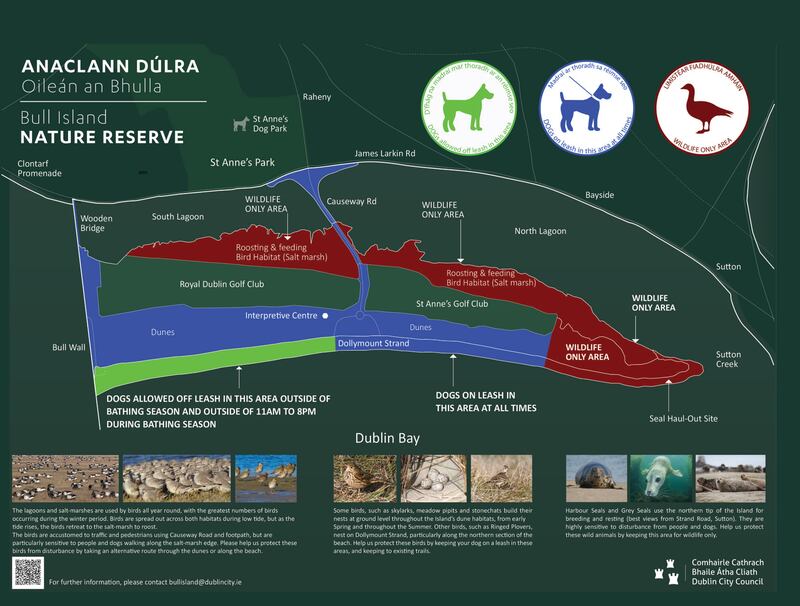
The response was a zoning plan, which was introduced in 2023, reaffirming the need for dogs to be on a short leash across most of the island while the northern tip would be a ‘wildlife only area’, providing sanctuary for resting seals and holding out the prospect for the return of nesting little terns and ringed plovers. The plan also restricted car access on the island but allowed for one area to the south of Dollymount Strand where dogs would be permitted off the leash.
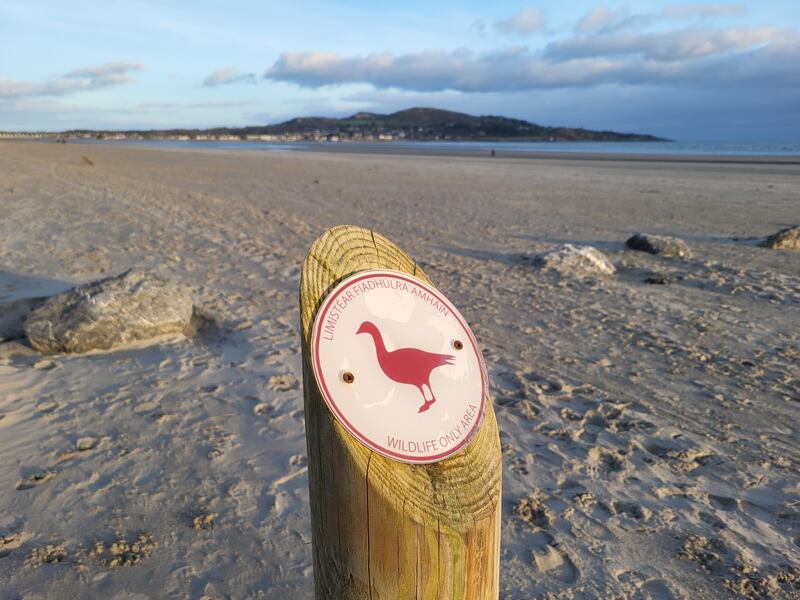
On a recent visit, it was possible to see the many clear signs showing the new zoning layout and explaining its rationale. The beach was free of cars and many dog owners were respecting the rules, keeping their pets on a short leash. The “wildlife only” area is marked by a series of stakes across the beach. However, it was also clear that many people were not paying any heed to the new dispensation.
The bait digging on the sensitive mudflats on the landward side also continues despite it being an “activity requiring consent” by the National Parks and Wildlife Service (NPWS). In a statement, the State body said that no such consents have been issued but that they “continue to monitor the practice of bait digging or shellfish collection on protected sites”.
[ Richard Nairn: How green are greenways?Opens in new window ]
Tom Cooney says that he has not “noticed any significant change” since the introduction of the zoning. “It’s not just my view, many of my contacts are of the view that notices are ignored”.
His report for 2025, published in January of this year, concluded that “although the North Bull Island is a legally protected site, numerous activities take place daily that have a negative impact on the island’s habitats and wildlife. The same activities that caused disturbances to birds and other wildlife in previous years were reported again in 2025”.
He questions why any part of the island should be open to dogs off leash given the importance of the surf zone for feeding sanderlings. He accepts that most dog owners do not want to harm nature but wants to see “strict enforcement” of existing legislation.
Dublin City Council’s management plan for the island states that efforts by the council and the NPWS to enforce regulations have “proven futile”. This is a remarkable statement. Would we tolerate people running amok in the National Gallery or at Newgrange? Why does it seem inconceivable that Bull Island would not have permanent wardens like any other site of such importance? So far, the longed-for compromise that would balance the needs of people and the rest of the island’s inhabitants remains elusive.


