The Dublin suburbs are not where you would expect to find a red-listed breeding wader.
Yet on a recent morning in Cherrywood, two lapwings were foraging on the roadside verge: one bird was pulling a worm, taut and clinging, from the mown grass, while rush-hour traffic, school runs and Amazon Prime deliveries poured on to the M50. Its mate rose from the verge, broad wings flashing white and black, and banked away over the hoardings.
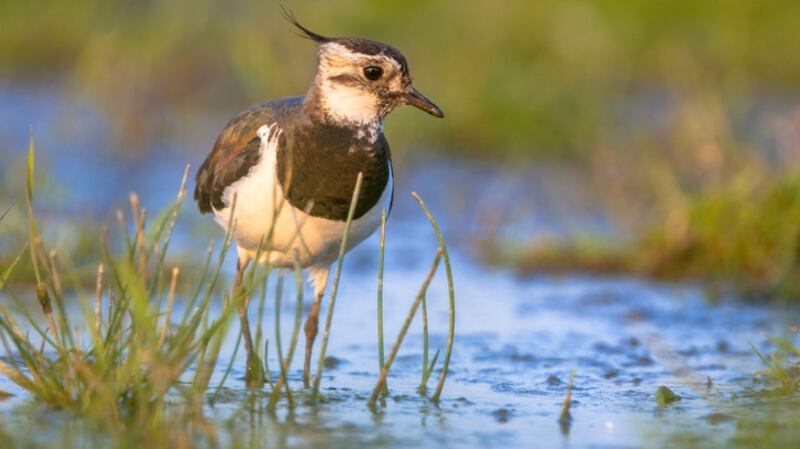
This pigeon-sized wader, still known to many as the peewit after its call, looks black and white at a distance. Up close it is far more striking: dark upperparts shimmering with iridescent green and purple and a wispy crest rising from the crown.
In flight, the wings are broad and rounded, the wingbeats slow and deliberate. Bold too, lapwings will mob any crow or magpie that comes too close to their nest.
READ MORE


Lapwings were once common across Ireland, but the landscape they depended on has changed: wetlands drained, farming intensified, the rough margins and wet meadows they need to breed steadily disappearing. Between 1980 and 2018 the Irish lapwing population fell 95 per cent. The most recent national estimate, in 2023, put the number of breeding pairs at just 800, making its presence in Cherrywood all the more remarkable.
Cherrywood is a new town taking shape on the southern edge of Dublin, wedged between the M50 and the N11, with the Dublin Mountains rising behind it. Designated a Strategic Development Zone (SDZ) in 2010, it will, when complete, be the largest urban development in the history of the State – 360 hectares projected to house about 26,000 people across 10,500 new homes, alongside parks, ecological corridors and transport infrastructure.

To the east of the project, where the Luas terminates at Bride’s Glen, lies a 13-acre site intended for the town centre with apartments, offices, cafes, shops. Planning permission was granted in 2019. Construction never began. This is one of four town centre quadrants. The others are in preparation or already building. On this one, nothing has been built.
While the site remained in limbo, the lapwings moved in. Cleared vegetation and scraped ground created exactly the kind of open, treeless terrain the birds prefer for breeding.
Flat ground means approaching predators can be seen from a distance. No trees means no perches for crows. The perimeter fence and surrounding roads function, unintentionally, as a defensive barrier against foxes, badgers, hedgehogs and unauthorised access. The roadside verges, regularly mown, provide close-cropped feeding ground, while pools formed in excavated earth offer shallow water for chicks.
On a managed conservation reserve, each of these features would take years of intervention to engineer. Here they arrived accidentally, as a byproduct of stalled construction.
The lapwings are not the only beneficiaries. Meadow pipits nest on the cleared ground, skylarks sing overhead in spring, and amber-listed ringed plovers also breed here, almost unheard of for Dublin. In winter, snipe roost on the site, up to 20 birds sheltering in the rough ground.
Local birders noticed quickly. Records submitted to the website Irish Birding and to the National Biodiversity Data Centre show spring sightings at Cherrywood every year since 2017. By 2021, the council’s own ecological consultants were formally recording breeding lapwings on the site in planning documents.
Three breeding pairs, says Hugh Delaney, a south Dublin ecologist who has birded this area since the 1980s, is the ceiling of what the site can hold. Territories are evenly divided. The birds return to the same ground each year.
He is keen to point out that lapwings were here long before Cherrywood. The fields around Tully’s Cross were arable land, barley and rough grass, and lapwings have been breeding in and around them for as long as he can remember. The development did not create the population. It compressed it.
Survival is precarious. One chick per pair is considered enough to maintain a population. Yet lapwings depend on numbers. A handful of pairs cannot provide the collective defence against predators that larger colonies can, making small populations especially vulnerable. Two years ago there were three fully grown chicks wandering the site. Last year was less successful. Foxes are suspected to have entered through a gap in the fencing.
The ecologist is not the only one watching the birds. Early in the mornings, before traffic builds, bus drivers waiting at Brides Glen have taken to watching the lapwings from their cabs. They recognise the tumbling display flights and know the birds by their electric, buzzing call. When they see the ecologist standing with binoculars, they already know what he is looking at.

Under a 2026 amendment to the planning scheme, development will eventually proceed, with more housing and fewer offices than originally envisaged. Across the wider SDZ, planners still dream of an 11-screen multiplex cinema and an ice hockey arena. Here all that has been built are lapwing nests, little more than scrapes in bare earth, lined with dry grass, holding four mottled eggs. Under Irish wildlife law, nests and eggs are protected during the breeding season; habitat is not. Once the birds disperse in winter, construction can proceed legally.
But even without development, this is not a permanent solution. Three pairs on 13 fenced acres surrounded by traffic is a remnant, not a future. Left alone, the site could eventually scrub over. Some saplings are already establishing on the margins.

Cherrywood will eventually house 26,000 people, and Dublin needs that. The question is: where do the inhabitants of these accidental refuges go?
The picture is not entirely bleak. Across Ireland, a patchwork of conservation projects is attempting to recreate the wet grassland and open landscapes lapwings need.
One of the most successful is near Kilcoole in Co Wicklow, where a National Parks and Wildlife Service project at Cooldross has grown the breeding population from five nests in 2017 to a peak of 77 in 2024, before predation reduced it to 41 last year.
The work on the 100-acre site is intensive with a 2.4km electrified predator fence, carefully managed water levels, and grazing timed to the fledging of chicks. It is a landscape held in deliberate balance. The birds come when conditions are right.
Cooldross is the source population for the Wicklow Coast Action Zone of the Breeding Wader European Innovation Partnership, an EU-backed scheme in which farmers are paid to restore wader habitat. It is the only grassland wader zone on the east coast of Ireland; most of east Leinster sits outside it.
The lesson of both places is the same: lapwings do not need much. They need open ground, short grass, shallow water and protection from predators. They need space made for them.
And there are urban examples elsewhere in Europe. In Basle, Switzerland, planning policy has required green roofs on all new flat-roofed buildings since 2002. Lapwings have begun nesting on them, a pay-off for a city that made the space deliberately.
For now, the focus is on quieter interventions. Anne Murray, Dún Laoghaire-Rathdown County Council’s biodiversity officer, is overseeing the relocation of a semi-natural meadow salvaged from another development site to a nearby attenuation pond. Bare areas will be kept open deliberately for lapwings. Whether the birds will use it remains uncertain. Cherrywood is not designed for them. It never was.
To the lapwing, there is no future in Cherrywood. But there could be somewhere else.