

Fewer than half (48 per cent) of surface waters in Ireland met the required water quality standards according to the recent Environmental Protection Agency (EPA) Water Quality in Ireland Report 2019-2024.
That this figure was down 2 per cent on the previous assessment (2016-2021) was disappointing news for all those working to clean up rivers around the country.
Yet local authorities are making efforts to embrace nature-based solutions to reduce pollution of water bodies (rivers, lakes, estuaries and coastal waters) from both urban rainwater and urban surface water discharges.
The Local Authorities Water Programme (Lawpro) leads stormwater management using nature-based solutions in Ireland with a national strategy for nature-based management of urban rainwater and urban surface water discharges. It is supporting nine projects in local authorities across Ireland.
READ MORE


The idea is that nature-based solutions replicate natural drainage processes, providing a more sustainable solution than hard engineering works.
“We are overly reliant on conventional piped systems,” Tom Brennan and Eamonn O’Connell of Lawpro told attendees at a nature-based solutions conference. “During downpours the capacity of these drainage systems can be overwhelmed, causing pluvial [rainfall] flooding.”
Dublin City Council has transformed a previously neglected green space in north Dublin as part of its efforts to clean up the nearby Santry river and prevent flooding downstream towards Dublin Bay.
The 2.6-hectare site in McAuley Park on Ribh Road and linear park on Lein Road in Artane is part of the council’s Rainscapes project for the Santry and Dodder rivers. It has been heralded as the largest urban nature-based solution retrofit project in Ireland and the UK.
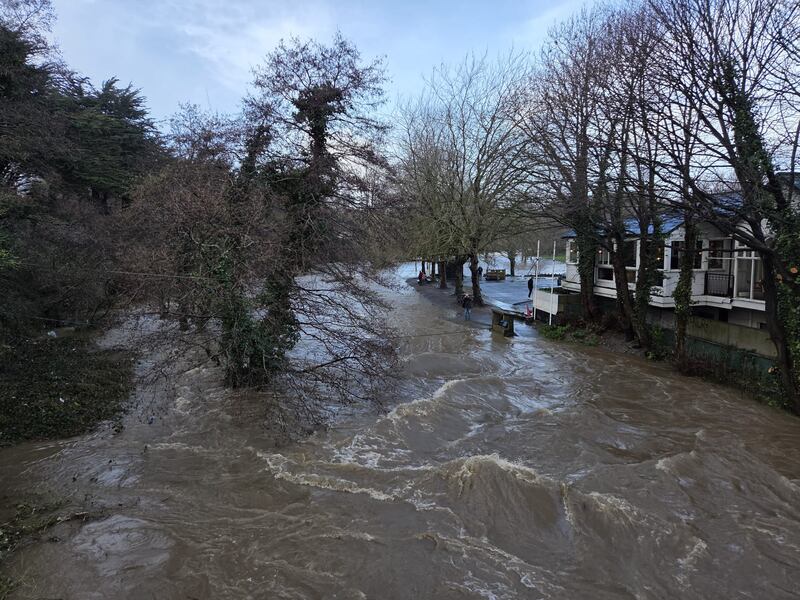
Experts agree that managing water is a huge part of building a climate-change-resilient environment as the cost of dealing with the consequences of floods is enormous. Emergency response and business disruption coupled with damage to property and infrastructure runs into hundreds of millions of euro from events such as Storm Éowyn in January 2025 and Storm Chandra last week.
“The sustainable management of surface water is to capture it as near as it lands rather than send it through traditional Victorian drainage systems into fast-flowing rivers and then as quickly as possible to Dublin Bay,” says Roy O’Connor, senior engineer with the council.
O’Connor says the council recognises that the old traditional drainage systems no longer have the capacity to cope with the increased frequency and intensity of rainfall events due to climate change.
“We need to slow the flow down to build flood resilience and to clean the water as it makes it way to Dublin Bay, which is a Special Protection Area and a Special Area of Conservation,” says John Stack, senior executive engineer with the council and the project manager for Rainscapes.
The measures in Artane have resulted in the re-landscaping of these green spaces to create an undulating terrain with low-lying spots where water can build up during heavy rainfall and slowly soak into the ground.
Permeable brick surfaces have also been laid out on footpaths and public parking spaces to allow water to soak down into the ground rather than run off quickly into sewers destined for Dublin Bay.
“This is a demonstration project to build trust in communities for nature-based solutions and impress on people the need to manage surface water,” O’Connor says.
“People think about the pollution of rivers and the sea, but urban runoff from roofs, footpaths and roads is the source of the problem.”

O’Connor says rainfall is both a private and a public issue. “We are building momentum with nature-based solutions, but there is also the education piece about managing water in the home.
“There is also enforcement where [Dublin City Council] checks if households are unwittingly connecting a washing machine in an extension into the surface water rather than the sewage water drainage system.”
The replacement of front gardens with concrete surfaces for parking cars has also contributed to flooding events. Stack says he asks people not to get rid of their front gardens.
“The Central Statistics Office found that if 20 per cent of the semidetached houses in Dublin get rid of their front gardens, it generates 17,500 million litres of extra storm water in heavy rainfall events. The city has to manage that,” he says.
Measures such connecting water butts or planters to roof gutters are ways of reducing the water runoff from your home. Permeable paving is another option for front gardens used for parked cars, but there are no Government subsidies for such measures.
“We consider the sustainable management of surface water as important as energy upgrades to your home,” says O’Connor.
The EU Water Framework Directive is the driving force for this change in approach from hard engineering solutions to softer nature-based solutions – also known as environmental engineering – to mitigate against flooding and water pollution.
“The EU Water Framework Directive requires every state to have plans in place for good water quality in water bodies,” says O’Connor.
The EPA recently warned that at the current level of progress, Ireland would fail to meet the EU and national goal of restoring all water to good or better status by 2027.
The Santry and Dodder rivers are priority areas for action by Dublin City Council. The so-called detention basins, as part of sustainable drainage systems, allow the water to be cleaned before discharging into the Santry river, which in turn flows into Dublin Bay. The river has a poor water quality status.
The EU Urban Waste Water Treatment Directive – which is now being transposed into Irish law – also requires urban runoff to be treated at source first, then along pathways towards a water body, and lastly through hard engineering solutions such as concrete walls and attenuation tanks.
Rain gardens – hollowed out wild flower beds at road junctions – are another measure to trap water during heavy rainfall, thus slowing down its course to prevent downstream flooding. “These rain gardens are about giving back to the community as well as delivering on our objectives,” says Stack.
According to O’Connor, the biodiversity and amenity aspects are secondary to the flood alleviation and water pollution reduction measures – but they are the most visible parts to the public.
Newly planted birch trees, wild flower beds, balance beams, rocks and wooden seats on newly laid paths might be the icing on the cake for engineers, but for locals they transform these green spaces into attractive areas to walk through and spend time in.
The costs of preventive measures using nature-based solutions are also often a fraction of that of hard engineering measures such as concrete flood barriers.
“When you are not firefighting, you can do things cheaper,” says Stack.
When completed, the Rainscapes project for the Santry river will clean the water and slow down its course into 60 pipes flowing into the river.
“Our aim is to bring the Santry river back to good water quality status in the Water Framework Directive and to mitigate floods and projected flood risks, as well as improving biodiversity and ecology in its catchment,” says Stack.
The council also plans to allow the river to meander again rather than be bound by the linear straitjacket imposed on it in the last century. Longer term, there are plans to put in a cycle lane as part of the Santry river Restoration and Greenway Masterplan.
“Currently, there is very little connected cycling and walking infrastructure in the area and people use their cars or buses. But our plan is that people will be able to cycle, scoot or walk from Ballymun to Bull Island,” says Stack.
Meanwhile, Lawpro says its overall aim is to upscale and mainstream these nature-based solutions to provide climate resilience and cleaner water, while reducing flood risk and improving public spaces.


