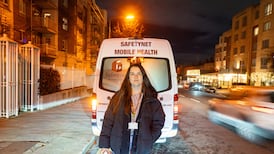
The doctor and nurse crouch in front of the flap of a tent pitched in the darkness beside Dublin’s Grand Canal to talk to the 77-year-old man for whom this is “home”.
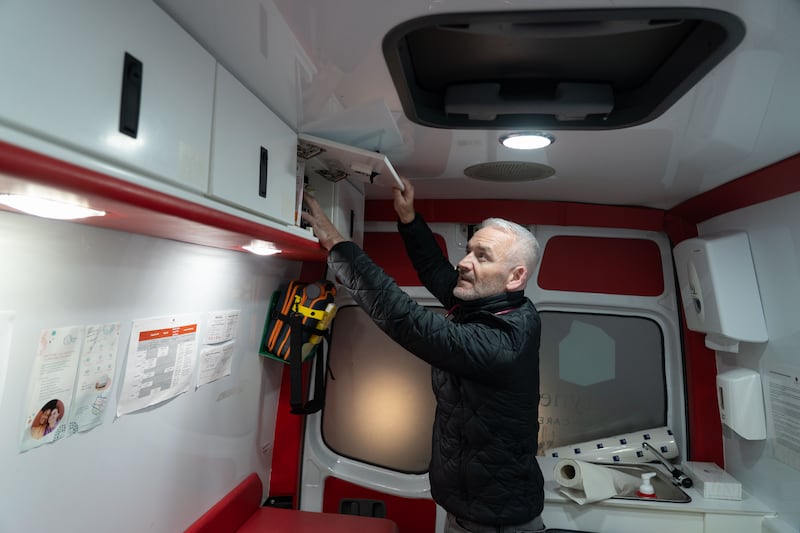
He is a rough sleeper with a heart condition and mental health issues, and is well known to Dr Enda Barron and nurse Sinéad Grogan of Safetynet Primary Care. On this chilly December evening, they have come to him in a white van fitted out as a compact, well-equipped GP room, with red seating providing a pop of colour in the clinical white interior. They want to review him, before prescribing another week of medication.
But, as expected, the man will not venture out of the tent. They check his blood pressure and pulse in situ as there is no question of coaxing him into the van, which driver Seán Fitzgerald has parked across the road.
Dr Barron will return in the morning with this patient’s medication, which comes in blister packaging to help him keep track of doses. He satisfied the doctor tonight that he was managing it, as he had the correct amount left from the current week’s supply.
READ MORE


Three nights a week, this mobile clinic brings healthcare to vulnerable people who live under the radar of mainstream health services. While there are several walk-in GP clinics for the transient street community, this GP service walks up to them.
“We prioritise their health when they might have different priorities,” says the chirpy and affable Dr Barron, who is the clinical lead on Safetynet’s primary care team and works on the evening mobile clinic once a week. “Sometimes, it’s about catching people where they’re at.”
Safetynet liaises with staff of services such as the Dublin Simon Community and hostels, who point them in the direction of individuals they are concerned about. There is no knowing who or what they might encounter on any given night.
“Everything is a surprise – a bit like general practice lots of times,” he says. But there are patterns of issues among patients they may, or may not, have seen before.
“It’s busy coming into this cold season because everyone has coughs, colds, flus, skin infections,” says Grogan, who is manager of the homeless primary care team. “We see a lot of scabies, people sharing tents. So there’s a lot of acute care needs. We’re not able to do more long-term, chronic disease management because it’s not really the appropriate space for it.
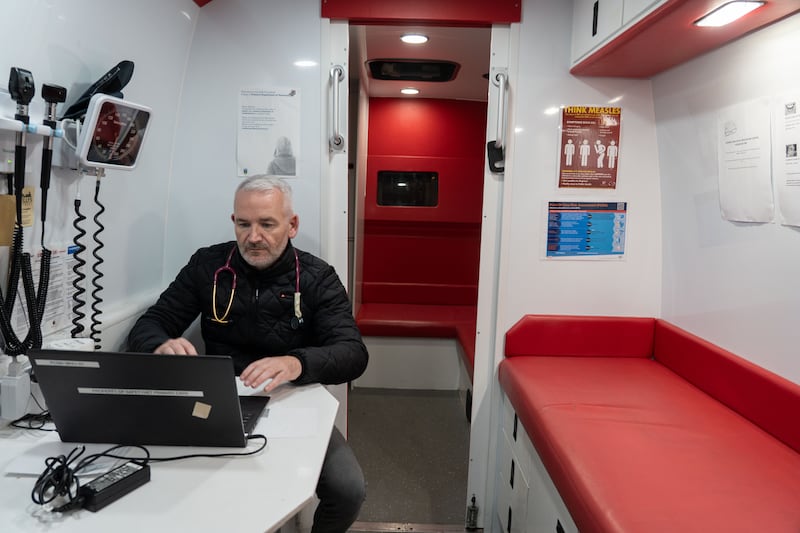
“We’re really just the first point of contact for people and then we try and get them into our day services for more detailed follow-up.”
However, the cohort is so transient, follow up is a huge piece of work in itself, she explains. They do this in partnership with other non-governmental organisations and Dublin City Council services. “It’s a lot of background work, nearly like detective work, to try and find people.”
Safetynet is also a point of contact for inclusion health teams working at St James’s Hospital or the Mater hospital. “If someone discharges themselves against medical advice, or attends ED [emergency department] and leaves before they’re seen, they contact us to see if we could try and find them or if we’ve come across them.”
Both St James’s and the Mater have open access clinics to which Safetynet can refer. “Meeting people where they are at” can be a cliche, but Safetynet is “100 per cent that”, says its chief executive Nicola Perry, speaking earlier from the organisation’s headquarters on Amiens Street. “We subscribe to the idea that people are not hard to reach if you’re looking for them in the right places.”
The mobile unit is just one part of services run by Safetynet, which was set up over 15 years ago with street sleepers in mind. It has since broadened its reach to anyone who cannot access mainstream health services for whatever reason. Maybe that is due to addiction or mental health; they don’t have a medical card or their lifestyle is too chaotic; they are newly-arrived migrants or members of marginalised communities such as the Roma.
Tonight, the van starts outside Mendicity, a charity in the Liberties that has been providing practical support to some of the city’s poorest residents for the past 207 years. Its centre, off Bridgefoot Street, prioritises those sleeping outside, offering free meals and snacks, showers, laundry and other services up to 10.30pm, six days a week. A short walk away, the Liberty Soup Run is setting up for the evening on Thomas Street.
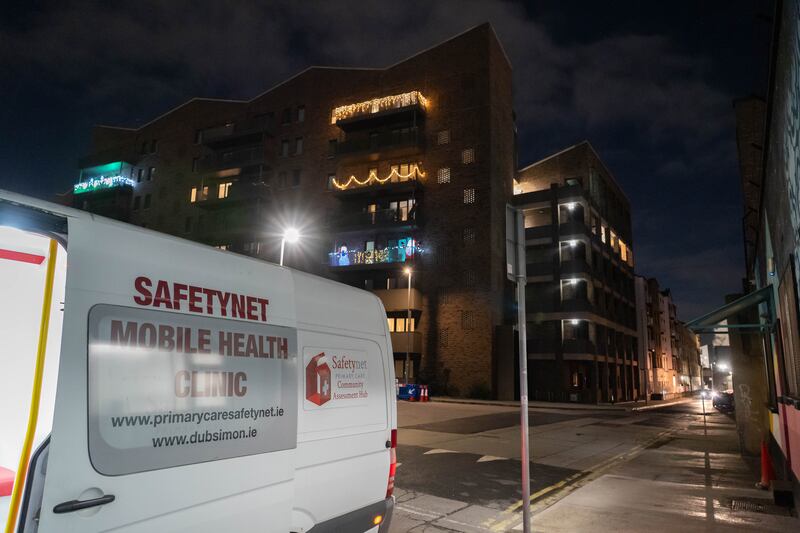
The first two men who Dr Barron sees in the van both have symptoms of respiratory tract infections, a common winter ailment but aggravated by their circumstances. Lung health tends to be an issue among this cohort of patients, he explains, due to their living conditions and the use of cigarettes and crack cocaine.
Neither man has attended Safetynet before so their details are logged in its data base, which can be accessed by relevant GPs and healthcare providers. This tracks individuals’ medical history, to avoid prescription duplication and guard against adverse drug interactions. It also saves patients from having to repeat their stories.
While Dr Barron and Grogan aim to treat the need that is being presented, they are also trying to cover other potential issues. “There could be other stuff going on,” he says. “You’re always trying to look at the bigger picture ... because you don’t know when they’re going to see another healthcare provider.
“It’s so important that we have this joined-up computer system, that I can see where people are at.”
For instance, somebody might come in saying they can’t sleep – which is a common complaint because they may be in a room with six other people, he points out. “Whereas that mightn’t necessarily be my priority because I see from the notes, maybe, that they’re HIV positive and they’re not taking ARVs [antiretroviral medication]. Or maybe they are pregnant.”
Then it is about trying to link them in with other services.
“There is always a solution, it’s just about trying to make sure that you make that solution as accessible and as easy as possible,” he says. Dublin Simon’s new Medical Residential Treatment and Recovery Centre (MRTRC) on Ushers Island provides both step-down (from hospital) and step-up (from community) care, to which they can refer patients.
One of the men he and Grogan see this evening is on a waiting list for MRTRC’s detox unit. Right now he needs a dressing on knee abrasions to be changed; he is already on antibiotics. Street drinkers often come in with cuts from falls and these are liable to become infected.
The man sways as he navigates the three small steps into the van. Dr Barron puts out a steadying arm and teasingly asks if he has had a drink earlier. Both he and Grogan banter with patients to help them feel comfortable and also to gauge their mood.
“I think people feel safe with us because it’s a bit of craic,” he says. “It’s a non-judgmental service. You can present whichever way you want. We don’t care.”
He’s not religious but in this work he always has the sense of, but by the grace of God go I ... “Circumstances can have such a negative impact on people’s housing and then they lose their housing. That impacts on their health and then they become, you know, despondent. It’s about trying to give people hope, I think.”
In an ideal medical provision society, says Perry, Safetynet wouldn’t be needed to try to fill gaps. About 90 per cent of its almost €3.5 million budget for 2026 comes from contracts with different branches of the HSE. A workforce of 50 operates primarily in the Dublin area but a mobile health screening unit, for example, travels to scattered International Protection Accommodation Services. It checks asylum seekers for bloodborne viruses and does chest X-rays to rule out TB.
Its 2025-2028 strategy recognises the increasing prevalence of people with mental health challenges amid an ever-growing homeless community. A record high of 16,700 people were in emergency accommodation around the country last month. The latest official count for people sleeping rough in Dublin, conducted last spring, was 121.
“This year we set up a counselling psychology clinic that’s two days a week,” reports Perry. “It is there for our own internal GPs to be able to refer to. We don’t have a magic wand. We can’t get access into, say, inpatient or psychiatry, outpatient support.”
That is why they wanted one mental health service that people could attend “without waiting for weeks or months or worse”.
Currently, “we do at least one involuntary admission a month and sometimes it’s more than that”, she says.
Can there be resistance within mainstream services to referrals from their medical staff? “I would say it depends on where we’re going,” says Perry. The organisation has excellent relationships with St James’s and Mater in particular, due to their “quite innovative and advanced inclusion health programmes”, she says.
“But if we’re referring to something like, for example, cardiology, there still is, being perfectly frank, an element of discrimination/stigma against people in addiction or with mental health [issues].” There can be an attitude that, “okay, we’ll make an appointment but the person won’t turn up and there will just be another DNA [did not attend].
“As opposed to where we’d be coming from, which is, well, that is a possibility, but it’s also a possibility with someone who doesn’t have an addiction issue – and you’re not going to not make an appointment for them.”
[ Alice Leahy: I have learned there is no single story about being homelessOpens in new window ]
She also mentions that all Safetynet GPs are trained to work through interpreters when necessary, which does not apply within the HSE “and that instantly is just blocking people”. They use three different companies who can provide interpreters trained in medical translation in a wide range of languages and are available remotely. The appointment is then conducted through a conference call.
The canal bank is the last call for the mobile clinic this evening.
The daytime outreach that Dr Barron will do the following morning will be without the van. “I just go with a backpack.”
Any evening there is a particular concern about somebody who is seen, that is flagged in the handover and Grogan, as manager, sends a GP to see them the following day.
“Sometimes, people do need to go to the emergency department, but they may not want to go for various different reasons,” says Dr Barron. “So then we have to look after them. We have to follow up the next day, to make sure they’re taking antibiotics and that they haven’t deteriorated.”