“Can I say: I drink gin and tonics and eat chocolates?” says retiree Pauline McHale when her class is asked to explain, as Gaeilge, what a typical work day entails.
She was one of seven adults ranging in age from their early 30s to their 60s sitting in a classroom above a bustling Camden Street, Dublin, on a recent Monday night.
While couples and friends entered bars and restaurants down below, these individuals were learning the Aimsir Láithreach (the present tense) at one point.
“Here we go,” says one student, as a quiz is projected on to the whiteboard before class finishes, in which they are tasked with selecting the correct conjugations of certain verbs.
READ MORE


They laugh and cheer together as they answer, sometimes incorrectly, but more often correctly, as they near the end of their 10-week beginner-level course in Irish.
After class finishes at 9pm, Ms McHale says she has “always wanted to learn Irish”.
“You didn’t learn it in school, it was battered into you,” the 66-year-old says.
“I think it’s sinful that we don’t speak our own language, we don’t get on the bus and say ‘dia duit’, and we don’t get off and say ‘slán’. Why aren’t we using our own language?”
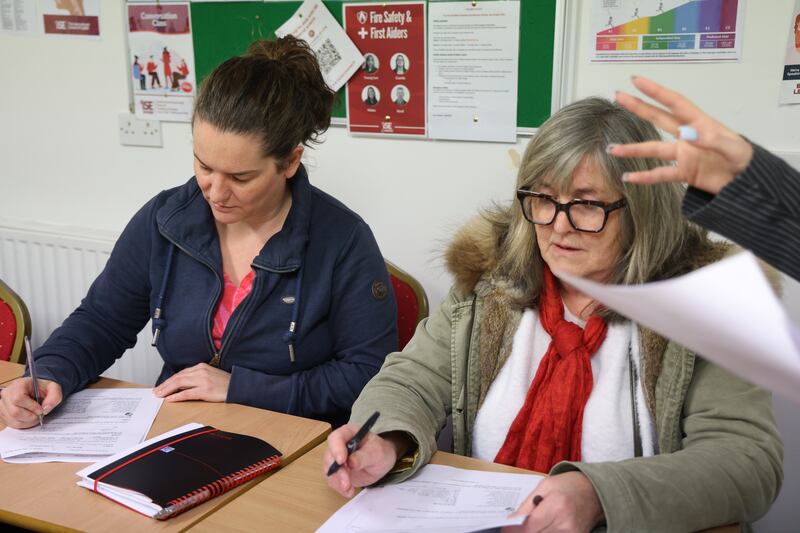
Rushing to make her bus home to Rathgar on time, she says her class has “a lot of fun”.
“I love it, and the crowd and teachers are lovely. I’m probably the thickest in the class,” she says, laughing.
Like Ms McHale, her classmate Anita Byrne, a 51-year-old from Donaghmede in north Dublin, recalls how Irish was “drilled into you” when she was in school.
“The only thing I knew was the accident – the timpiste,” she says, which was “learned off by heart”.
Nearing the end of her first set of Irish classes since she left secondary school, she now plans to travel to Gaoth Dobhair in the Donegal Gaeltacht next year to put them into practice, saying they put a far greater emphasis on Irish as a “spoken language”.
“I’m so thrilled, I’m raging I didn’t do it years ago. I just love it. We have a language, why don’t we speak it?” she says.
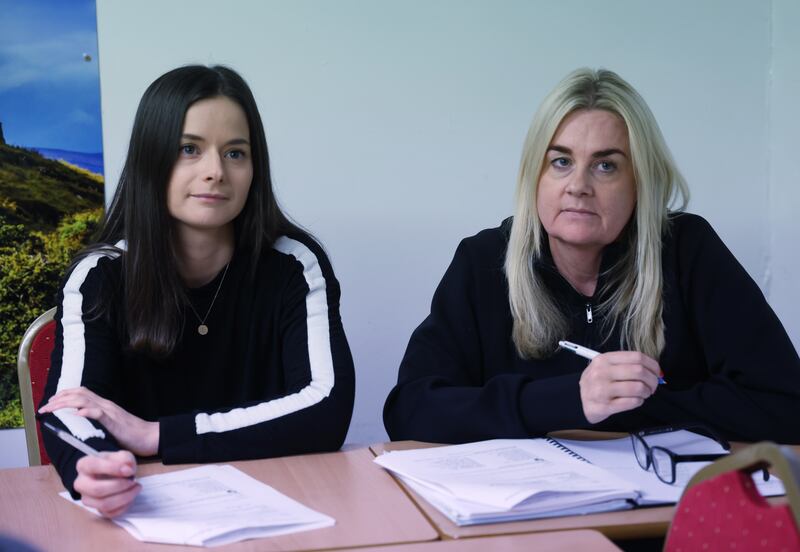
She believes a resurgence of interest in Irish is driven largely by its use in popular culture, particularly by Belfast rap trio Kneecap, which is “reinvigorating something in people”.
“I have a 22-year-old son who I would have had to drill to do his Irish homework, and now he wants to learn it,” she says.
There has been a “huge demand” in recent months for classes at Conradh na Gaeilge, according to Eimear Nic Mhuiris, who co-ordinates and organises the adult evening classes. Some 247 adults, ranging in age from their 20s to their 70s, registered for its 10-week autumn term.
The expression of interest list for the last summer term had garnered 104 people. However, this has since grown “exponentially” to 588 people for upcoming classes beginning in January.
To cope with increased demand, Conradh na Gaeilge is working to schedule extra classes across various levels from beginner to advanced to accommodate as many learners as possible.
“Most of them are coming back to learn Irish. They all did it in school, and a lot of them didn’t have the most positive relationship with it,” Ms Nic Mhuiris says.
“We do have a lot of people learning Irish for the first time, people who have just come to Ireland and are intrigued by the language and want to learn it as well, so there’s a good mix of people.”
As to the potential reasons for the demand, she says there have been “a lot of positive influences” recently through media, music, and activists, giving rise to “pride” in the language.
The most recent motivator, however, is President Catherine Connolly, she says. “We’ve had people contact us after her inauguration, they’re so motivated to get back into Irish because of that,” she says, adding: “It’s lovely to see it grow.”
The way Irish was taught in school was mentioned by all who spoke to The Irish Times, with Mary Kennedy, a 60-year-old from The Ward in north Dublin, describing it as “rigid”.
“Depending on your school or teacher, it wasn’t as comfortable to make mistakes,” she says.
Ms Kennedy, who started Irish classes three years ago after moving back to Ireland from London, where she lived and worked for more than three decades, is now enrolled in more advanced classes.
She felt it was important to learn Irish “in terms of looking to the future and saving it”, she says.
“The numbers of Irish speakers are so depleted, so, for me, it’s about not letting it die. It’s something of ours that speaks to what we are as Irish people, what we’re becoming, what we were, and what we will be,” she says.
Also looking to the future is Wesley Mulcahy, a 41-year-old originally from Cobh, Co Cork, whose son recently started junior infants at a Gaelscoil.
His decision to enrol his son in a Gaelscoil could translate to further opportunities in the future, he says. “I just thought it was in all our interests that I had a good attitude towards Irish. I didn’t want him to absorb any negative attitude towards it,” he says.
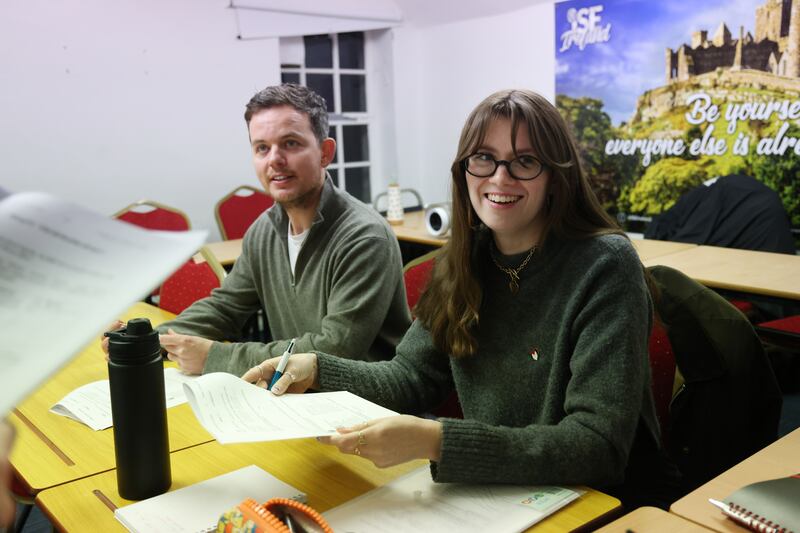
Although “reasonably academic” when he was at school, he recalls finding Irish “very difficult”, saying he felt more comfortable “talking in French”.
He describes previously being “nervous” and “reluctant” to use the language due to a lack of confidence, which he believes is felt by many, and while learning Irish has been a challenge, it has been a “wonderful one”.
Heidi Kavanagh, meanwhile, a 30-year-old speech and language therapist from Rathfarnham, cites the Palestinian people as a motivating factor in her decision to learn the language. “I found them really inspiring, in terms of them keeping up their culture, despite everything. If they can do that, then I can go to class once a week,” she says.
She adds that she was “always complaining about how bad Irish was in school”, saying: “There’s no use in complaining about it when you can just do it as an adult.
“It’s just good craic. There’s less pressure, and we’re all there because we want to be there, not because we’re worried about the Leaving Cert.”