

Vehicles are parked up on footpaths at Newry train station where its free car park, with more than 350 spaces, is full.
Derrybeg Lane, the road beside the station, is lined with cars. A digger blocks another road that leads to the busy Camlough Road roundabout while diversions are in place.
“It’s absolutely mental,” one station worker is overheard saying, “but it’s been like this since we went to the hourly Dublin service (in October 2024).”
It is Thursday. A week has passed since the publication of a new plan earmarking the Co Down city as a cross-Border commuter hub for Dublin.
READ MORE


The Newry Next report proposes the construction of 6,000 new homes over the next decade, in a move that aims to help tackle the Republic’s housing problems.
Inside the glass-fronted train station, a pensioner looks confused as she attempts to buy a ticket from a machine for the lunchtime Enterprise service to Dublin.
“Sorry ma’am, you can’t buy tickets for cross-Border services at our ticket machines. It’s the same for all stations in Northern Ireland . . . you need to go to the counter,” a staff member tells her with an eyeroll.
“I know, it doesn’t make sense.”
An economic black spot with soaring unemployment rates during the 1980s, Newry could become Ireland’s Malmo, according to the report. The southern Swedish city is home to thousands of people working in the nearby Danish capital, Copenhagen.

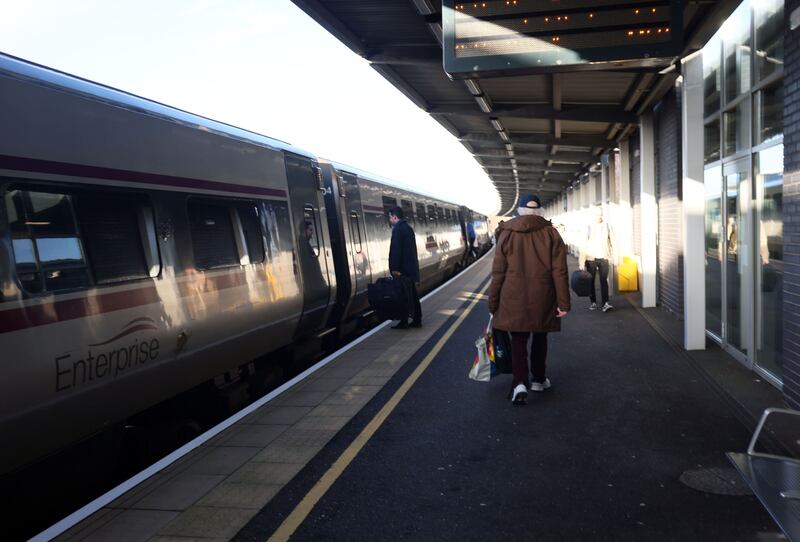
Gerard Scullion is standing on the station platform waiting for the 2pm Dublin train. He is travelling to a work event.
The Belfast-based solicitor grew up in the Glens of Antrim and supports the idea of making Newry a commuter base.
Scullion says he already sees the trend taking shape with some of his friends.
“They are commuting to Dublin and working for the big legal firms. They have no desire to live in the south but see the potential of working there and coming back up north,” he says.
“If you’re going to unlock the whole economic cross-Border potential, there needs to be more investment, not just in Newry, but that whole Border region – even Belfast and beyond.
“It’s a small island, it shouldn’t be that difficult.”
Newry was granted city status in 2002 and Scullion is critical of its infrastructure.
“Between the state of the roads and congestion and traffic, it’s no more a city than Cushendun or Carnlough,” he says.
“They need to really vamp it up. Even the road coming in here to the station, it’s just shocking.”
Deficits in Newry’s water system are identified by the report’s authors as the main stumbling block for new-build projects in the area. It is stalling the delivery of 1,300 homes and 30 commercial developments.
Tom Kelly lives in Newry and travels to Dublin twice a week for work by train.
“I often drive to Dundalk station as you can’t get parked at Newry,” he says.
A former chair of the Newry city status campaign group, Kelly says the idea of an extra 6,000 houses is “currently not feasible”.
“The commute to work is one thing, [but] you also have to sort out the provision of services. We have a hospital under threat and our schools are at capacity. Even our recreational services are poor – we still don’t have a 3G pitch.
“You can’t give people the title of a city and not put the financial resources behind its infrastructure.”
He believes the new proposals can help strengthen the case for improved cross-Border services, particularly in health.
“If you’re receiving your income from the south and being taxed in the south but buying your house in the North, then is there not a good reason for you to argue that Daisy Hill Hospital should be improved?
“Fluidity between the North and south, people living on both sides of the Border and working there and deciding economically where works best for them, also leads to shared services.”
Emma Morgan is an accountant from Skerries, Co Dublin. She is among the growing number of young professionals living in the Border city – she moved in 2019 – while continuing to commute to Dublin.

The mother of two is on maternity leave and is due to return to work in March.
She says she is “not surprised” by the idea of making Newry a cross-Border commuter city as house prices are so high in Dublin.
“My brother has just moved into an apartment in Ranelagh and thought it was a steal – but it’s tiny and way more than the cost of our mortgage for a four-bedroom detached house,” she said.
Demand for property has led to a spike in house prices in Newry; Morgan’s home has increased by £100,000 (€115,300) in value since she and her husband bought it for £265,000 six years ago.
The mother of two admits she is concerned about the impact of further growth on services.
She has already registered an interest in a local primary school for her six-month-old daughter Penny and her son James, who is approaching his second birthday.
“Beside us, there is a proposal to build social housing for 1,200 people,” says Morgan.
“But the schools around here are at capacity. You can’t get an NHS dentist any more. A school principal encouraged me to register my two. She told me it won’t make a difference but it will let the school know how many are interested in going in three years’ time.
“I like Newry and have a life here I could never have in Dublin . . . sometimes you need to overwhelm a system for them make a change.”
Back at the station, the teatime return train from Dublin is running late.
Shortly before 6.15pm, a station worker uses a clicker to record the 100 passengers coming through the turnstile.
The car park begins to empty.
Architect Niall McBrierty is among the passengers returning from work.
“I live in Carlingford – it’s easier to get to Dublin from Newry,” he said.
He fully supports the plan to leverage the city’s cross-Border potential.
“It makes sense to build 6,000 houses here. I actually did a project for the city centre on its expansion,” he added.
“Obviously when you’ve no demand, you have no requirement. But when there is demand . . . like most infrastructure projects, people say, ‘well where’s the money supposed to come from?’. I hope it can be found.”


