

Should Irish dignity survive St Patrick’s Day, there is the Irish Open to think about. The golf competition is slated to take place in September in Doonbeg, Co Clare, at the Trump International Golf Links – a venue that was coincidentally announced at the first possible opportunity after the return to power of Donald Trump.
Control of the course passed to his sons, Donald jnr and Eric Trump, when the big man got the nuclear codes again, with Eric visiting this week to discuss what has been described in local media as the “Ballroom Development”.
The proposal would involve the construction of a new single-storey ballroom building with all the bells and whistles, including “Champagne and tea stations”. The planning application has been made to Clare County Council, following the commencement of works on its sister ballroom at the White House last year. Chino-wearing cash-rich Americans at the Irish Open will also get to view a Trumpian ballroom in construction if all goes to plan.
Planning documents claim there will be no further impact on Vertigo angustior, the whorl snail in terminal decline on the Clare dunes. But Friends of the Irish Environment, who were there arm-in-arm with the snail in 2000 when the original permission for the links was granted, want no further approvals to be made until the conservation situation improves.
READ MORE


The snail appears to be the greatest source of resistance to Trump developments locally, despite the unpredictable potentate’s recent campaigns against Greenland, Venezuela and Minnesota. Fianna Fáil councillor Rita McInerney, a Doonbeg resident who was shouted out by Taoiseach Micheál Martin in the Oval Office last year, told Overheard there was a “general welcome” for the ballroom, which can help expand the seasonal golf-focused trade into a year-round business, with consequent benefits to local prospects.
As for a presidential visit? “We are always aware that a US presidential visit can happen at any time,” she says. “We have worked as a community with the relevant authorities and agencies to ensure that they are conducted without major incident and we will continue to do so.”
It will be a chance to “engage with the office of the US President to negotiate and discuss issues pertaining to our own country’s relationship and trade with the US as well as highlighting international issues”, she says.
Plenty to talk about, in that case.

Jaipur on tour
Happy birthday to Leo Varadkar, who celebrated this week not in one of the chic Dublin restaurants he frequents but in Rajasthan in northwestern India. The former taoiseach was a decent draw at the long-running Jaipur Literature Festival, where he spoke about leadership, leaving politics and helping to cultivate links between Europe and diverse, democratic India.
On Trump, he warned that the US president’s “big-country, almost imperialist view” treated the people of Ukraine, Gaza and Greenland as though they didn’t matter. “Nobody’s home should be treated as real estate,” he said.
And if Trump does pursue Greenland further? Europe might have to break up with the United States. Europe would have to say, “This marriage, which has worked very well for 75 years, isn’t working any more,” Varadkar said. “We have an abusive spouse and we’re leaving this time.”
The audience went on to serenade him with a happy-birthday singalong for his 47th.
Jaipur Literature Festival will, it turns out, be coming to Ireland later in the year for a 10-day-trip taking in Belfast, Armagh, Dundalk and Dublin, bringing with it various Indian authors and intellectuals.
Irish ties to India are long-running, although not necessarily always in the shared-values sense. At one point, almost 50 per cent of the British army garrison in India was Irish. Coole Park, so inspirational to Yeats, was bought by a Gregory with an Indian fortune, and the Duke of Wellington’s brother – a sturdy Meath man – was governor general.
Overheard would expect the Irish hosts of the Jaipur tour to focus more on the postcolonial links than the colonial ones, however. We can use as many friends as we can get.
Terminal trouble
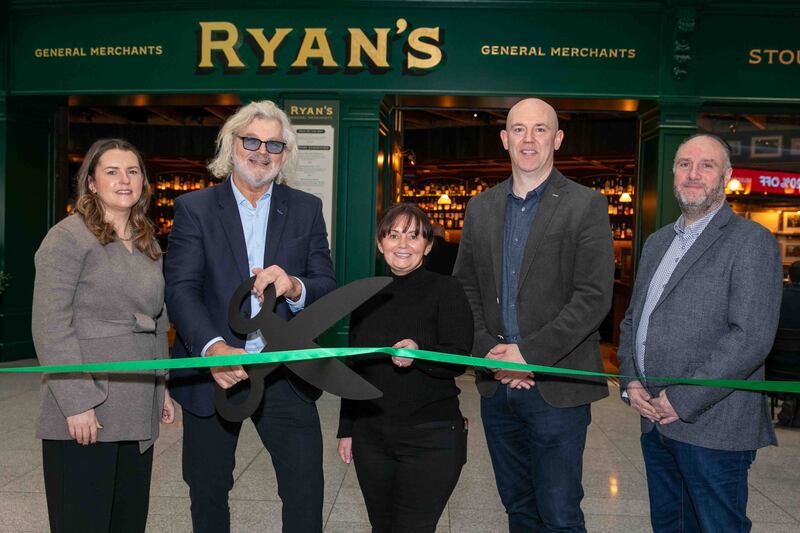
“Should I buy Ryanair?” asked Elon Musk amid his recent propaganda war with the low-cost airline, “and put someone whose actual name is Ryan in charge?” Brushing past his obvious ignorance of Tony Ryan’s entrepreneurial achievements, a similar question might be asked of Ryan’s Pub, recently opened in Dublin Airport.
The pub “blends the charm of a classic Irish local with the buzz of Ireland’s busiest international gateway”, ominously, and “promises plenty of craic” from the moment it opens, every day, at 4am.
The pub is named after Mary Ryan, photographed in 1988 by Tom Lawlor hanging out her washing against the backdrop of a jet. Many of the Ryan family, a helpful press release informs us, have worked at the airport in the decades since. It’s a short commute.
No guarantee of a real Ryan behind the bar, however. It’s a venture by the Wright Group, one of its eight outlets.
Musk threatened to buy Ryanair as part of a somewhat technical argument about wifi and aerodynamic drag. He can’t, even if he wants to: retrieve Regulation (EC) No 1008/2008 from your mahogany bookshelf and find article 4, which demands European majority ownership of European airlines.
Michael O’Leary, for his part, held a press conference to thank Musk for the free publicity. He is unlikely to be seen in Ryan’s Pub, however. It’s in Terminal 2, a Ryanair-free zone.

Busting the sludge
There you sit, Irish citizen, coffee in hand, glasses on, ready to perform an important piece of admin you’ve been putting off through a State agency. But what’s this? A broken link. Interminable jargon. Unclear process. The requirement to print out a form and post it to Kerry.
This, it turns out, is called “sludge”, and researchers at UCD have tackled it in the paper Reducing Friction, Promoting Fairness: Behavioural Perspectives on Sludge in Irish Public Services, published this week.
“Sludge describes procedures or processes that waste time, sap energy, or discourage participation,” say Margaret Samahita of the UCD School of Economics and Leonhard K Lades, visiting from the University of Stirling with his pressure-washer ready to blast away the blockages in Irish bureaucracy.
The paper describes sludge’s various forms and how they affect different service users, including those who have less administrative literacy, are older, are time-poor or simply have less mental energy to be embarking on a quest to secure their permit, advice or refund.
They make some recommendations: plain language, logical steps and helplines are among them. They also suggest “periodic sludge audits” to find things that can be improved. Sounds good.


