The serendipitous discovery by locals of skeletal remains at a seventh-century monastic site in the aftermath of Storm Eowyn’s mass felling of trees last January has further established the rich heritage of the peatlands in the Co Offaly townland of Lemanaghan.
The discovery has also highlighted the conflicting realities of cultural conservation and the proposed development of a wind farm by partners Bord na Móna and SSE Renewables on this vast bogland.
With more than 800 identified sites and a broad array of artefacts, this landscape holds one of the most significant treasuries of wetland archaeology in Europe. Now, with the publication of the results of the excavation and analysis of the human remains, which lay amid the roots of the fallen trees, this latest find significantly adds to the rich repository.
For Aoife Phelan, a local teacher and member of the Lemanaghan Bog Heritage and Conservation Group, the tension between the conservation of these sites and the proposed development of about 15 turbines up to 220m in height has been brought into stark focus for locals once again.
READ MORE


She confirmed last week that radiocarbon dating has revealed the human remains exposed in the roots of the fallen Scots Pine trees belonged to the early medieval period, placing them around the time of St Manchán.
The excavation and analysis concludes that one burial date was between 662 and 817, while another was between 707 and 939, said Phelan.

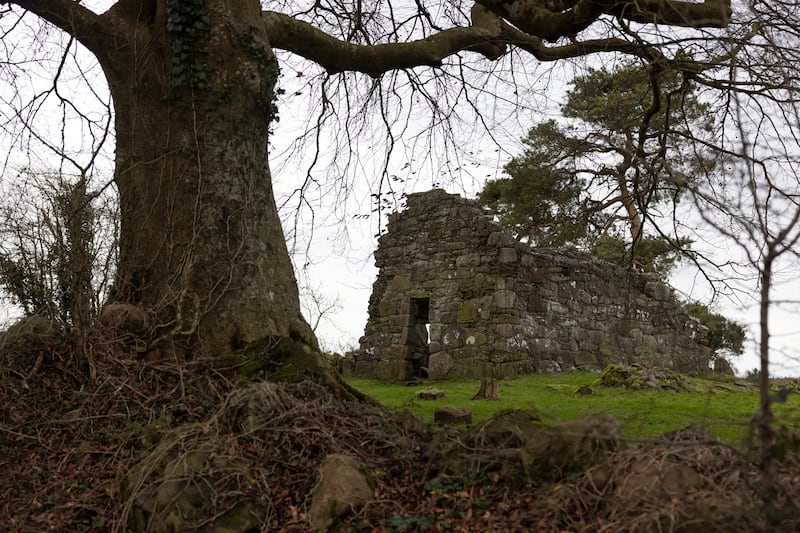
“Our initial discovery was actually on St Manchán’s Day, when I was walking the pilgrimage route with my children and nieces and nephews following Storm Eowyn,” says Phelan. “When I first saw the fallen trees within the enclosure at St Mella’s Cell,” – Mella was Manchán’s mother – “my own reaction was one of devastation. I have always loved the peacefulness of this space – its sense of stillness that feels deeply rooted in time. The children, however, responded very differently. They immediately began climbing the toppled trees, turning what I saw as damage into an adventure.”
It was not until the group examined the photographs later that they noticed some of the material entwined in the upturned tree roots could be bones.
The following day, local man Séamus Corcoran correctly identified what he believed to be a human skull. It was later confirmed, setting in motion the appropriate notifications and chain of events that led to the archaeological investigations and excavations. These were led by Dr Denis Shine of the Irish Heritage Schools in consultation with the National Museum, National Monuments Service and Offaly County Council.
“While the excavation was small in scale it was incredibly challenging due to complex and unusual circumstances created by Storm Eowyn, which resulted in extremely precariously held together burials that were severely disturbed by roots. However, we were lucky to have a very experienced team, who deserve our thanks, as do Offaly County Council and the National Monuments Service for funding the dig,” said Shine.

Following meticulous removal of the roots and exposure of the skeletal remains, the excavation of the burials was overseen by project osteoarchaeologist Dr Annamaria Diana.
“Four disturbed articulated inhumations were identified with further human remains observed in the northeastern tree root plate, but thankfully these could subsequently be preserved in situ,” she said. “All skeletal remains from the site are currently being analysed to assess biological profiles and possible pathological conditions as well as to establish the minimum number of individuals represented. Based on preliminary observations, the assemblage clearly includes more than the four articulated burials and contains individuals of different ages, with identified juvenile teeth confirming the presence of children in the burial ground.”
The landscape already encompasses an early monastery; a unique surviving oratory; a medieval togher (ancient causeway); medieval shrine; holy wells; and internationally important relics. Furthermore, the surrounding bog lands are renowned for a cross-millennial living landscape replete with prehistoric wooden trackways and platforms, Bronze and Iron Age artefacts, medieval tools and objects of daily life preserved in the peat.

“Lemanaghan is a place where archaeology, folklore, faith and landscape intersect in a very tangible way, and that richness has naturally led myself and other local people to advocate for its protection and care over many years,” says Phelan.
She stresses that locals are very concerned about the proposed development of the wind farm and its impact on the landscape.
”[We have] long campaigned against proposals by Bord na Móna and SSE Renewables to develop a wind farm on Lemanaghan Bog, emphasising the need to safeguard the site’s exceptional archaeological, cultural and environmental value, which must take precedence over large-scale industrial development,” Phelan says of her group.
The group, she says, is not opposed to development or renewable energy in principle, but advocates for “appropriate siting, meaningful community engagement and informed decision-making”.
She criticises “the so-called engagement process” with the developer and cites the Lemanaghan Conservation Plan, published by the Heritage Council in 2007. It states: “It is important that the options considered for the post-industrial use of the bog are sympathetic to the significance of the site.”
In the group’s view, the proposed 220m turbines do not align with that principle and do not reflect the intent or spirit of the heritage plan for Lemanaghan.
A spokesman for Bord na Móna and SSE Renewables said: “We are currently preparing an environmental impact assessment report for the proposed Lemanaghan Wind Farm which will be submitted in due course for scrutiny and assessment as part of a planning application to An Coimisiún Pleanála.”
A question put about the impact of this latest find on the consortium’s plans was not addressed.
In a broader context, local historian Catherine Corless, whose research uncovered the Tuam mother and baby home scandal, argues it is vital that local history is preserved for future generations.
She gives an example from her own parish of Cortoon, near Tuam.
“A voluntary committee got together to save an ancient large-scale fort, hardly recognisable with bushes, foliage and brambles,” she says. “On researching this fort it was disclosed that it held numerous ancient burials of all ages, and is associated with St Aidan. Thanks to their efforts, it is now a sight to behold, and fronted by a stone plaque which displays its full history.”
She says local history should be part of the school curriculum. “History class was always about the world wars, the great leaders, the politics, but our own local history is on our doorstep and is just as important.”


