

“Civilian hulls painted grey” is a term often applied to the vessels of the Irish Naval Service.
The eight ships – of which only four are available for duty due to personnel shortages – are ill-equipped for modern challenges.
They have limited ability to detect what is happening above the waves and precisely zero ability to see what is happening below. As illustrated by the drone incursion during the visit of the Ukrainian president last December, even if they do detect a threat, there is not much the lightly armed vessels can do about it.
For decades, this was not much of a problem. According to a 2000 White Paper, fisheries protection accounted for more than 90 per cent of naval operations.
READ MORE


However, the increasing activity of Russian ships above and below the seas combined with plans to dramatically expand offshore infrastructure such as wind farms, is forcing a change of mindset among officials.
For years, the Naval Service was a poor relation of the Defence Forces. Now, it is to become an actual navy.
This is far more than a name change, it is an entirely new mission for the organisation.
According to interviews with six military and Government officials, the goal is to create a force capable of protecting national security while deterring espionage and potential sabotage by hostile nations.
The officials described a broad-ranging plan to fit out existing ships with advanced technology capable of detecting the presence of hostile submarines around offshore infrastructure while ramping up co-operation with France and the UK to drive off potential threats.
The approach is informed by an analysis of the specific threats facing Ireland as well as meetings of Nato’s Undersea Infrastructure Coordination Cell that are attended by Irish officers.
[ Ireland to deploy large numbers of undersea trackers to detect Russian submarinesOpens in new window ]
In most countries, this programme would be called Anti-Submarine Warfare. However, Department of Defence officials prefer the less bellicose-sounding Maritime Domain Awareness.
“It’s the most ambitious project ever undertaken by the Naval Service,” said a military source, speaking on condition of anonymity as they were not authorised to disclose details not publicly available.
“The challenge is to do it as efficiently and cheaply as possible,” said another official. “We have to be creative. Ireland is never going to acquire its own submarines. We [have to] find other ways of deterring threats.”
In his 1990 publication, the Future of Seapower, the late British naval historian Eric Grove described nine types of navy, ranging from a “token navy” to one capable of complete global power protection.
At a recent seminar on threats to critical national infrastructure, hosted by Engineers Ireland, senior Naval officer Commander Cathal Power said Ireland fields a level eight navy, a constabulary force focused on enforcing fishing regulations.
“Tongue in cheek, people would turn around and say we were a token navy over the past couple of years when we couldn’t actually get our fleet to sea,” Power said. “Hand on heart, they’re probably not far wrong.”
The goal is to move the organisation up two rungs on Grove’s scale, to a level six force; an “offshore territorial defence navy”.
The first indication of this direction of travel was the Defence Forces 2024 strategy statement that promised enhanced subsea capabilities to protect “subsea data cabling infrastructure”.
Fishery protection is mentioned in passing once in the 24-page document. By contrast, it is mentioned 11 times in the 2017 version.
Since 2024, the increasing number of Russian vessels in Irish waters has accelerated this change in priorities, said a source.
Ministers have increasingly raised concerns about the Russian shadow fleet, a group of about 500 ageing ships used to transport sanctioned oil. These ships frequently travel through Ireland’s Exclusive Economic Zone (EEZ).
However, although the shadow fleet remains a pressing concern, it is what is happening under the sea and out of sight that most worries security officials.
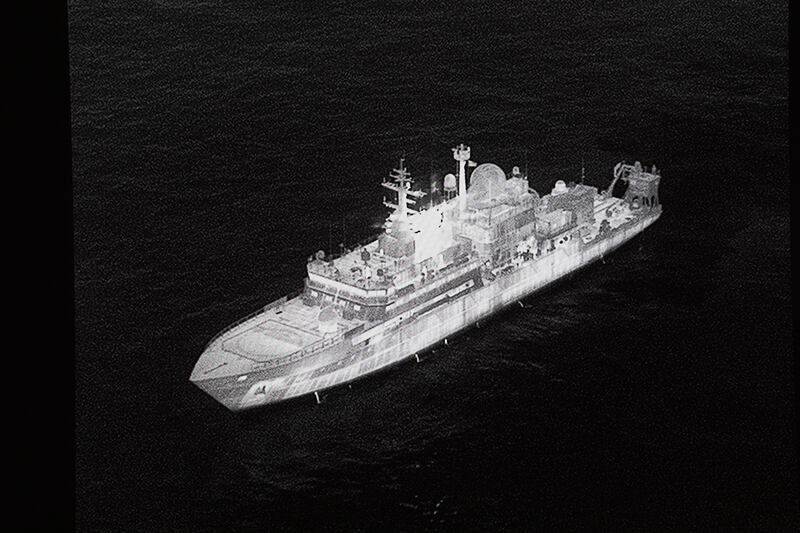
Since 2014, the Russian vessel Yantar has made multiple visits to the waters around Ireland, sometimes loitering over subsea infrastructure for long periods.
Western security services believe the Yantar is an intelligence-collection vessel capable of mapping and sabotaging infrastructure. It is equipped with an internal moon pool, allowing it to launch and recover mini submersibles in secret.
The Defence Forces is also aware of nine other submarines and six mini-submarines in Russia’s Northern Fleet that could be used to threaten subsea infrastructure.
The Defence Forces would also like the ability to detect what friendly nations are doing in Ireland’s EEZ.
US naval ships equipped with mini subs are also occasional visitors to the waters off the west and south coasts. This includes the Zeus, a US naval cable-laying vessel. Their main job is the maintenance of the US sound surveillance system, a network of undersea sensors in the North Atlantic designed to monitor Russian submarines.

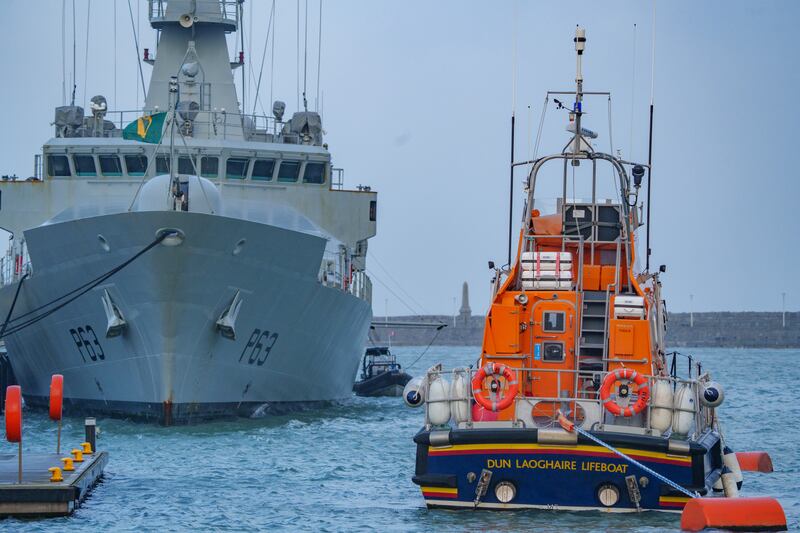
The initial step in equipping the Naval Service to monitor this underwater activity will be taken next year when the first of the Beckett class of vessels – the four offshore patrol vessels named after Irish poets and writers – are sent for a midlife refit.
The ships will be taken out of service one at a time for an extensive programme of work that will extend their lifespans into the 2040s.
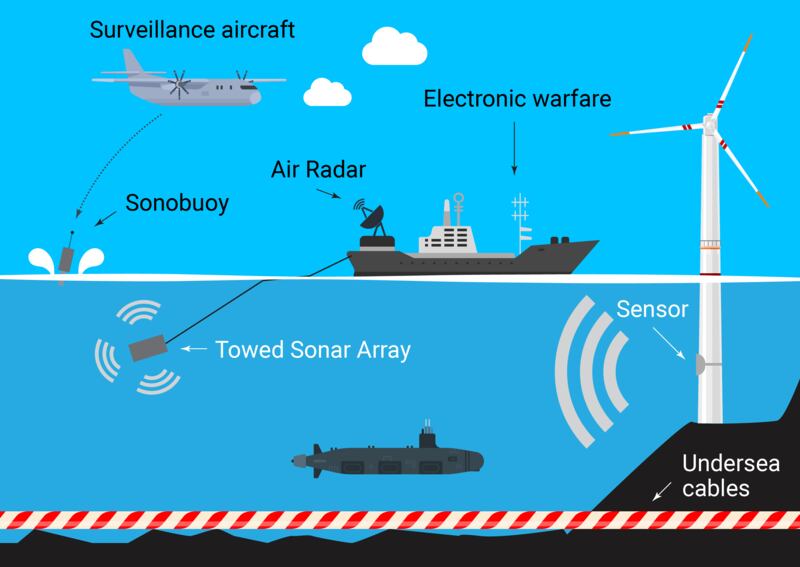
Three of the ships will be fitted with towed sonar arrays, which the Government is buying from the French defence company Thales for about €60 million. The deal includes an option to buy a fourth array if needed.
A towed sonar array (TSA) is a collection of sensors attached to a long cable that is spooled out the back of a ship. They are capable of using both active sonar – which sends out a sound pulse and detects any echoes it creates – and passive sonar that simply listens for sounds under the waves.
Although they are the most capable vessels in the Irish fleet, the P60s are not equipped for anti-submarine warfare. For one thing, they are too noisy. Any sonar equipment is as likely to pick up the ship’s engine as it is a Russian submarine.
[ Helen McEntee briefed on Russian spy ship movements by military chiefOpens in new window ]
The TSAs will be capable of detecting activity from many kilometres away.
The four ships will also be fitted with medium-range air-search radar, allowing them to detect airborne threats such as the drones spotted in Dublin Bay last December. They will also get electronic warfare systems, capable of jamming drones and sensors. All of these systems will be operated from a new control room that will be retrofitted on to each ship.
Ships equipped with TSAs will be deployed on routine patrols around subsea infrastructure and in response to specific intelligence – for example, a sighting of the Yantar near a group of cables.
Patrol patterns will be based on analysis of where an enemy actor can inflict the greatest amount of damage in the least amount of time. There are some areas of the EEZ where a hostile ship could drag its anchor through a large number of data cables in just a few hours.
If suspicious underwater activity is detected, one of the Air Corps’ C295 maritime patrol aircraft will also be deployed to monitor from above. If required, it will launch torpedo-shaped devices called sonobuoys from its flare dispensers. These drop into the sea before deploying a microphone below the waterline.
These microphones will be able to pick up sounds missed by the sonar.
Complementing these systems will be a series of permanent sensors located on the sea floor and attached to privately owned subsea infrastructure.
The Government is not planning to charge private companies for this increased protection, sources said. However, they do expect them to co-operate by mounting sensors on their infrastructure.
All of this information will be fed into a new national maritime security centre for analysis before being shared with EU nations through the Common Information Sharing Environment system.
The project will cost hundreds of millions of euro and require extensive specialised training for naval personnel.
Even with all of this, there are limitations on what can be achieved. The new technology will be able to detect the presence of an unknown undersea object. But in most cases it will not be able to determine if they are a threat.
This means if an Irish naval ship detects a submarine, it will have no way of telling who is operating it.
“The only thing we will know for sure is it isn’t one of ours because we don’t have any,” said one military source.
If an unknown vessel is detected, Irish authorities will ask friendly countries if they have a submarine in the area. If the answer is no, Ireland will ask French or UK authorities for assistance in positively identifying the vessel and, if needed, chasing it away.
The goal is deterrence rather than confrontation, said sources. “If a submarine commander believes they are about to be picked up on sonar, their immediate instinct is to turn around and get away,” said one officer. “That’s all we need. If after five years we don’t detect anything, that will be a success.”


