
Plans for the rejuvenation of Mountjoy Square, Dublin’s only “true” Georgian square, have finally been released for public consultation, more than a decade after the regeneration was proposed.
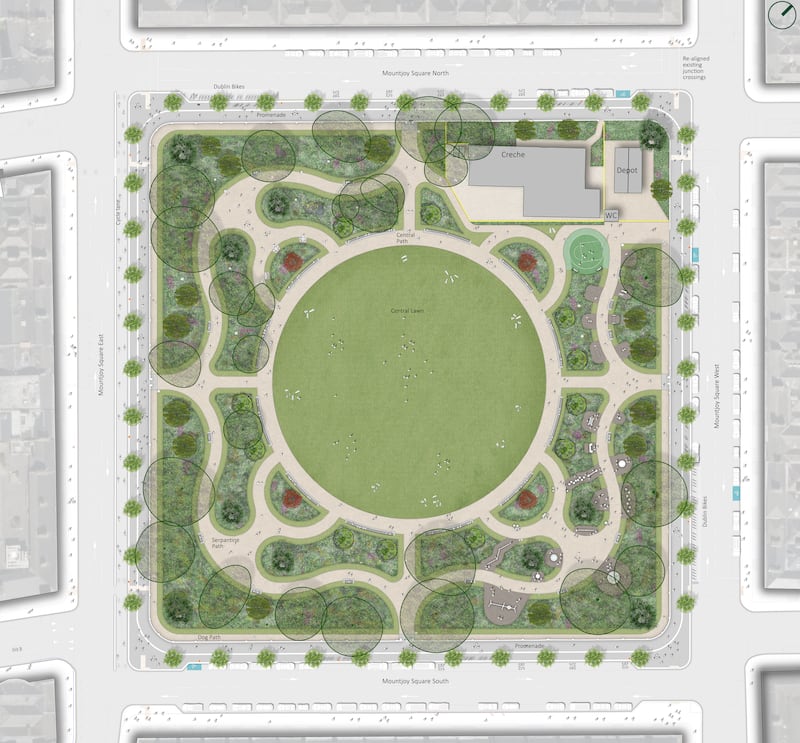
Dublin City Council plans to restore the original 18th century circular lawn and ornate footpath network, and conserve and repair the existing historic perimeter railings, including the reinstatement of 84 lamp irons.
It would also remove a 2,700sq m tarmac and concrete surface, used as multipurpose sports area, and demolish a 1930s community centre which the council said was of “minimal social and architectural merit” and has a “demonstrably detrimental impact on the overall character and visual coherence of the park”.
The plans have been endorsed by the Dublin Civic Trust, the organisation working to protect the city’s architectural heritage, as offering the potential to “revive” Mountjoy Square and transform it into “a world-class destination for locals and tourists”.
READ MORE


Mountjoy Square was designed in 1802 as a “pleasure garden for passive recreation” including a central circular lawn with formal planting and defined paths.
The 4.4 acre park is a perfect square measuring 134m by 134m, the only one of the city’s five Georgian squares to have four equal sides, making it the city’s only true Georgian square.
It remained privately owned until 1938 when it passed into the ownership of Dublin Corporation. Most of the significant changes to the park date from that handover, with the addition of public toilets, a nursery and a community building. The central lawn was bisected, with tennis courts screened by fencing.
More buildings were added in the late 1960s and about 20 years ago a new playground was installed. Today, the park is in two distinct halves. The western half remains as an open grass park, with the buildings and sports facilities concentrated in the eastern side.
In 2014, the council announced plans to remove the creche, community centre, maintenance depot and sportsgrounds, and restore the park to its original Georgian design.
However, in 2018 it revised these proposals, keeping most of the buildings, but removing the hard-play surfaces and restoring the lawn and paths.
The new plans, available for public consultation and submissions until February 26th, retain the creche and depot in the northwest corner, but the community building would be demolished, with its services moved to a new location and the tarmac surfaces would be removed.
The circular lawn would be restored, along with new toilets, a basketball court, gym equipment, drinking fountains, while seating would also be installed. There would be extensive ornamental tree and shrub planting. Some existing trees would be felled but the council said for each tree lost, a replacement tree would be planted.
In addition to the railing and lighting restoration, outside the perimeter of the park the existing footpath will be widened and, on its western side, a two-way cycle route will be built, resulting in the loss of nine car parking spaces. That cycle route will be extended down Gardiner Street to Beresford Place at the back of the Custom House, as part of the Dublin City Centre Transport Plan.
The park has been blighted by increasing dilapidation and antisocial behaviour and, particularly at night, “provokes an ominous and uninviting atmosphere, contributing to a perception of safety concerns within the broader surrounding urban context”, the council said.
The project will address “antisocial behaviour by enhancing the park’s attractiveness, encouraging positive use and increasing visibility through improved lighting and design”, it said.
Civic Trust chief executive Graham Hickey praised the plans for their “clever synergy of the original Georgian design of the square with a host of active facilities and sensational landscape design that embrace the needs of 21st-century urban life”. It was, he said, “a truly showstopping project.”


