

Eugenio Biagini, who has carried the torch for the teaching of Irish history at Cambridge University since the 1980s, recently held a seminar for undergraduate students in Sidney Sussex College on the Troubles.
Just one was Irish, and the majority came from around the globe. Many, though, were British-born, but of strong Irish heritage – from the Republic and Northern Ireland, Catholic and Protestant.
“Suddenly, all the emotions that people had in the background of their family memories came to the forefront. The students divided themselves, literally, between unionists and nationalists,” he says.
“There were a few Indian and south Asian students completely taken aback by the spectacle of militancy, suddenly deployed in public in an otherwise very professional academic setting.”
READ MORE


The Italian’s passion for teaching Irish history explains his happiness at last Friday’s announcement of a new chair in Irish History at Cambridge – funded by a once-off €4.5 million grant from the Irish Government – and why it matters.
The post will be held from later in the summer by Prof Alvin Jackson, whose work was applauded by Taoiseach Micheál Martin when he spoke in Trinity College, Cambridge, on Friday.
Throughout the centuries, the British, Biagini argues, have rarely given thought to Ireland – partly caused by the lack of teaching in schools and universities on the ties between the two islands. He is far from alone in holding that opinion.

The Brexit referendum was but one of the latest examples, Biagini argues, and the 2016 referendum debate would have been “completely different” if the British-Irish relationship had been properly understood.
“The Brexit debate was so self-indulgent,” he says, “It was wrong from beginning to end, but the beginning was not in England, but on the Border. And we don’t know yet what the end will be,” he goes on.
The Childers Professorship of Irish History at Cambridge, named after Robert Childers, executed during the Civil War, and his son, Erskine, the later president of Ireland, will help to bridge the gap.
The links between Cambridge and Ireland have always been strong, illustrated by the Childers, historians JJ Lee and Ronan Fanning in the 1970s, and Nicholas Mansergh, and his late son, Martin, who died last year.
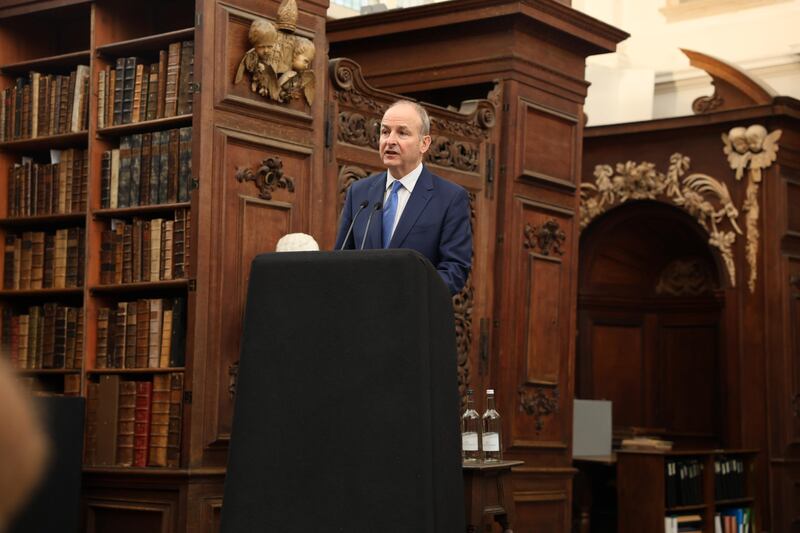
Today, a new generation of historians, Prof Richard Bourke and Dr Niamh Gallagher, are installed in Cambridge. The new chair “will not create Irish history in Cambridge – there is a long tradition of Cambridge historians writing important works in the field”, said Martin. “Rather, it will guarantee and expand this tradition.”
Irish scholars and Irish topics are to be found throughout, but the creation of the Chair of Irish History, and the appointment of Jackson, strengthen the relationship.
The Government donation “ensures a permanent and essential place” for teaching and research on Irish history in the world-famous university”, Jackson said on Friday, and “that it is sustained for future generations”.
Privately, the donation has raised a few eyebrows among Irish academics in Ireland, critical of what they see as underinvestment in permanent history posts at Irish colleges.
Displaying his own interest in history, the Taoiseach told the gathering in Trinity College – founded by Henry VIII – that people will always divide over the shared history of the two islands.
“No credible scholarship could ever oblige the Irish people to think better of Oliver Cromwell. Indeed, most of us are also unlikely to ever change our minds concerning the decision of the founder of this college to declare himself King of Ireland,” he said.
But, he said, the decision to name the post after the Childers, father and son, was deliberate, since the Anglican nationalists’ lives “ultimately speak to the remarkable complexity and interconnections in the British-Irish relationship”.
“They are a reminder that you cannot understand Irish history if you try to impose crude assumptions about religion or class,” said Martin. “We have done little to develop a sense of Irishness”, which “is more than a cover version of old orthodoxies. No one could look at the ways in which certain groups use our flag, or their aggression towards those who do not toe the ideological line, and fail to worry about the damage which this might cause in years ahead.”
The study of history costs, requiring the highest standards. Support for quality scholarship “should be a much greater priority for democratic governments, even when faced with stretched budgets”, he said.

In Biagini’s eyes, the teaching of Irish history offers Cambridge students insights into Ireland and the British-Irish relationship, but the lessons learned help them understand the Middle East, southeast Asia, or the United States, “for that matter, too”.
Recently, he showed students film of the late Rev Ian Paisley speaking at a 1977 rally. “It was uncannily reminiscent of Trump, the style, the effectiveness, the ability to connect with ordinary people was just amazing,” he says.
By contrast, the grainy film showing Terence O’Neill’s “Ulster stands at the crossroads” speech from 1968 showed students that politicians can be “absolutely right, but still be quintessentially out of touch and elite.
“You could see that he knew what he was talking about, but he was completely out of touch. He had no sense at all [of] how to communicate with the man and the woman in the street.
“This has made students engage with all sorts of issues. In my classes, there has not been for a long time any sense of complacency, or superiority about Ireland.”
A number of British universities, notably the University of Liverpool, have Irish studies departments, along with Aberdeen, the University of London, Sheffield, Swansea and York.
Equally, significant work has been done in Edinburgh since the 1980s, where, by some counts, there are now more Irish history PhD students than at either Oxford, or Cambridge, or, indeed, any other university outside of Ireland.
While there are many academics in Irish universities studying elements of British history, most – but not all – do so through the lens of Ireland, rather than the broader canvas of British history.
A chair of British History at an Irish university would have value, argues Prof Eunan O’Halpin, since there are many elements of British history that have nothing to do with Ireland, but should be better understood here.
For now, despite the appointment of British academic Helen Parr as professor of history at the University of Limerick, no Irish university has a post as similarly well-endowed as the new Cambridge position covering British history.
Such a post is not needed, argues Trinity College Dublin’s Prof Micheál Ó Siochrú. Because of our history, Irish historians must “engage with” Britain in a way that British historians do not have to match.
“Most have absolutely no understanding of Ireland, no interest in it, never engaged with it. It doesn’t feature on their radar in any meaningful way,” says Ó Siochrú.
The idea of a chair of British History at an Irish university, he says, “seems to me an incredibly old-fashioned way of addressing [it]. Why not a chair of French history, of Italian history, of German history?
“That sort of that national approach, frankly, I find, really a little old-fashioned. There’s much more innovative and interesting ways of approaching history that do not have to be nationally focused in that way.”


