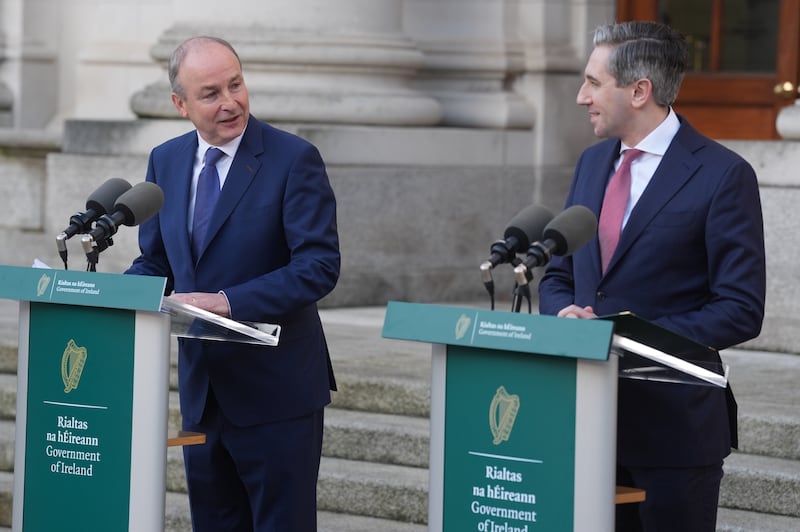
Government formation, or something like it
Any prospect of a left-wing party such as Labour going into government had vanished like festive snow on the ditch over the Christmas period this time last year, and January brought the crisp winter clarity that the Fianna Fáil and Fine Gael coalition would rely instead on an eclectic clatter of independents to return to power.
The involvement of one Michael Lowry, seen as the de facto leader of the Independent group, immediately aroused suspicions of secret constituency deals, which the Government denied. Leaning on Lowry also exposed the Coalition to harsh criticism, with a whole new political generation dusting off the findings of the Moriarty tribunal which criticised Lowry’s behaviour as “profoundly corrupt”. Both Fianna Fáil and Fine Gael came under tremendous pressure about Lowry’s involvement in government formation. In one unfortunate media doorstep, the prospective Taoiseach Micheál Martin told journalists that Lowry would “not be in government to do any corruption”.
The new Government was expected to form on Wednesday, January 22nd. But what should have been a gala days of civility and ceremony in Leinster House descended into absolute acrimony, when the opposition derailed proceedings in protest at “so-called Independent” TDs, who were propping up the Government, being given Opposition speaking time. It was quantum politics from TDs who seemed to want to exist in two states at once; Government and Opposition.
The wild melee in the chamber, which became a long-running spat known as the speaking rights row, was a baptism of fire for the newly minted Ceann Comhairle Verona Murphy. In the fracas of one particularly chaotic day in the Dáil, Lowry gave Paul Murphy a now infamous two finger salute which, after being captured on camera by the socialist TD, became the iconography of everything the Opposition was claiming was wrong with the Government set-up.
READ MORE


What became a very tedious row stretched well into March and started to exhaust the patience of the public, before finally being resolved to limited satisfaction when a motion on the dispute was finally passed that month. But the speaking rights row would set the tone for the 2025 political year, by ossifying a binary, dividing line in Irish politics: Fianna Fáil and Fine Gael on one side, and a more cohesive and united Opposition on the other.
Getting their house in order
Once the Government finally got up and running in a meaningful way, the minds of ministers started to concentrate on the most important and pressing social and political issue in the State: housing. Everyone sitting around the Cabinet table knew that the fortunes of this Government would be determined by the endurance of the housing crisis, and that the promise to deliver 300,000 new homes by 2030 was hanging like a Sword of Damocles over this Coalition.
In February, Taoiseach Micheál Martin had warned his own parliamentary party to brace for “unpopular decisions” on housing. But he likely didn’t anticipate the strength of the unpopularity within his own Coalition to one ill-fated proposal at least. Minister for Housing James Browne had an inauspicious start to his tenure in the most important Government department with his abortive effort to make Nama boss Brendan McDonagh the new “housing tsar”. McDonagh had been the favoured choice to lead a new Housing Activation Office, one of the key promises from the programme for government. But he ruled himself out, after it was suggested he would retain his €430,000 annual salary – the price of a family home in some areas, for those lucky enough to be able to buy one.
The new Government did keep its promise to make difficult decisions on housing, by plainly pursuing developers with a suite of proposals explicitly designed to stimulate private investment. This included a reform of Rent Pressure Zones, which did accidentally ban short-term lets in some of the most popular tourist areas of the State. New standards for apartments were also brought forward. Though these were tripped up by a legal case that seemed to come straight from the mind of Momus, the Greek god of satire and mockery. The new apartment standards became the subject of a judicial review, the same legal instrument that the Government has long been complaining is dogging housing development because it’s being used as an extension of the planning process.
[ Is Ireland ready for drab Soviet-style apartment blocks?Opens in new window ]
While the housing crisis still dominates as a national political issue, the change in tone from the Government on immigration indicates that ministers believe that this is a growing issue in the public consciousness too. Minister for Justice Jim O’Callaghan put an increased, visible focus on chartered deportation flights – with 2025 on track to have the highest number of such deportations in 20 years. The latter half of the year saw him bringing stricter measures for both Ukrainian and international protection applicants to Cabinet.
In the Department of Health, Jennifer Carroll-MacNeill had to grapple with a series of scandals and controversies that emerged from Children’s Health Ireland. And in the background, the much-delayed Occupied Territories Bill and its proposal to include services started to attract unwanted attention from US politicians who accused Ireland of legislative anti-Semitism.
Amadans and potential uachtaráins
Any hope Ireland has of cherishing our national image as bashful and self-effacing was surely obliterated by the conveyor-belt of hopefuls who confidently presented themselves during the summer as prospective presidents of this once proud nation. But once former Boomtown rats and erstwhile meterologists were cleared from the field by what then seemed to be a mercifully high bar for nomination, the only prospective non-party political candidate was Catholic arch-conservative Maria Steen.
Her blue Hermes handbag got an awful lot of attention, and Steen got very close to being nominated as a candidate. But not close enough. After she lost out by just two signatures, Independent senators who failed to back her were bombarded with abuse by Steen supporters. In the aftermath, there was a blazing war of words between Steen and Senator and columnist Michael McDowell – exchanged through the medium of The Irish Times.
Fine Gael, which has never won a presidential election in its history, went into the summer feeling confident that it had the front-runner and possible next president of Ireland in former MEP Mairead McGuinness. When she dramatically pulled out of the race on health grounds in August, there was a groundswell of support within the party for former minister Heather Humphreys to replace her. The fact that Humphreys, as a Border-county Protestant, was a popular choice among TDs and senators may have saved Simon Harris’s bacon. After a very lacklustre and at times incoherent campaign, which placed a questionable focus on negative messaging and attack videos, the Tánaiste managed to avoid coming under too much pressure after Fine Gael’s very underwhelming electoral performance.
Down in west Cork, Taoiseach Micheál Martin was pondering his own party’s prospects. Though he would deny it, close colleagues felt that Martin was going through the horrors at the thought of Bertie Ahern appearing on the ballot for Fianna Fáil. Ahern, who had just been immortalised in a CMAT song about the social and human toll of the financial crash, was openly nursing ambitions for the Áras – building on his legacy as a peacemaker after the Belfast Agreement. Martin was apparently mystified at the desire of Ahern to run and resurrect the memories of Fianna Fáil’s worst days. How darkly ironic it was then to have their great new hope Jim Gavin publicly unravel, over a property issue related to the aftermath of the financial crash.
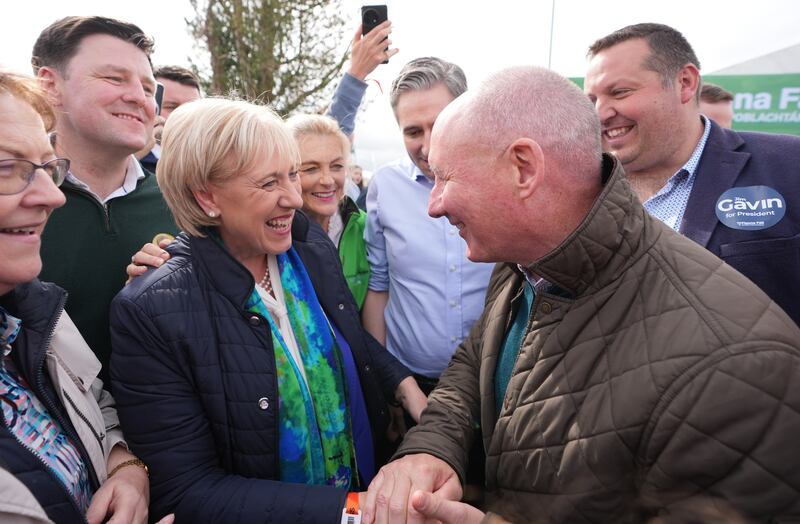
Having reported on plenty of crime-boss style moniker’s for the Sunday World, its deputy editor Niall Donald became the reluctant star of the presidential election when he was unveiled as “the tenant” – the renter who was owed €3,300 by his former landlord Gavin. The former GAA boss dramatically dropped out of the race, and plunged Fianna Fáil into a state of furious misery.
For the first time in his 14-year tenure, Martin’s leadership is facing its first, and most serious existential threat. As it faces its centenary year in 2026, Fianna Fáil may now be on the brink of ousting its longest-serving leader after Éamon de Valera. While it is not clear at the time of writing if Martin would lose a no-confidence motion, it’s certainly not clear that he would win one either.
But the single most fascinating story of the 2025 presidential election was, of course, that of the winner. Seasoned and well-respected Independent left-wing TD Catherine Connolly had already made history when she united five parties behind her run for Áras an Uachtaráin. Labour, the Social Democrats, Sinn Féin, the Green Party and People Before Profit were quick to present her candidacy as an electoral test for a prospective left-wing government.
[ Catherine Connolly’s speech was surprisingly political. It doesn’t really matterOpens in new window ]
But her campaign was even more interesting than that. Connolly’s authenticity made her impervious to the kind of controversies that would topple a lesser candidate, and her unapologetic defence of her ideological positions earned her support even from those who don’t align with her views. The only sour note for the election of the 10th president of Ireland was the significant subplot of the scale of spoiled votes cast on October 24th. In her inauguration on November 11th, Connolly vowed to “ensure that all voices are represented” in an attempt to appeal to those who clearly felt they had not been on the 2025 ballot paper.
Much of the Connolly campaign opposed some landmark Government policies, including the plans to unravel the triple lock. This will be an interesting issue to watch in 2026, as will the way the presidency interacts with Ireland’s presidency of the Council of the European Union in the latter half of next year.
Dear prudence, dear Paschal
It was coming up on a year since the 2024 general election where no fewer than 18 Fine Gael TDs had hung up their canvassing boots, in an exodus of experience from the party that has been in power for 14 years. But Fine Gael’s biggest loss was yet to come.
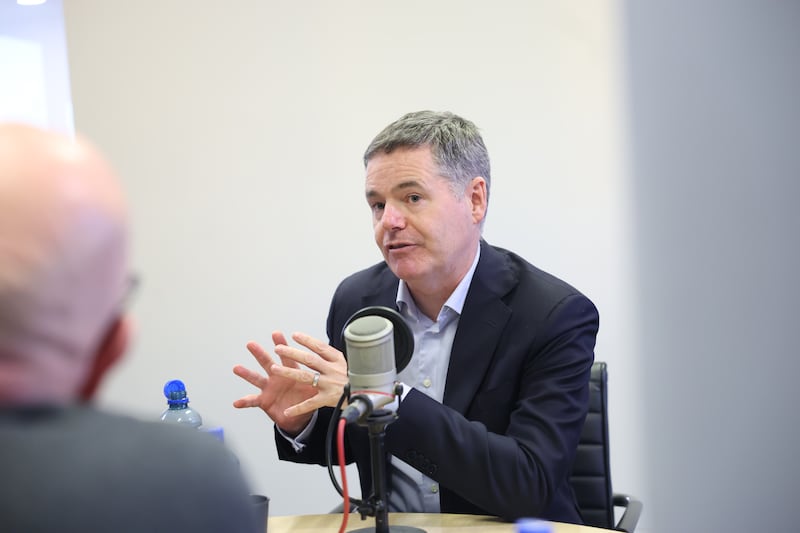
On an innocuously sunny Tuesday morning in November, phones across Leinster House started to trill with the emerging news that “Prudent” Paschal Donohoe was leaving Irish politics almost immediately for a job with the World Bank. It came after a modern record of stewarding a decade worth of budgets – in either the Department of Finance or Public Expenditure. It was also immediately recognised as a significant blow to both the stability and intellectual heft of the Coalition.
In the mini-reshuffle that followed, Fine Gael leader Simon Harris appointed himself to the freshly vacated role of Minister for Finance. While his loyalists were quick to talk up Harris’s near decade of experience at the Cabinet table, there were eyebrows raised across Government about the prospective clash between the Tánaiste’s more populist instincts and his new fiscal obligations. His performance over the next year will be keenly scrutinised, as will his relationship with his fellow money minister Jack Chambers, who was also damaged by his involvement in the Gavin campaign. Relations between the two comparatively young men, by Irish political standards, may prove to be a crucial indicator of relations between the Coalition partners as a whole.