Britain’s two most famous official residences, Downing Street and Buckingham Palace, are a leisurely 15-minute stroll away from each other in central London.
They are more or less linked by St James’s Park, a verdant city garden that stretches to the back of Downing Street, where UK prime minister Keir Starmer lives and works. At its other end, it reaches to the imposing Queen Victoria memorial at the royal palace, the main home of Britain’s monarch King Charles.
In 2025, Downing Street and Buckingham Palace were also linked by something else: an unrelenting torrent of turbulence that buffeted their respective occupants.
They faced different challenges. For Starmer, the year brought a stream of dire political setbacks as his government’s authority wavered and Nigel Farage’s Reform UK streaked ahead in the popularity stakes. Meanwhile, the alleged antics of Andrew, Charles’s younger brother, ensured the royals endured a proper annus horribilis as tough as any had by their mother, the late Queen Elizabeth, who famously uttered the phrase in 1992.
READ MORE



That year, there were revelations about the troubled private lives of Diana and Charles, then the Prince and Princess of Wales; the separation of Andrew and the divorce of Princess Anne, as well as a fire that raged through Windsor Castle.
In 2025, the dual dramas of the UK’s government and its monarchy mostly played out on parallel tracks. But occasionally they overlapped, such as when Andrew’s travails over his association with sex offender Jeffrey Epstein came to a crescendo near the year’s end, posing awkward constitutional questions for king and prime minister.
For both men, 2025 will likely go down as a year to forget. For the rest of us, the sheer spectacle of it all will live long in the memory.
Here is how their respective crises played out during the year.
January and February
The year got off to an inauspicious start for Starmer, and the then Prince Andrew was embroiled in the story. Just before Christmas 2024, scandal erupted when it emerged that Andrew had grown close to an alleged Chinese spy in Britain, Yang Tengbo.
The issue complicated the Labour government’s plan to improve economic relations with China, as further details of the scandal tumbled out in the new year, just as the UK’s chancellor of the exchequer, Rachel Reeves, went on an official trip to Beijing.
January was also a difficult month for the prime minister due to the provocations of Elon Musk, who was the then-incoming US president Donald Trump’s closest confidante. It was awkward for Starmer, who was keen to cultivate close ties with Trump.
Billionaire Musk used his X social media platform to call for the UK prime minister to be jailed over the grooming gangs scandal, where men, often of Pakistani Muslim descent, raped and abused vulnerable white British girls on an industrial scale. Musk accused Starmer, a former prosecutor, of being “complicit” in official neglect of the issue.
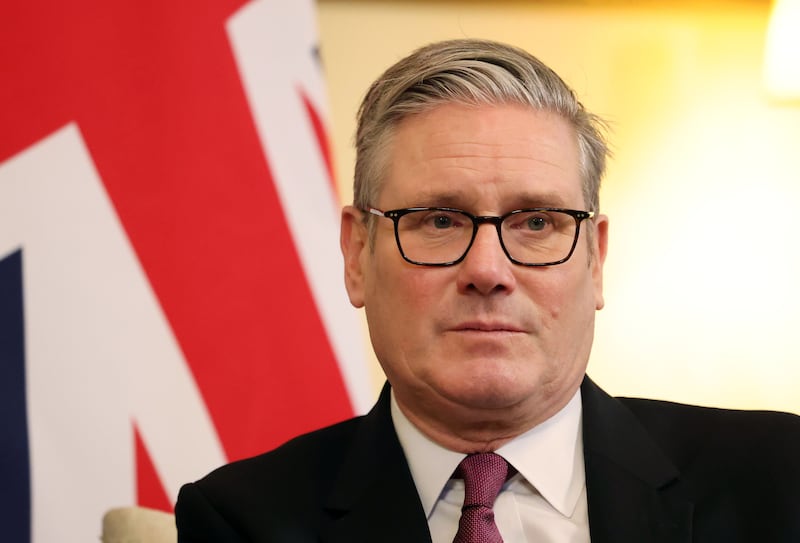
Friction had been brewing between Starmer and Musk since the previous summer over the UK prime minister’s tough response to right-wing riots that engulfed Britain after the Southport stabbings. This time, the prime minister chose not to rise to Musk’s bait.
Musk also aimed brickbats at Starmer’s main political foe, Farage, who had always presented himself as Trump’s favourite politician in Britain, although as 2025 wore on it seemed the US president grew more distant from him.
In January Musk was upset with Farage for refusing to embrace the far-right activist and political agitator Tommy Robinson, whom the US businessman admired. “The Reform party needs a new leader. Farage doesn’t have what it takes,” Musk posted on X.
Like the UK prime minister, Farage tried his best not to fall into the trap of getting into an unwinnable verbal war with the US president’s most powerful confidante.
By February, Reform topped a UK national opinion poll for the first time, ahead of Labour with the Tory party a distant third. Farage’s party would not relinquish its lead for the rest of the year, pulling farther ahead with each new poll. Starmer had been prime minister for only seven months, yet people were already talking about Farage as his successor.
Meanwhile, the coming storm hadn’t yet kicked off in earnest for the royals. In January Andrew became a grandfather for the fourth time when his daughter Princess Beatrice gave birth to Athena, 11th in line to the throne.
It was also announced that the cancer suffered by Catherine, the Princess of Wales, was in remission. But if the king, who in 2024 was also diagnosed with cancer, believed this was a sign of a better year to come, he would soon be disabused of that notion.
March and April
While the Labour government led by Starmer slid further into domestic difficulty, the prime minister was kept occupied by tricky international matters.
At the start of March he hosted Volodymyr Zelenskiy at Downing Street, a day after Ukraine’s president was humiliated by Trump in a fiery Oval Office meeting, and two days after Starmer’s own visit to Washington, when he invited Trump to Britain for an unprecedented second full state visit.
Zelenskiy was also hosted on his trip to Britain by Charles, in what seemed like a coded message to Trump to lay off the wartime leader – the US president is known to covet a close relationship with the king.
The fear in Downing Street that relations with the US could come off the rails was deepened by comments from Trump’s vice-president, JD Vance, who said that Ukraine could not rely on protection “from some random country that hasn’t fought a war in 30 or 40 years”, widely seen as a put-down of Britain.
Again, Starmer didn’t directly rise to the provocation, but he pushed back subtly in the House of Commons by pointing out that many British soldiers had died alongside Americans in Iraq and Afghanistan.
Charles, who had resumed public duties during his cancer treatment, was briefly hospitalised again in March. He was also forced to cancel a trip to Birmingham as well as three meetings with ambassadors in London.
Buckingham Palace said it was just “temporary side effects” of his cancer treatment, but the British public was reminded of the physical vulnerability of their king.
Charles and Queen Camilla celebrated their 20th wedding anniversary in early April. But just over two weeks later a portent of the coming storm arrived in news of the suicide of Virginia Giuffre, a victim of Epstein’s who also alleged she had been forced by him to have sex three times with his friend Prince Andrew, more than two decades before.
May and June
The domestic political pressure on Starmer from the rise Reform and Farage began to mount.
On May 1st, Reform’s candidate Sarah Pochin pipped a Labour candidate to victory in a crucial byelection in the Cheshire constituency of Runcorn and Helsby, just south of Liverpool. It was once considered one of the safest Labour seats in Britain.
The Irish Times caught up with Farage on the campaign trail. As he leaned on a fence with a pint in his hand, he identified what he saw as one of the biggest problems facing Labour: Starmer himself.
“It is only nine or 10 months on [from Labour’s general election victory the previous July] and a really big issue in places such as this is that Starmer himself is so incredibly unpopular,” said Farage. “I’m trying to work it out. It’s not because he’s a nasty person – because he isn’t. It might be a lack of authenticity.”
Reform also performed well in a slew of local elections in England on the same day, with a projected national vote share above 30 per cent, just a few percentage points below the threshold that delivered Labour a landslide Westminster election win months earlier.
Starmer responded on May 12th with a speech promising a crackdown on immigration, as he warned Britain faced becoming an “island of strangers”, which some said echoed Enoch Powell’s infamous anti-migrant “strangers in our own land” speech. Starmer later admitted he was wrong to have said what he did.
The next month, Starmer effectively lost control of his own party when the government was forced to abandon plans to cut the welfare bill, after a huge rebellion among Labour backbenchers. He struggled for the rest of the year to regain his authority as leader.
On the royal front, Charles celebrated his 77th birthday, although his public falling out with his youngest son, Harry, continued, with the prince complaining that his father wouldn’t speak to him.
July and August
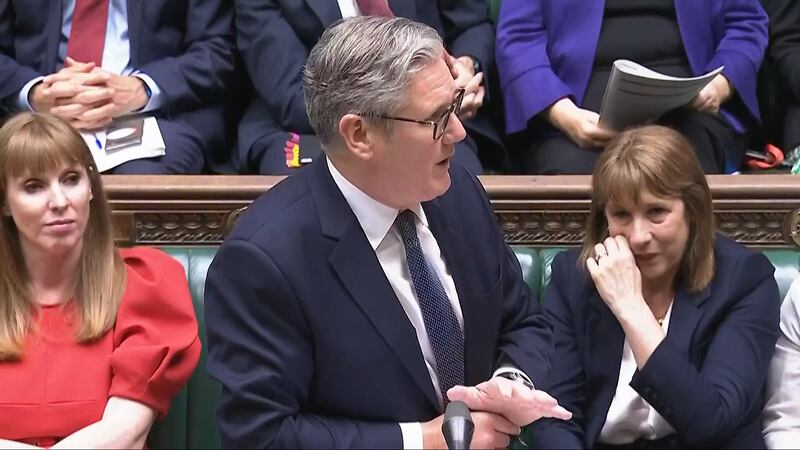
July began with Reeves crying on Labour’s front bench in the House of Commons during prime minister’s questions. The previous month, data was released to show that the UK economy had shrunk in April. Pressure was beginning to tell on the chancellor.
Throughout the summer, left-wing protests spread over the UK government’s decision to ban activist group Palestine Action. Meanwhile, the sense developed that Britain was a country increasingly divided and on edge, as right-wing protests spread against asylum hotels, most notably at Epping in Essex.
Buckingham Palace was rocked in August by the publication of a book, Entitled: the Rise and Fall of the House of York, which painted an unflattering portrait of a spoiled and unpleasant Andrew.
September and October
Starmer’s political woes deepened with the resignation of his deputy prime minister and housing secretary, Angela Rayner, for underpaying stamp duty on a flat. The news filtered through to a jubilant Reform UK crowd during that party’s annual conference in Birmingham. Reform presented itself as a government-in-waiting.
Trump was due for his state visit, but the week before, Starmer was forced to sack his ambassador to Washington, Peter Mandelson, after files released in the US showed how close he was to Epstein.
This turned up the heat on Andrew. Embarrassing emails from 2011 re-emerged that suggested the then prince had not been telling the truth when he previously claimed he had cut off all contact with Epstein in 2010.
Further releases from the so-called Epstein Files in the US showed that Sarah Ferguson, Andrew’s former wife and still his closest ally, had emailed Epstein in 2011 – after he had served time in jail – to call him a “supreme friend”.
There were more damning releases in the weeks ahead. By October 17th, Buckingham Palace sought to relieve the pressure by announcing that Andrew had agreed to stop using his titles, such as Duke of York. But he would remain a prince.
The criticism over his Epstein links would not subside, however. On October 27th, the king was heckled by a member of the public over Andrew at a walkabout in Litchfield. Days later it was announced the king’s brother would be formally stripped of all his royal titles, including prince. The horror deepened when he was removed from the roll of peers on Halloween.

The royal defenestration of the man now known as Andrew Mountbatten-Windsor was almost complete. Starmer indicated that the government supported the king’s judgment.
November and December
The UK prime minister said it was “working to remove” all royal titles held by Andrew.
Meanwhile, the pressure applied on Labour by Reform revealed cracks in the government party. Government sources anonymously briefed British media that Wes Streeting, the health secretary, was planning to depose Starmer but that the prime minister would fight back.
This sparked fury among Streeting’s Allies. Starmer denounced the briefing and apologised to Streeting.
It wasn’t all plain sailing for Reform: its former leader in Wales, Nathan Gill, was jailed for accepting bribes from a Russian spy.
Starmer and Reeves advertised their political weakness with a huge tax-and-spend budget designed to mollify their Labour critics who had rebelled so effectively over welfare cuts earlier in the year.
As Westminster political circus rolled into December, the year seemed destined to end as it had began, with Starmer on the back foot and his rivals on the attack.
For the royals, there was no chance of the disgraced Andrew joining his relatives for the traditional Christmas Day church ceremony at Sandringham. The annus horribilis of him and his brother the king was complete.