
It’s 8.15am in a bright German secondary school classroom and Jack Teahan from St Brendan’s College in Killarney is trying to explain Puck Fair, the ancient August festival in nearby Killorglin.
“A goat goes up on a scaffolding and he’s king for three days,” Jack begins, not noticing the German teenagers’ jaws drop.
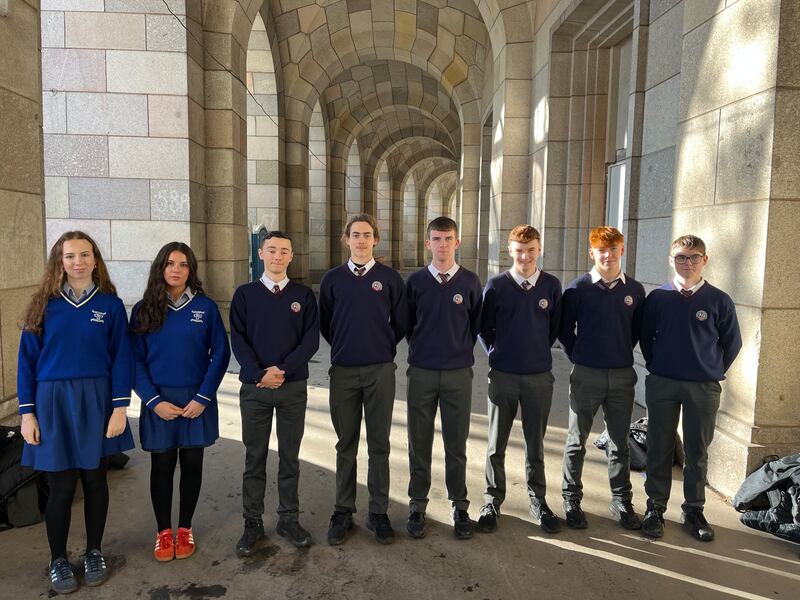
Jack – and eight other Killarney transition- and fifth-year students – are midway through their weeklong visit to Roth, a pretty town in the Frankonia region of Bavaria in southern Germany.
The steep gabled houses and cobbled streets are a long way from Killarney – almost 2,000km to be precise – yet, in this early morning English language class at least, the locals and their traditions seem curiously familiar.
READ MORE


Timo Schmidt, a 19-year-old German redhead who visited Killarney last year, is happy to tell the Irish visitors of a festival near Roth where “they start queuing from 5am and, when the beer tent opens at 8am, 500 people race in to get a place and stay there drinking until midnight”.
This time it’s wide eyes all round from the Irish visitors: seven from the all-boys St Brendan’s and two from St Brigid’s girls’ school next door. In their tidy blue school uniforms, they stand out alongside the German teens in hoodies and jeans and baggy sweatpants. Some of the visitors have taken additional Irishification measures.
Paddy Myers, the only Irish redhead in the group, admits he only got his copper hue from a bottle the night before. His mother isn’t thrilled, Paddy says, but he is clearly delighted with the result – and the trip: “It’s great to be here and see the sense of learning German.”
The driving force of this exchange is St Brendan’s German language teacher Angela Daly. Despite her name – and flawless Kerry accent and intonation – Daly grew up near Stuttgart before a Kerryman lured her back to the kingdom.
“It’s a lot of work but we’ve been blown away by the warmth of the welcome we get from everybody,” said Daly, who remembers her own exchanges as a highlight of her school years, and about more than just language immersion. “It’s about cultural interaction, learning social skills like nuanced listening and thinking outside the box.”

Mid-trip, Daly knows first-hand just how much unpaid work such trips entail. As well as two accompanying teachers, who need cover back in Ireland, there are insurance questions and considerable red tape over Irish Garda vetting for everyone in contact with the students in both countries.
Daly says she is lucky to have a supportive principal and colleagues in Killarney. Another boost has come from Killarney’s 20-year-old town partnership with Pleinfeld, a town near Roth.
Josef Miehling, the former mayor of Pleinfeld, has been an Ireland enthusiast for 30 years and is passionate about the partnership.
“It’s all about the meetings and the chats between people, and school exchanges were always a goal of the partnership,” he said. “But it can be difficult to find schools in Ireland that still teach German.”
The numbers reveal just how hard. Some 431 secondary schools in Ireland still offer German, down 16 per cent in the last 20 years. Almost a third of Junior Certificate German students fail to continue to the Leaving Certificate. And the numbers taking Leaving Certificate German has slipped 21 per cent in the last five years. Other languages show a similar pattern.
Ask language teachers about this – and Ireland’s persistent monolingualism- and some point to a belief among parents that English is enough to have in a globalised world. Others are sure that AI will obviate the need to sweat over irregular verbs.
But teachers, business people and diplomats say such thinking is optimistic and short-sighted. Even even with current economic difficulties, Germany remains Europe’s dominant economy. Despite the historical popularity of French – and the surge of Spanish, with a link to sun holidays – German is, with 100 million native speakers, the Continent’s most-spoken language.
When [students] see how fun and interesting languages can be ... that opens a door
— Laura Sinnott, German teacher at St Dominic’s College
Laura Sinnott, a German teacher at St Dominic’s College in Dublin’s Cabra neighbourhood is another school exchange enthusiast. Next May, she is taking her pupils to Kiel in northern Germany.
Sinnott spent time in Germany during secondary school and, after university, lived in Vienna for five years, where fees were just €18 per semester. There are no university fees at all in German universities while a master’s degree fees are often a fifth of the Irish equivalent.
Then there is the proximity. While in Austria, Laura was over and back to Ireland, something that eases her eventual return; her electrician brother, now living with children in Australia, is rarely able to visit.
Sinnott has noticed how the last decades of immigration to Ireland have already made bilingual students the norm in her urban school. And, as head of the German teachers’ Association (GDI), she sees school exchanges as key to addressing reservations in monolingual Irish minds about language-learning.
Her school’s exchange to Kiel next year is fully funded by the EU’s Erasmus+ programme, meaning cost is no longer a limiting factor.
“Students realise there is nothing to be afraid of, and when they see how fun and interesting languages can be ... that opens a door,” said Sinnott. “We got our funding even though, at first, we were placed on a reserve list. The EU have the money for this, I just don’t think Irish schools are aware this is there.”
Back in Roth, local secondary school English teachers say any Irish schools considering an exchange are pushing at an open door in Germany. The exchanges have created a buzz about Ireland in Roth, they say, even among those who have never visited. But this interest shouldn’t be taken for granted, and Ireland needs a new generation of ambassadors. In Bavaria, one teacher notes, the Northern Ireland conflict has been off the history syllabus.
After the morning English class ends, it’s time for today’s outing. The Killarney students, their new German friends and two sets of teachers board a train to nearby Nuremberg. Their destination: the sprawling megalomania of the Nazi-era party rally grounds, nearly twice the size of Dublin’s Phoenix Park, with half-finished stadiums and marching grounds.
In the chilly sunshine, an engaging guide explains to the students the warped thinking behind Nazi-era fascism, Hitler’s “architecture of intimidation” and his plans – with a deliberate nod to the present – to “make Germany great again”.
As the students listen in rapt attention, the teachers are thinking about the uncomfortable echoes of the past in our present. One of them is Ralph Gieselmann, a Roth English and history teacher.
Four decades ago he studied and worked at the University of Ulster in Coleraine, at the height of the peace process. He still draws on that experience today, as other troubling historical ghosts stalk Europe once more.
Where ‘rage bait’ is the word of 2025, we have to do more in the education system and schools to work against that
— Angela Daly, German teacher at St Brendan’s College
“Trips like this can only be a good thing,” he said, “particularly if it shows young people that other people aren’t that different and if it prevents them thinking that it’s no problem voting for an extremist nationalist party.”
Such thoughts are on Daly’s mind, too. In a quiet moment during the exchange, the Killarney teacher recalls a long-forgotten remark by a former lecturer: school exchanges are “about securing the peace, at a low level, for the future”.
“I didn’t think much of that at the time – but I do now,” she said. “In a world of division and discord, where ‘rage bait’ is the word of 2025, we have to do more in the education system and schools to work against that.”
When Ireland was a language pioneer
Ireland may struggle now but, once, it was a modern languages pioneer. This year marks the 250th anniversary of Trinity College Dublin’s modern language chairs, created in 1776 by John Hely-Hutchinson.
These included one chair for French and German, and another for Spanish and Italian. In the case of German, it is widely recognised as the first such chair in the world.
Today’s modern language successors at Irish universities see this year’s anniversary as a perfect opportunity to take stock and pave a more ambitious path into the future.
After a first event at Queen’s University Belfast, and concluding events this year at Trinity College Dublin, a University of Limerick (UL) event last November took stock of the gap between language ambition and reality.
Minister for Arts, Media, Communications, Culture and Sport Patrick O’Donovan told the Limerick gathering the Government recognised “the very real need for graduates with strong language skills and intercultural competence”.
Being able to speak our neighbours’ languages, he said, reflects “the value the EU places on multilingualism and remind us of the role Ireland can and should play on that stage”.
Back on the home stage, interesting things are happening in Irish schools, with the phased introduction of primary language teaching.
UL professor Gisela Holfter, a key figure in the 250th anniversary discussion, points out how modern languages were once obligatory across the board in Irish university education. Why, she wonders, should 21st century Ireland – more prosperous and more dependent on the world like never before – be any less ambitious?
“Languages are not an optional extra but a strategic necessity – for education, diplomacy, the creative industries and the wider economy,” she said.
As Languages Connect, the Government’s current language strategy, ends in 2026, Holfter hopes any new policy will tap into Irish universities’ “shared commitment to strengthening Ireland’s linguistic capacity, and to ensuring that future generations can thrive in an increasingly multilingual world”.