
Somewhat ironically, 2026 has been declared by online influencers as the year people will move their lives offline.
Videos of people assembling “analogue bags” – essentially holdalls of entertainment to keep boredom at bay – have gone viral on Instagram and TikTok. People are swapping Spotify for radio, Kindles for books, and phone cameras for film.
But behind the buzz is a widespread, real-world desire to return to a time before smartphones absorbed hours of every single day, before they were an extension of our bodies. There is a growing sentiment now that the way to thrive in our high-tech world is by living a low-tech life.
Social media’s original promise was to enhance our lives and build community, to connect us with other people. Yet research shows the more time people spend on these platforms, the more likely they are to feel depressed and lonely. Australia’s recent ban on under-16s using social media platforms was a world-first policy designed to protect children from harm.
READ MORE


It’s not only social media we are giving so much of our downtime to, but online shopping, gaming and random videos of random things. The internet is a never-ending supply of content, and more than 50 per cent of it is now AI generated. It can absorb so much of our attention that we can easily forget just how exciting life can be beyond our little screens.
So lock away your phone, log out of Netflix and find inspiration in the ideas below to feed the mind, body and soul.
Getting started
Analogue kit
Set yourself up by buying or borrowing a few items that will reduce the practical role of a smartphone in your life. Your lifestyle might require different things, but a good place to start is an alarm clock, so you can keep your phone out of your bedroom; a watch, so you can check the time without checking your phone; and a notebook, so you can jot things down to act on when you’re ready. Most things are a lot less urgent than they seem when the option to respond or act immediately isn’t there.
Freedom phone
The necessity of emails, maps and internet banking is enough to prevent many of us from making a permanent switch to a “dumb phone” that can’t connect to the internet. There are workarounds, such as removing all non-essential apps from your phone or installing controls to limit screen time. Another option is to procure an old phone, one that doesn’t have internet capabilities,. There are lots of options available for under €50, and you can get a pay-as-you-go SIM. Give the phone number to the people in your life who might need you in an emergency, or who you could call in one. Think of it as your freedom phone, the one in your pocket when you go hiking, or at the bottom of your bag when you go out with friends and just want to see where the day takes you, or when you’re cosied up at home and need a few hours or days of being entirely present with yourself and the people around you.
[ No Instagram, Netflix or YouTube: Can I survive a four-week digital detox?Opens in new window ]
Collecting
Technology was supposed to streamline our lives, yet somehow it feels more complicated than ever. We stream music and movies, download books and save thousands of images in the cloud. But do we really own any of these things? If the internet went down, would you have anything to show for years of honing your tastes, curating and collecting? Is there a case for owning actual books, for printing out favourite photos, for finding an old Discman and listening to an album all the way through?
Mind
Reading

The secret to getting back into reading is reading purely for pleasure. Page-turners, characters that stay with you, fiction or non-fiction that is so compelling you bring the book with you wherever you go. Conventionally seen as a solitary way to experience the world, reading can also be a social pursuit. “We have found that community and friendship flourish when phones are put away,” says Maeve O’Brien, co-founder of Silent Book Club Dublin, where people gather once a month in Mish Mash Café on Capel Street to read together. “While it can sometimes be difficult not to check your screen for an hour or two, we have found people start to crave it.”
Photography
Taking photos with a dedicated camera rather than a phone camera might seem cumbersome, but it offers something different: a chance to slow down, look, engage and create. “Using a ‘real’ camera invites you into a more mindful, observational space where you’re not just capturing life but composing a story and creating art,” says Andrea Hunt, a photographer and tutor with the Dublin Photography School. “Many people are drawn to film photography out of curiosity or a sense of nostalgia. What often keeps them there, then, is the slower, more thoughtful way of working that it encourages. You begin to trust your eye, your understanding of light, and your own patience.”
Board games
Ditch the notion that board games are only for the festive season, and instead embrace them as part of everyday life, as they have been for thousands of years, from ancient Egypt to ancient Rome. Nine Men’s Morris, a strategic board game, was so beloved by the 13th-century monks on retreat at Glendalough that it was found scratched into a flat piece of slate at the remote Temple-na-Skellig church, which is accessible only by boat. Today, charity shops are often a treasure trove for picking up a nostalgic family classic or discovering a new niche favourite.
Cinema
In an era where you can stream or rent almost any film instantly, going to see a movie on the silver screen retains a certain romantic quality. Cinema’s history in Ireland is storied; James Joyce first introduced cinema to Ireland in 1909 with the Volta Cinematograph Theatre on Dublin’s Mary Street. It was a short-lived venture for the writer, as Dubliners had a fairly muted reaction to his programme of European cinema. Alongside blockbuster cinemas, there are some beautiful independent options around the country with diverse programmes. Consider Dunamaise Arts Centre in Co Laois, The Dot Cinema, a tiny private cinema in Dublin 2, or Triskel Arts Centre in Cork.
[ Top travel: the hottest destinations to visit in 2026Opens in new window ]
Arts and crafts
Stitching, knitting, pottery throwing, printing – all manner of arts and crafts offer a chance to create rather than consume, to use your hands for flair and individuality. There is no need for perfection in the end product, but the very making and doing provides an antidote to the passive viewing of algorithmically curated content. “The tactile nature of embroidery makes it such a detox from scrolling,” says Alice Cummins, an embroiderer and tutor of the craft. “The repetitive motion of the needle and thread coming through the fabric. The “in-out-in-out” is almost like meditating. Obviously, you also get a beautiful piece of art out of it, too, but I think most people I know who stitch do it more for the process than the finished product.”
In-person events

One of the hooks that keeps many of us on social media is the promise of connection, with friends, strangers and potential work opportunities. Yet the number of hours spent scrolling in solitude versus the moments of actual fruitful connection does not work in our favour. Instead, try going to one in-person event a month – a talk, a lecture, a concert – and speaking to three people there. It’s fertile ground for real-world connections, based on shared experiences and interests.
Language
Learning a new language is arguably one of the most complex mental activities humans can do, but the rewards are great. It has been shown to boost memory, concentration and creativity, as well as improve communication skills and empathy. A recent study published in Nature Aging found that speaking multiple languages can slow brain ageing, the gradual decline in brain processing speed, attention and other cognitive functions. Immersion in the language is the way to maximise these benefits, so stay away from language apps on your phone. Try looking for an in-person class, or if you have a little Irish there’s likely a ciorcal comhrá, an Irish-language conversation group, in your area. As the saying goes, “Is fearr Gaeilge bhriste ná Béarla cliste”.
[ Sí, oui, ja! You can learn a language late in lifeOpens in new window ]
Body
Sauna
The extreme heat of a sauna makes it a perilous environment for technology and forces people to leave their phones behind. Fynn Cook, who owns the off-grid Sauna Shack in Co Tyrone, says he often hears phones pinging away in the changing space. “For once, those notifications don’t matter and can be ignored until later.” Without screens or distractions to take people out of the experience, saunas can become micro hubs of connection. “There is something about sharing conversations in a sauna that opens people up, allowing vulnerability and talking openly,” says Cook.
[ Nude saunas in Ireland: ‘I realise I will soon be naked among these strangers’Opens in new window ]
Bushcraft
You don’t have to believe in a doomsday scenario to think it might be worthwhile to know how to look after yourself in the wild with no Google or ChatGPT to ask for help. There are overnight courses around Ireland where you can learn how to make fire from a spark using things such as birch bark, lichen or sap, how to sterilise stream water for drinking, and how to build a shelter. “It’s important for people to have these skills,” says Nathan Kingerlee, who runs Outdoors Ireland’s bushcraft and survival courses in Glengarriff, Co Cork. “Whether it’s for the simple enjoyment and therapeutic value of being able to head outdoors and sit beside your campfire listening to birdsong. Or the ability to survive off-grid for even a week, say in the event of a longer-term power cut or disaster, knowing you can also help and look after those around you.”
Growing your own

Growing your own vegetables is a no-brainer if you have any space. It is cost-effective and fosters a deep appreciation of food and connection to the earth. “Any activity that forces you to be out in nature is going to have a positive impact on your mental health,” says Fergus Finlay, from Abercorn Farm in Greystones, Co Wicklow. Abercorn offers day-long courses on how to grow your own vegetables at home. “In a world of instant gratification, growing plants and vegetables is the complete opposite. It takes time, patience and care,” says Finlay. “It forces you to be fully focused on the now and what’s happening in front of you.”
Walking
Go on a walk without a phone, a watch or music. Gen Z calls this absence of distraction “rawdogging”, and it’s seen as a test of endurance. It doesn’t need to be a punishment, though; it can be a time to connect to your natural surroundings. You could take note of the trees around you, see how many you can identify, and which ones mystify. Maybe learn a new one each day, so that nature is no longer one green and brown blur, but trees you know by name. Niall Mac Coitir’s book Ireland’s Trees: Myths, Legends and Folklore is the perfect accompaniment.
Running
Running as a sport is booming, with record numbers signing up for the 2026 Dublin and Cork city marathons. It’s cheap, accessible and delivers a boost of happy hormones as a reward for your efforts. Run alone or join one of the many run clubs around the country, like the Run for Palestine run club, which does a 5km loop every Sunday morning in Dublin. “The pace is very inclusive, enabling runners of all ages and abilities to come along,” says Ola Løkken Nordrum, who founded the group in 2024. “I’ve met so many brave, warm and inspirational people. It has become a space where people can come together and find strength in one another.”
Cooking from a cookbook
Somehow, cooking blogs have become part of the “enshittification” of the internet, the degradation of the online environment. Recipe websites are often so cluttered with ads and pop-ups that you’re constantly scrolling up and down. Cooking a recipe from a cookbook, on the other hand, can bring “comfort and relaxation”, says chef and bestselling author Cherie Denham. “A cookbook comes with heart and soul; a recipe from a Google search does not. I find they bring great comfort and relaxation, particularly at night-time. When I leaf through those pages, and gaze at those photos and read introductions to the recipes, it brings me to a happy place that a computer simply can’t.”
[ ‘Stop saying yes’: Over 50 ways you can make your life easier in 2026Opens in new window ]
Swimming
There are just a few environments left in this world that are completely inhospitable to phones. Swimming pools are one of them. For child protection, phones, tablets and any device capable of photography are typically prohibited poolside. In the water, whether you’re floating, paddling or doing laps, there is total freedom from technology and from the outside world. Being in water is a chance to reset and recalibrate. Wild swimming has a similar appeal, a silky, salty release that is hard to find elsewhere. As Bonnie Tsui, the author of Why We Swim, observes, “You don’t have to be a great swimmer to appreciate the benefits of sensory solitude and the equilibrium the water can bring.”
Soul
Offgrid stays

“Digital detox”, offgrid stays are on the rise, offering the opportunity for a real break and a real rest. In south Donegal, Lough Mardal Eco Lodge is one such tech and gadget-free zone. On entering, guests leave their devices in lockboxes in the lobby and “find themselves chatting to one another, rather than disappearing into their screens”, says Clare Tindal, who owns and runs Lough Mardal with her husband Marcus Tindal. “The natural environment draws us out of ourselves. You will feel your shoulders drop, your mind declutter and ultimately the immense relief to have separated yourself from your tech devices and their shallow stimulations.”
Music meditation
Any practice where you give all of your attention to a single object or activity is a form of meditation. Research has shown that listening to live music during meditation may help focus an active mind, decrease heart rate, anxiety and pain, and guide you to a deeper relaxation. Taking all of this into account, musician Danny Forde created his piano meditation offering. He chooses cosy places in beautiful natural surroundings to play piano for groups, who can lie down and rest. “I like to call it ‘pure listening’, where you practice staying with each note as it’s played, without analysis or judgment,” Forde says. Improvised and beautiful, it is a soothing lullaby in a manic world and can be replicated at home with a CD or RTÉ’s LyricFM.
Journaling
The Artist’s Way is a cult book cum self-help course, passed between friends and creatives for three decades. Written by Julia Cameron, it has been credited by celebrities including Elizabeth Gilbert, Alicia Keys and Reese Witherspoon, alongside millions of others, for helping them rediscover and embrace their individual creative spark. Alongside different weekly exercises, Cameron asks that the first thing you do each morning on waking is write out three pages longhand. These are called Morning Pages. They are private, not to be shown to anyone. “There is no wrong way to do Morning Pages,” Cameron writes in The Artist’s Way, meaning you can write anything you like, nothing is too petty, too banal or too ambitious. It’s a way to start the day fresh, and although Cameron introduced the practice decades before the first smartphone, it can seamlessly replace the morning scroll.
Playing an instrument
Music feeds our soul, and picking up a new instrument or rediscovering one long cast aside can be an entirely absorbing activity and open up many new doors. Rionach O’Callaghan, a retired teacher who took up the ukulele through a term of night classes in Blackrock Further Education in Dublin after the pandemic, says it lifts her spirits being able to play music in a group. “My youngest son played the ukulele when he was very small, and l always thought it sounded like a happy instrument. I played the piano in my youth, but l wanted to play an instrument that was portable and fun. Ukulele is both of these things. Playing it with a group lifts my spirits, and l try never to miss our weekly sessions or the parties.”
Volunteering
Our time is the most valuable resource we have, so why not donate it and make a difference? The National Volunteering Database has thousands of varied opportunities across the country to get involved in, depending on your interests. There’s openings to plant native Irish trees with ReWild Wicklow, write letters to people in nursing homes, volunteer at Dublin Zoo, take part in a beach clean-up, become a court and forensic accompaniment volunteer, a driver for autism assistance dogs, or to join the Pachamama project to sew reusable period pads for girls in developing countries so they can stay in school or work.
Free-diving
The pull of free-diving, where you dive in open water without oxygen, for many people is the opportunity for silence, to look inside yourself. It may sound extreme, but it’s building a following among swimmers and non-swimmers in Ireland. “It’s like you’re grounded and limitless at the same time,” says Julia Guziuk, who runs Freediving Aran off Inis Mór. “It’s meditation wrapped in adventure, a quiet space where the only ‘noise’ is your own mind and learning to soften that is very powerful.” Divers here can see cliff walls, kelp forests, soft corals, jellyfish and dolphins in this private slice of the Atlantic, which has depths of 20 to 30 metres for beginners to more experienced freedivers.
Birding
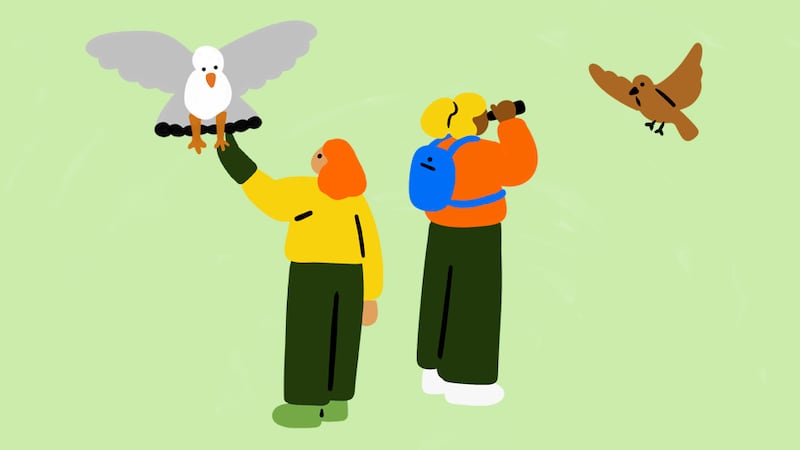
There are more than 450 species of birds on Birdwatch Ireland’s list, and many are rare or unusual or migratory birds. Learning to identify even our most common garden birds deepens every experience of being outside. Hang a bird feeder in your garden or attach a suction feeder to your window and watch the birds come. If you want to level up your twitching, Birdwatch Ireland runs a citizen science survey open to everyone between December and February. By taking part, you can help provide information on how bird populations fare during the harsh winter months each year.
Dark sky observatories
One way to put pinging notifications into perspective is to look up, as far as the eye can see and farther still. Stars, planets and the mysteries of the cosmos can make the screens we spend so much time staring into seem dull. Ireland was once a leader in astronomical research, and for seven decades between 1845 and 1914, the observatory at Birr, Co Offaly, had the largest telescope in the world. Birr’s giant “Leviathan” telescope is no longer operational, but there are opportunities to stargaze through super-powerful telescopes at Ireland’s two other historical astronomical observatories at Dunsink Observatory, Dublin and Armagh Observatory, Armagh.


