
A few years ago, even amid motor industry experts, you’d have probably received only a halfhearted shrug of recognition if you’d mentioned the Brussels motor show.
In 2026, though, Brussels has emerged from the shadow of the now-defunct Geneva motor show and is suddenly home to all manner of exciting new vehicle and concept car debuts.
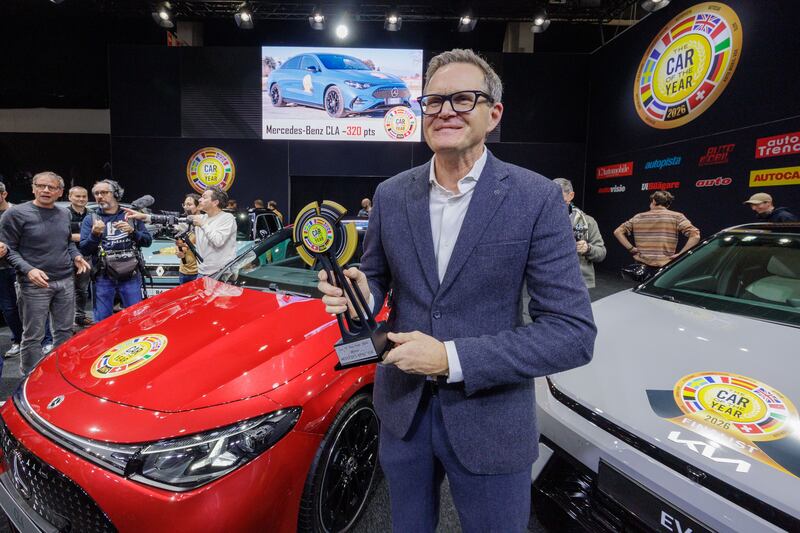
And, of course, the announcement of the winner of the European Car Of The Year, about which you can read more here.
First up at Brussels, when it comes to new metal, is the Kia EV2.
READ MORE


We’ve seen the EV2 in concept form before, and aside from the position of the rear door hinges, this production model is pretty much as-was.
It gets a more sober interior, of course, even if the cabin is still quite stylish and draws on the EV3 and EV4 for both inspiration and components.

Kia wants the EV2 to compete with all-electric cars like the Renault 4 E-Tech and the incoming new BYD Atto2, as well as the likes of the Toyota Yaris Cross hybrid, so it’s targeting a price of less than €30,000 in most European markets for the most basic trims.
You’ll be able to choose from a 42kWh battery with simpler, cheaper lithium-iron phosphate (LFP) chemistry and a range of 310km, or a larger 61kWh nickel-manganese-cobalt (NMC) battery with a range of almost 450km. Interestingly, the basic model gets more power – 145hp against 135hp for its front-wheel drive electric motor.
[ Mercedes-Benz CLA crowned Europe’s Car of the Year 2026Opens in new window ]
It’s also the first Kia to get the option of 22kW AC charging, thanks to its focus on urban driving, so as to make better and faster use of medium-power kerbside chargers. The big dashboard screens look familiar from other Kias, but the EV2 gets a simplified and more affordable software set-up, as well as plenty of physical buttons.
There’s a 362-litre boot, which is smaller than that of its Renault rival, but the Kia is roomier than the R4 in the back, and there’s the option of a two-seat back seat layout, with reclining backrests.
This is the sixth of Kia’s all-electric models (seventh if you count the all-battery Niro, and eighth if you have an old Kia Soul EV knocking around), and it’ll go on sale in Ireland later this year.
If that’s a bit too basic for your taste, Kia was also showing off the sporty 292hp GT versions of the EV3 and EV4, both of which come with four-wheel drive and acid-green paint for their brake callipers, as well as a pretend gear shift for a properly sporty feel.
There’s also going to be a GT version of the big EV5 SUV, with 306hp. While the smaller GT models will be quicker, the EV5 GT will get a clever camera system that monitors the road ahead for bumps and warns the adaptive suspension what’s about to happen.
So, that’s an affordable EV and some hot EVs from Korea. What about something a little more ... devilish? Supercars may not have been too thick on the ground in Brussels, but Alfa Romeo was showing some willingness, with the debut of its ‘Bottegafuorisere’ bespoke model division.

Think of it as being like Aston Martin’s ‘Q’ division, but for Italian saloons – Bottegafuorisere’s first car is a much-modified Giulia Quadrifoglio saloon, named ‘Luna Rossa’ after a yacht racing team.
It gets a wild carbon-fibre aerodynamic bodykit, but keeps the standard 520hp twin-turbo V6 petrol engine. Only 10 will be made, so its relevance to Alfa’s future (still no electric Giulia, we note ...) is small at best, but its appearance pleased the motor show traditionalist in us.
Right, back to the electrics, and Mazda’s new CX-6e. In spite of appearances and expectations, this is not a cutting-edge new electric SUV. That will be related to the new CX-5.

Instead, this CX-6e is a taller version of the sleek 6e saloon, a car that Mazda makes in China in co-operation with Changan Motors. It looks smart – especially in the new ‘Nightfall Violet’ colour scheme, and the huge 26-inch touchscreen on the dash raised a few eyebrows. However, Mazda may have missed a trick, as the CX-6e gets only a 78kWh LFP battery, with a range of just 484km. That’s considerably less claimed mileage than the Audi Q6, with which Mazda ambitiously reckons this car competes.
Chinese brand Zeekr – part of the same Geely group as Volvo and Polestar – was at Brussels, showing off a fastback rival to the VW ID.7 and Hyundai Ioniq 5 badged as the 7GT. Think of it as a more affordable, all-electric Porsche Panamera and you’re getting the idea.

You can choose between basic 75kWh and bigger 100kWh batteries, with the latter offering a devilish (that word again ...) 666km range on one charge. That range figure is almost secondary to the whopping 450kW DC charging speed that allows a 10-80 per cent top up in as little as 13 minutes. There are no official plans for Zeekr to come to Ireland just yet, but the 7GT has been confirmed for a UK launch, so right-hand drive models will certainly be available.
Brussels is still a relatively small show – around 300,000 people are expected to visit during the course of the event, compared to 500,000 for Munich or Paris – but with the continuing absence of the old Geneva show, and the gap that leaves for showing off new cars to European customers in the early part of the year, there’s plenty of opportunity for growth here.
Just like Switzerland, Belgium is a relatively neutral territory for car makers, with no indigenous brands. Better yet, compared to Geneva, Paris, Frankfurt, or Munich, Europe’s lawmakers are only a short hop and skip from the show halls of the Brussels Expo if some late-evening lobbying needs doing.


