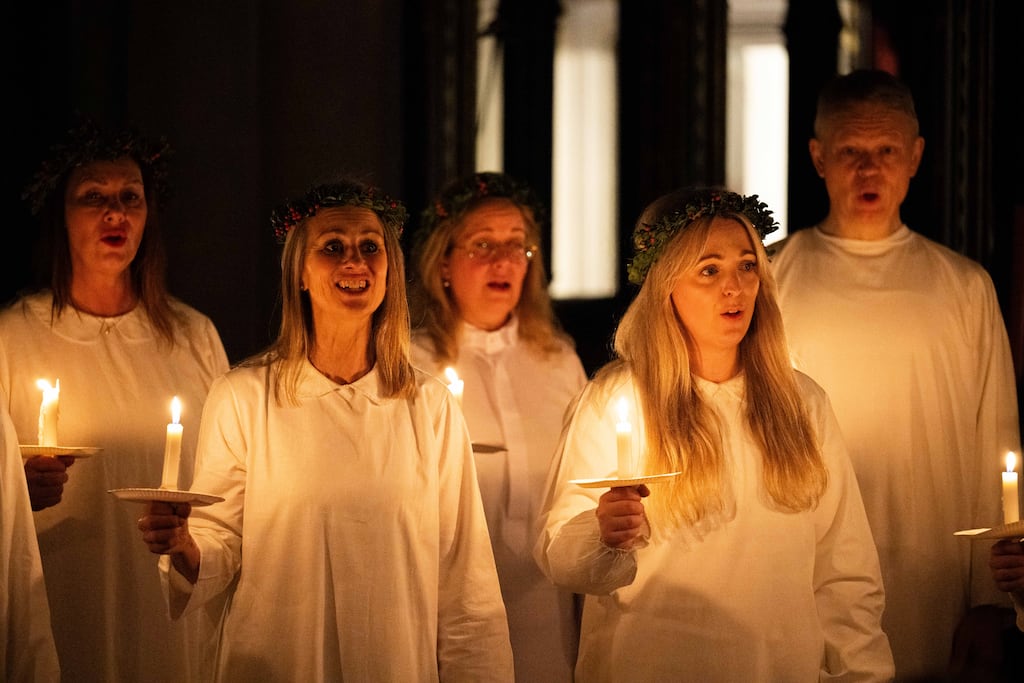
“Love came down at Christmas – love all lovely, love divine.” Perhaps, when it comes down to it, it’s Christmas carols that speak more forcefully than any sermon about what Christmas can mean to us.
Having been brought up in the UK as a somewhat heterodox Christian, attending church only occasionally and being aware, even as a child, of a variety of ways in which human beings can become aware of the divine, I found it hard to find any Christmas inspiration when I first settled into adult life in Dublin.
The Protestant churches seemed dyed in the wool, the Catholics obsessed with the Virgin Mary and the Sacred Heart. It was only ecumenical church services that spoke to me at all, probably because the clergy involved had to make an effort to communicate with all comers. The temptation was to give in to my husband’s preference for staying in bed on Sunday mornings with the newspapers.
That began to change when, as a journalist, I was sent to cover a charismatic conference in the RDS, probably around 1980. Here was some real life at last.
READ MORE


It renewed my desire to find some meaningful worship, though at first all I could find was a weekday communion gathering in Avila, open to all comers, which I attended with Catholic neighbours I had met at the RDS. That and weekly meetings of Al-Anon, which taught me more about compassion, self-awareness and divine guidance than any church.
When it came to Christmas, having despaired of my local Church of Ireland church, I ventured to St Paul’s Glenageary, hoping that the rector there would disclose something of the mystery of the incarnation. To my disappointment, he chose rather to entertain the children with Christmas stories, and the service as a whole was more formal than inspiring. But at least the carols were lovely. “O come to us, abide with us, our Lord Emmanuel!” Yes, here indeed we were approaching the mystery of the incarnation – and with beautiful music.
Exchanging the peace could take up to five minutes as people moved out of their pews to greet newcomers or reconcile with friends they might have offended
Less than 10 years later, in the summer of 1988, I was ordained to the diaconate in the Church of Ireland, and in 1990 to the priesthood.
What had happened? To cut to the chase, I had been led to a church, not too far away, which made the love of God known, not just in word but in action. You could say it had begun to incarnate God’s love.
Touched, but in no way disordered by the charismatic renewal movement, every word of the communion liturgy was as laid down in the prayer book; yet each phrase came from the heart as well as the lips of the clergyman presiding.
Rather than formal hymns backed by a droning organ, there were modern worship songs led by a group of musicians – not just guitars, but flutes, violins, a dulcimer and drums. Lay people were entrusted with leading the prayers and the congregation expected to throw in their own petitions.
Exchanging the peace could take up to five minutes as people moved out of their pews to greet newcomers or reconcile with friends they might have offended.
Yes, this for me was a revelation of what churchgoing needed to be – a sharing of God’s love and an invitation to be part of that love in our daily lives and relationships.
It was crucial as we accompanied my husband through his final illness. “When we get through this, I just want to do what you are doing for other people,” I remember telling the rector, in response to his prayer with us. Forty years later, I don’t think I have ever fully managed that, but at least it has been my aim, whether in parish life, in teaching, or my somewhat active “retirement”.
But at least it has been my aim: to make known and to express God’s love, mindful of the Celtic communion: “As the bread and wine which we now eat and drink become part of us, may we become part of you, bone of our bone, flesh or our flesh, loving and caring in the world.”
Christmas, the feast of the incarnation, prompts us to reflect on that love: on the Virgin Mary, so radically open to God that she risked all to obey his call and give birth to the child of the spirit; on the Christ child, born in a stable, threatened by government, forced into exile, yet aware at only a few years old that he must “be about my Father’s business,” on Joseph, who took Mary as his wife despite her pregnancy, trusting his dream that “what was conceived in her was of the Holy Spirit.”
The Christmas hymns, not only the Christmas scriptures, inspire that reflection:
“O holy child of Bethlehem, descend to us we pray,
Cast out our sin and enter in, be born in us today.”
Canon Ginnie Kennerley was one of the first four women priests ordained in the Church of Ireland in 1990


