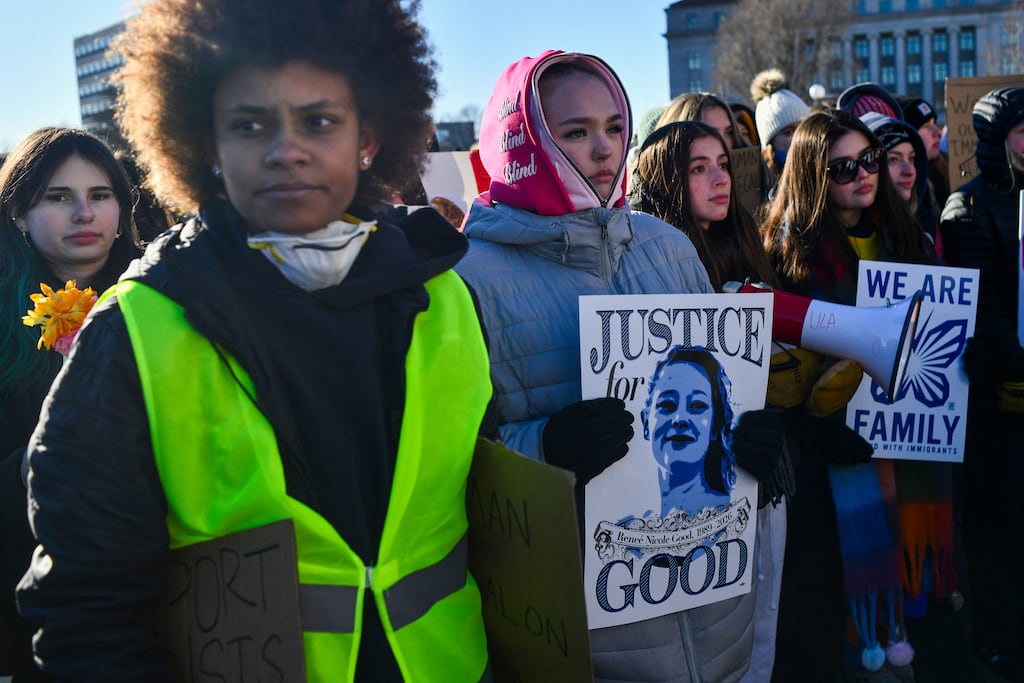
On the morning of January 7th in Minneapolis Immigration and Customs Enforcement (Ice) agent Jonathan Ross shot dead unarmed mother Renee Good, firing three rounds at close range as she attempted to navigate her vehicle at low speed away from him. Despite the administration’s insistence that he acted in self-defence, very few believe that his life was in any way threatened.
Protests against Ice and the Department of Homeland Security have been ongoing for years, with a significant uprising in Los Angeles last June and July. The agency budget has tripled since last year. Using an immigration policing apparatus increasingly staffed by zealots and worse, the Trump administration has carried out a series of provocations, from takeovers targeting cities such as Chicago to the construction of detention centres like “Alligator Alcatraz” and targeted sweeps on political dissidents like Mahmoud Khalil and Mohsen Mahwadi.
Investigative journalist Ken Klippenstein has published leaked documents revealing a sprawling network of secret Ice projects involving not just deportations, but large-scale surveillance and intimidation.
After Good’s killing, the administration doubled down. From their first term, they had learned that they were too weak and reactive to public opinion. This time, there are no apologies, no resignations and no mercy. Attorney general Pam Bondi accused Good, without evidence, of being a “domestic terrorist”, and homeland security secretary Kristi Noem ordered the deployment of hundreds more agents to Minneapolis.
READ MORE


It’s difficult to overstate the level of force being used against the city at this moment. One account describes agents “swarming our neighbourhoods in unmarked cars ... arresting and detaining people with no warrants or cause or justification other than being brown or black... bashing out people’s windows after traffic stops and dragging them out of their cars; knocking on doors indiscriminately and asking people for documents or to turn on their neighbours.”
Successive US administrations have deported millions of people. Barack Obama was nicknamed the “Deporter in Chief” for the 2.4 million expelled. The current government seems driven as much by the goal of inflicting humiliation and terror as by numbers. For an administration obsessed with symbolism, the fact that Good was killed a mile from where George Floyd was murdered in 2020 is surely significant, a chance to rewrite the defeats of the past.
White House deputy chief of staff Stephen Miller has declared that all Ice agents have complete federal immunity from prosecution. Not only has Ross not been indicted, but the FBI is attempting to press charges against Good’s wife. The message is clear: the state has absolute power to kill those it deems enemies and any oversight is tantamount to treason. If an agent of the state kills someone, it is the immediate legal problem of everyone present except the agents themselves.
Against this assault, opposition is building strength. Demonstrations have spread from large cities to small towns. We haven’t yet seen the numbers taking to the streets in protest as during the Black Lives Matter summer of 2020, the Gaza genocide, or even the anti-Trump No Kings marches. Instead, we are seeing two important shifts: a hardening of opinion and tactics among the politically engaged, and a broader spread of disgust with Ice among the public witnessing its actions on their phones.
It is winter, and protest cycles in the US tend to spike in the summer months. Activists may be realising that, no matter how large their marches, such demonstrations have proven to be ineffective by themselves. At a local and national level, new organisations are being created to resist Ice overreach and to abolish the agency altogether, a position that enjoys narrow majority support, according to the latest polls. The creation of a reliably anti-Ice voting bloc, with a core of activists, would be novel in an electorate that has historically swung wildly on immigration.
The challenge will lie in how to translate public support for abolition into concrete action. Even if Democrats retake the house, senate, and presidency, mustering the votes for such a move would be immensely difficult for a party not strong on backbone. A more likely outcome is some budgetary oversight and a package of “reforms” that would do little to disempower a now semi-autonomous branch of the state security structure.
A pervasive and escalating sense of chaos has engulfed the US over the last year. State killings are nothing new, but it now feels as though all guardrails have gone and the nation is governed entirely by what the administration can get away with. There has been a near-total breakdown of public trust in institutions previously seen as apolitical, or at least whose politics were mediated through predictable processes.
Agencies staffed by young, far-right “groypers” pump outovert white nationalist propaganda and repost lurid videos of conspicuous cruelty. The government is pulling on every lever of power, with no apologies or expectation of being believed in their justifications.
At the centre of everything is Ice, an already powerful agency transformed into the president’s personal enforcement wing. This has resulted in a vertiginous mood, which is even affecting the apolitical. A feeling that things were out of control contributed to Joe Biden’s defeat, and portends a similar loss for Republicans in November, assuming elections happen under relatively fair conditions.
These next months look set to be the most dangerous yet, as an administration running out of time sees just how far it can go.
- Jack Sheehan is a writer based in New York


