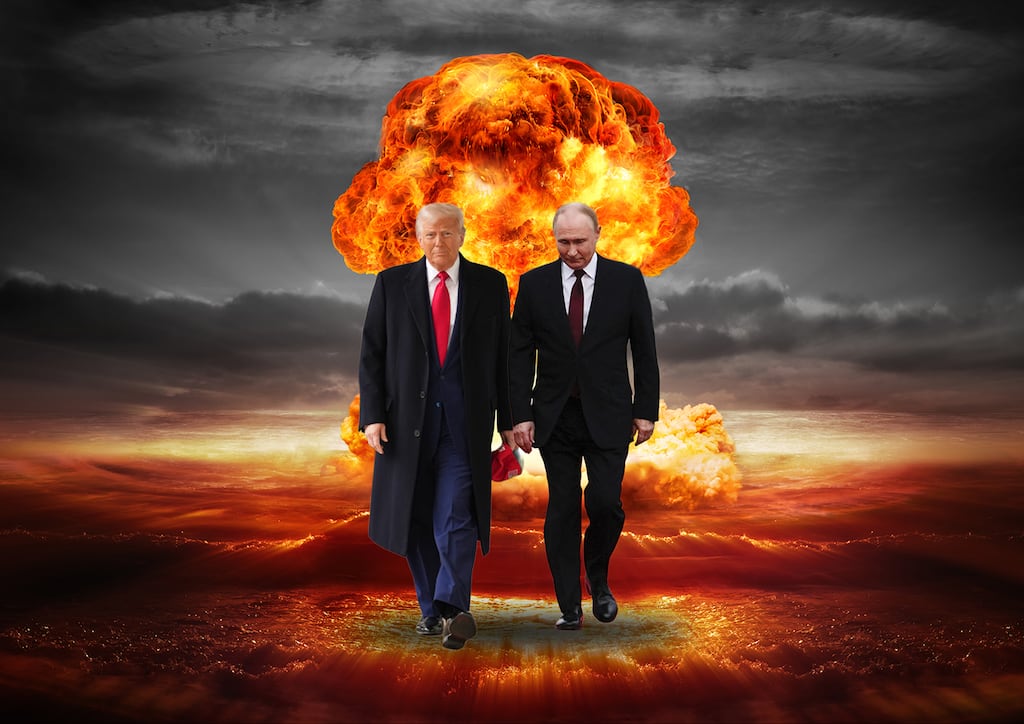

Have we lost our fear of nuclear weapons? Have we become complacent and started to believe they are never going to be used?
And have we lost the widespread sense of imminent catastrophe engendered by the Cuban missile crisis – along with the real fears that brought one million people demanding nuclear disarmament to the New York streets in 1982, the largest demonstration that country has seen?
Does the possibility of accidental launch and devastating retaliation, or rogue state proliferation, no longer terrify us?
These are the questions Kathryn Bigelow asks in her chilling and timely film, A House of Dynamite, about the immediate response to a nuclear attack on the US: “I feel like nuclear weapons, the prospect of their use, has become normalised. We don’t think about it, we don’t talk about it.”
READ MORE


They are the questions Europe’s political class were articulating at last weekend’s Munich Security Conference. Rearmament in the face of Vladimir Putin’s warmongering was discussed, as was the sense that Donald Trump’s America will no longer stand by its security guarantees. Talk of European conventional rearmament also saw both German chancellor Friedrich Merz and French president Emmanuel Macron address a European nuclear deterrent in their speeches.
But not everyone is on board. Spanish prime minister Pedro Sánchez admitted that Europe must get stronger to deter Russia, but said: “I strongly believe that nuclear rearmament is not the right way of doing it.”
The predominant assumption is that the deterrence myth – an irrational faith in nuclear weapons keeping the peace – is rarely challenged.
Ireland rightly supports a different approach, and makes the case that nuclear weapons are not just morally indefensible, and their use impermissible in humanitarian law, but also that the deterrence rationale is fundamentally flawed. The Treaty on the Prohibition of Nuclear Weapons (TPNW) has been endorsed now by more than half of United Nations member states. The Austrian rapporteur to the group speaks of the urgent “need for a paradigm shift away from nuclear deterrence” – a call echoed by Irish diplomacy.
The TPNW prohibits the development, testing, production, manufacture, transfer, possession, use or threatened use of nuclear weapons. It prohibits states from allowing nuclear weapons to be stationed on their territory and treaty parties from assisting, encouraging or inducing anyone to engage in any of these activities.
The credibility of the deterrence doctrine is more hotly contested than ever. Advocates present it as a stabilising force. Yet history shows that it has repeatedly led to crises that could have escalated into full-scale nuclear war. From miscommunications during the Cold War to recent threats by nuclear-armed leaders like Putin, deterrence has more often brought us close to catastrophe than it has prevented it.
[ A world without nuclear arms control has begunOpens in new window ]
Nuclear weapons have repeatedly not deterred conflicts involving nuclear-armed states. Nor have they deterred non-nuclear-armed states from attacking nuclear-armed states.
That is why the expiry this month of the US-Russia New Start arms control treaty, limiting each one’s deployed missiles to roughly 1,550, is so alarming. It is seen, as one commentator put it, as a “a death knell for more than five decades of arms control at a time of surging global instability”. It could potentially trigger a new arms race.
Neither country seems interested in extending Start, with Russia continuing to update its nuclear forces and China pursuing a huge nuclear build-up.
Trump is also talking about resuming nuclear testing – the US has observed the Comprehensive Nuclear Test Ban Treaty since 1992, even though the Senate never ratified it. Other nuclear states are likely to follow suit.
Start’s demise is a major blow to that other pillar of Ireland’s role in the UN nuclear debate, the 1970 nuclear non-proliferation treaty (NPT), which is up for review this year.
Under the NPT, states without nuclear weapons commit not to acquire them, as long as the weapons states made good faith efforts to disarm. But weapons states are doing precisely the opposite, while the US is walking away from its promises to protect them with its nuclear umbrella.
Supposedly complementing deterrence as a means of avoiding nuclear war, the creaking disarmament process has seen the world’s nuclear stockpile shrink from some 70,400 warheads in 1986, to 12,500 today in 50 years of treaties.
At the same time, while nine states, including Israel and North Korea, now possess nuclear weapons, that number could more than double in the next two decades. South Korea, Japan, Iran and Saudi Arabia have already expressed the aspiration to acquire them, while in Europe, the issue has been raised in Poland, Turkey and Germany.
There is a real danger of a resumption of that arms race. The bulletin of the atomic scientists has just moved its estimate of the risk of a nuclear conflict, the doomsday clock, to 85 seconds to midnight.
It’s time to wake up. If there was ever a time to return to the streets, it is now.


