As a rule of thumb Irish political leaders tend to be survivors. There is not the same tradition of prime ministers falling on their swords as there is in Britain.
Taoiseach Micheál Martin will next month reach the milestone of being leader of Fianna Fáil for 15 years – the second-longest holder of that position after Éamon de Valera.
His authority has come under pressure on several occasions since 2011, notably after the poor general election results in 2020 and the dismal showing in the Dublin Bay South byelection in 2021 when the party received only 5 per cent of the vote.
One party TD at the time said it needed “to ask the real, tough questions and that includes the leadership” in light of “the worst election in the party’s history”.
READ MORE



It was not the moment, as it turned out.
But might that moment be the review into the party’s shambolic presidential election campaign, particularly if it casts a harsh light on Martin’s judgment backing Jim Gavin, a successful GAA football manager but an untested political neophyte.
Weeks after the October 24th election, the promised report has yet to materialise and now looks like being pushed back until January.
The awkward squad of TDs and Senators who are critics of the leader has grown in numbers. But is there a mood for leadership change among the middle ground of the parliamentary party, who will be ultimate arbiters?
On the debit side for Martin, among 15 councillors across the State who spoke to The Irish Times, there was striking consensus that the campaign had been a disaster, that Gavin should never have been picked as the candidate and that the party’s membership and councillors had been totally excluded from having a say in the selection process.
On the credit side, none thought that Martin’s leadership was even remotely vulnerable in the short term, though some said the review, whenever it is published, could reignite criticism. Almost all agreed they cannot see Martin leading Fianna Fáil into the next general election.
One or two suggested the delay in the review being completed might suit the leader. In one off-record comment made to The Irish Times, one councillor says: “It’s curious that it has been kicked for touch because things fade as time goes by.
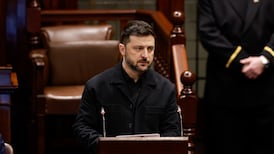
“There may be tactics there. He has also got opportunities such as meeting Zelenskiy,” the councillor says, referring to the Ukrainian president, who visited Dublin this week.
“The leader does have very good qualities and that allows him to remind people of what they are and hope things settle down again.”
Unsurprisingly, there is unanimity over Gavin being a poor choice.
“I’m a GAA man myself but I think Gavin was pushed on us over the Cork candidate,” says Conor Tormey, a councillor from Meath, referring to Billy Kelleher, the Fianna Fáil MEP who lost out to Gavin in the race to be the party’s nominee.
Cllr Donal Gilroy from Sligo has similar sentiments.
“I would never have been known for my footballing skills. My position was usually left outside. A friend of mine who would be a strong Fianna Fáil supporter and a football manager said to me: ‘He was as good at politics as you were at football.’”
Gilroy says there are some questions over Martin’s leadership, but past experience shows change may not happen quickly.
“There is a mood for change. But with Bertie Ahern and Charlie Haughey there was the same mood but it took a lot of time,” he says.
Martin “won’t go on forever”, he says, but adds: “I don’t think there’s a mood to go changing just at the moment. I think he will be the one who will ultimately look at the writing on the wall and make the decision.”
South Dublin councillor Emma Murphy is from a younger generation that has never had the chance to campaign for a Fianna Fáil presidential candidate. She says that what happened in the autumn was very frustrating. She now believes the party needs “to take our medicine and move on”.
“The frustration didn’t linger. I was a little bit surprised at it,” she says.
Her view is there is no immediate threat to Martin’s leadership.
“He was the person who steadied the party. He took over the reins when it wasn’t popular to be leader. That has to be recognised.”
She adds that the faults around the campaign are wider than the leadership question alone.
“As a party we have to take responsibility for the fact that we didn’t have the proper structures in place,” she says of the candidate selection process.
Kerry councillor Norma Moriarty also has strong views on the shortcomings of party processes.
“There was a lot of disquiet and criticism of a process where people felt locked out of. I would hope the lesson is this: can we please have a more robust process going forward in terms of choosing a presidential candidate and engage the party membership in that?” she says.
Moriarty believes the issue of leadership is now live, though it might not be settled for some time.
“Micheál Martin has done an exceptionally good job as leader for a very long time. It is blatantly obvious the conversation of his successor has well and truly started,” she says.
“Succession planning is a healthy thing in any organisation. It is important that if people have ambition, they have a sense that that ambition can be realised.”
For some councillors, the debacle is very much in the rear view mirror.
“There was a lot of giving out already during the campaign and after the campaign,” says veteran Laois councillor Séamus McDonald.
“Time is a good healer. It has faded away a lot now because I travel around a lot and I haven’t heard any comments or criticism at all in the last few weeks.”
Galway city councillor Alan Cheevers shares a similar view; he says the presidential election is a “distant memory” for the people he represents.
“All they’re interested in is how they’re going to get houses, how they’re going to get a rental property, how they’re going to get on the property ladder,” he says.

Gary Murphy, politics professor at DCU, is the biographer of former Fianna Fáil leader Charles Haughey, who survived multiple heaves and crises. He sees similarities between Haughey and Martin, especially in their devotion to politics.
“CJH could not conceive of what life would be like if he wasn’t at the heart of things politically and I’d say that Micheál Martin is the same,” says Prof Murphy.
He says he heard serious internal disquiet over the fiasco in the immediate aftermath of the presidential election.
“If there had been somebody to wield the knife, he could have been in trouble,” he says.
That moment has seemingly passed. Prof Murphy is of the view that there is enough respect internally within the party to ensure Martin remains at the helm for the European presidency in the second half of 2026.
After that he sees the prospect for change.
“I just can’t see him leading the party into the 2029 election at the age of 69,” he says. “Despite his Spartan lifestyle, he’d simply be too old.”