In October, on the eve of the presidential election, Catherine Connolly sat at a long table in the Galway Bay Hotel, flanked by the leaders of each of Ireland’s most popular left-wing parties. It was a high point for the nascent left alliance.
Before a single vote was cast in the election, Sinn Féin leader Mary Lou McDonald had stood and called for a left-wing coalition to “send Fianna Fáil and Fine Gael packing”. Paul Murphy of People Before Profit said those present had “a responsibility” to provide a credible left alternative in the next general election.
Luke ‘Ming’ Flanagan, the Independent MEP, had managed to finagle himself a spot at the top table. He described uniting the left as being as difficult as “getting a whole lot of butterflies into the one bubble”.
Despite the success of Catherine Connolly in the presidential race and her installation in the Áras, over the past two months, Flanagan’s ominous diagnosis has proved true, at least on the party-political level.
READ MORE


Sinn Féin, Labour, the Greens and the Social Democrats have already indicated that they will field candidates at the first test for any new era of co-operation: the upcoming Galway West by-election to replace Connolly herself in the Dáil.
On a grassroots level, some of the momentum of the presidential campaign has carried on. Several of Connolly’s key lieutenants founded Tonn na Clé, an organisation of activists and organisers, which has been busy.
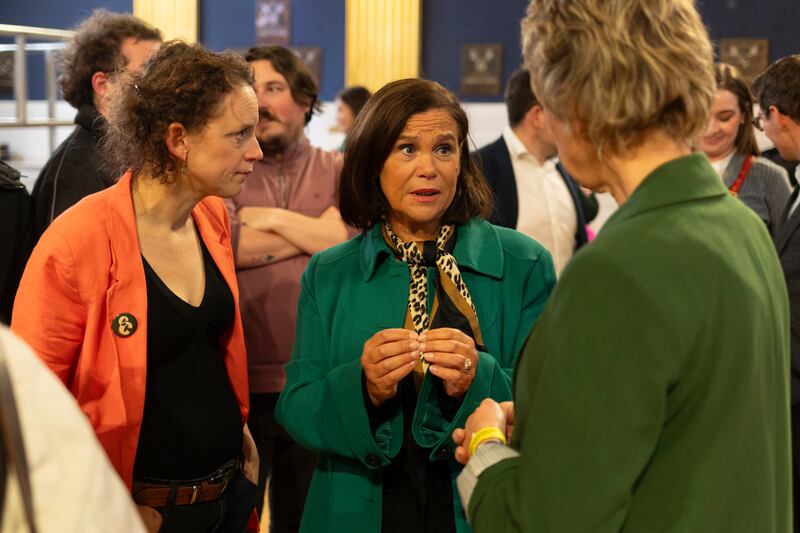
In the two months since the presidential election, Tonn na Clé have hosted more than 10 actions in Galway city, including mass gatherings on issues such as neutrality and homelessness.
It has formed a core group of more than 300 members, including all the left-wing members of Galway City Council, and through them has managed to have motions passed in the local authority on both the Occupied Territories Bill and Irish neutrality.
While its core membership is currently largely Galway-based, a number of Catherine Connolly’s election team from other parts of the country have joined.
Founding member Michelle Ní Chléirigh describes Tonn na Clé as a “private network” of the left, rather than a political party.
“It’s kind-of a hyper-democracy, a true democracy. A citizen’s assembly that is activist-born and comes from the grassroots,” she said.
“It is an effort to unify the left at a grassroots level and in parallel the political parties themselves would also unify, in terms of creating the foundations for a left government.”
Talk of an agreed candidate for Galway West came to nothing, but a “Vote Left, Transfer Left” ethos is crystallising under Tonn na Clé
In practical terms, this will see all non-aligned members of the group canvassing for vote-left transfer-left. In the more crowded field of a Dáil by-election, maximising the power of a left-wing vote down the ballot can prove more important than in the Áras race, whether Connolly effectively faced only one opponent, a Fine Gaeler.
Members of left-wing parties may also give two canvassing days a week to canvass under this banner.
“[We are] trying to be that glue between the political representation and the people on the ground. So that we can amplify when there are various bits of policy that need to be given voice to,” said Ms Ní Chléirigh.
“When elections come up, like the upcoming by-elections in Galway and Dublin, we will be campaigning for vote left, transfer left.
“We anticipate that there will be multiple left candidates and what we are trying to do is ensure there is an engine underneath a strong, united left.
“When policy comes up that we need to get enacted into legislation, [we want to ensure] that the right representatives are in place and that they are proposing the policy that needs to be there to represent all of our marginalised communities.”
One person who could benefit from such a left-wing “engine” is independent city councillor Eibhlín Seoighthe.

The former Social Democrat was the co-convener of Catherine Connolly’s presidential campaign in the Galway area, and an option for an agreed left-wing candidate, if the alliance had held.
Ms Seoighthe, who will announce if she intends to contest the by-election in the new year, says it may take some time for this left-wing energy to transfer from the grassroots to mainstream politics.
“Shortly after the election I reached out to all the political parties,” she said. “Sinn Féin were the only one that I couldn’t get hold of. I spoke to the other parties about the potential of getting behind a united left candidate for the by-election. I felt there was an appetite for it.”
“My hope and my optimism for all the parties getting behind a left-wing candidate is gone,” she added, though she said discussions about left transfer pacts were ongoing.
Despite this apparent setback, Ms Seoighthe says there is plenty of momentum in the left.
“There is a whole community of people who want to continue doing something, but the question is how do we navigate that space and what does it look like?” she said.
“If you remove the political aspect from this, I don’t think the momentum is gone. Forget about seats, the presidential election brought a whole lot of people out who never thought they would see themselves activated. They are still trying to figure out what is next for them.
“I think there is a foundation for more long-term change to come out of this.
“There could be something more to this that has a long-term impact. Maybe not for this by-election, but maybe for the next general election or for the local elections.”