Catherine Connolly won the Irish presidential election last year for many reasons, some of which may take time to decipher. However, her stances on Irish unity, on the Irish language, on the very issue of identity, are among those reasons. Such identity questions will become more important in coming years.
One of the enduring consequences of the departure of the United Kingdom from the European Union has been to put the question of Irish unity back on the political agenda on the island of Ireland. That debate is happening against the backdrop of a changing identity landscape across the island. Much has been made of the rise of the so-called middle ground in Northern Ireland – of those who do not identify with traditional “unionist” or “nationalist” labels.
These “others”, we are told, will be pivotal to the outcome of a unity referendum. But, beyond arithmetic, what does this shift mean at a deeper level for the idea of Irish unity? Does an identification as “others” find expression in the Republic of Ireland?
If so, how might non-traditional and emergent patterns of identity – both North and South – shape the process, outcome and aftermath of a potential border poll?
READ MORE


The ‘others’
The number of Northern Ireland voters who identify as “neither nationalist nor unionist” has increased markedly. Indeed, the Northern Ireland Life and Times (NILT) surveys demonstrate that “neithers” have been the largest single group in Northern Ireland since 2006 – not unionists or nationalists.
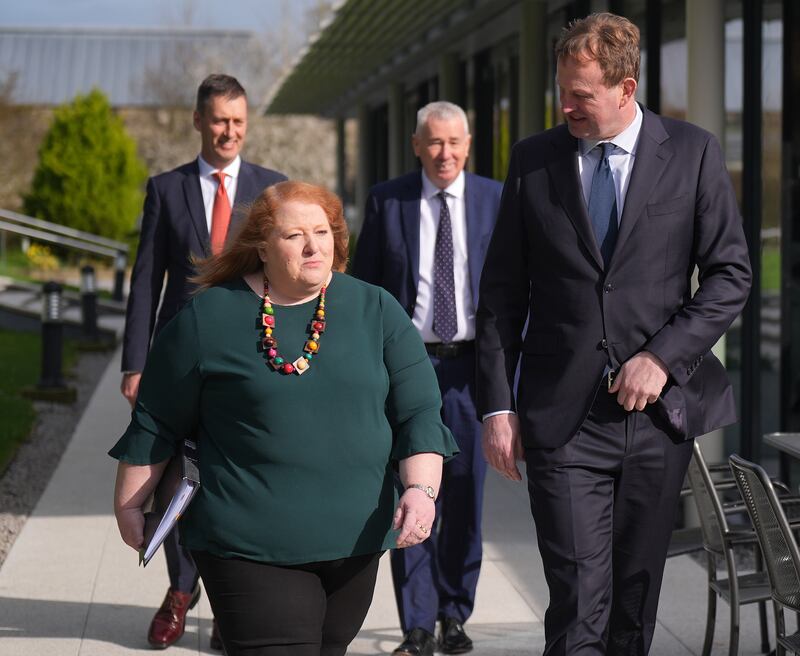
The Alliance Party, which aligns with neither nationalism nor unionism and was once a marginal player, is now the third-largest party at Stormont, behind Sinn Féin and the DUP, even if recent polls point tosome dangers for the party.
But what does this mean for the Republic? There is no such category as “others” in the South. Yet, if we look more closely, there are striking points of convergence taking place in identity trends on both sides of the Border.
Detailed research from Arins (Analysing and Researching Ireland North and South) reports that support for Irish unity in Northern Ireland has grown slowly but steadily since 2022, from 28 per cent to 34 per in 2024. Support in Northern Ireland for remaining in the United Kingdom in the same period fell slightly, from about 50 per cent to 48 cent.
However, the research shows that there are large difference between Protestants and Catholics in Northern Ireland on the issue, with 82 per cent of Protestants saying they would vote to remain in the UK, and just 7 per cent opting for unity.
In the Republic, 64 per cent would vote for Irish unity, 16 per cent would vote against and about 13 per cent are undecided, according to the polling.
However, the Arins surveying indicates that some different attitudes to the holding of a referendum, as distinct from whether it should pass, exist, with 81 per cent of Catholics in Northern Ireland supporting the holding a referendum, but also 40 per cent of Protestants.
Points of convergence, North and South
The changes taking place on the identity question will have consequences for relations between the two parts of the island, and for the political future of the whole. For a start, both show an increasing detachment from traditional forms of nationalism, and a distancing from those political labels.
In the South, nationalism has changed in intensity and form. Since the foundation of the State, there has been a move away from a more hardline nationalism, in society and politics, and towards a tacit acceptance of partition, without diminishing the appeal of a united Ireland.

Recent Arins survey data demonstrates that a majority in the South continue to aspire to Irish unity, but levels of support are contingent and conditional on cost and other factors. Over time, this more gradualist form of Irish nationalism has taken on a “civic” and banal character that – notwithstanding the recent rise of far-right nationalist movements – reflects a more inclusive, diverse republic.
Beyond national identity, both parts of the island have changed socially and economically, in line with the rest of the world. Both have experienced secularisation since the 1960s and 1970s, rapidly since the 2000s. Economic trends have followed distinct but similar trajectories over the past 30 years. Migration patterns in both jurisdictions are comparable, with a steep increase in immigration in the 2000s breaking long periods of ethnic and racial homogeneity.
If asked in a referendum, a large number of voters will be most swayed by hard-headed calculations rather than identity appeals
Social attitudes have undergone transformation across the island. The rise of social liberalism – shown by votes allowing for marriage equality and abortion – has been a defining force in the politics of the Republic, while a new “liberal/conservative” cleavage has formed in Northern Ireland politics on social issues such as LGBTQ+ rights.
Party politics North and South can appear like parallel universes. Yet even here there are similarities. Parties of the expanding “centre-ground” in Northern Ireland and those of the political mainstream in the Republic strike a surprisingly similar tone when it comes to Ireland’s constitutional future.
Our analysis of Fianna Fáil and Fine Gael’s handling of the unity question post-Brexit finds echoes of the Alliance Party’s messaging in Northern Ireland. The principle of consent and commitment to the Good Friday Agreement is placed to the fore, with discussion about the future couched in the language of peace and reconciliation.
Implications for Irish unity?
So, what does this convergence mean – if anything – for the prospect of Irish unity? While we cannot know the precise impact, it has implications for the process, outcome and aftermath of any change.
The diversity and fluidity of identity shows that citizens must be involved in the unity debate. Research by UCD and University of Aberdeen colleagues shows a strong appetite among voters traditionally less engaged in formal politics – women, migrants and the young. However, they want “bread and butter” issues, such as health, housing and childcare, to be placed to the fore in that debate, beyond issues of “high politics”, such as the institutional design of a new Ireland, or future defence arrangements.
[ Majorities in North and South favour planning for Irish unityOpens in new window ]
The UCD-University of Aberdeen research argues strongly for the need for deliberative forums, such as citizens’ assemblies, and a more expansive agenda that encompasses issues of everyday welfare, ahead of constitutional doctrine.
For any future campaign on Irish unity, this fluidity equates to a substantial number of “floating voters” who are ripe to be courted by parties on either side of the debate.
The alignment in the discourse of parties such as Alliance in the North and Fianna Fáil and Fine Gael, suggests the potential for post-unity alliance, coalitions, or even mergers
For now, southern voters are more worried about the health service, housing, the economy and cost of living than they are about the question of constitutional change. If asked in a referendum, a large number will be most swayed by hard-headed calculations rather than identity appeals.
This has obvious implications for the messaging and tone party campaigns adopt. It could even exert a moderating effect, as parties such as Sinn Féin and the UUP seek to sell their agendas based on socio-economic interests rather than nationalist or unionist identity.
Given the large pool of non-aligned voters, “civic” parties in Northern Ireland, such as Alliance, will play a central role.
Without underestimating the potential for division, these dynamics could – an emphasis on the “could” – create the conditions for a more civic debate along the lines of that seen in the lead-up to the Scottish Independence referendum in 2014.
When it comes to the aftermath of constitutional change and the process of constitution-drafting and institution building, this analysis highlights the critical need to accommodate not just unionism and nationalism, but also the growing number who identify with neither tradition.
Such an outcome has practical implications for the design of government in a united Ireland, if one was accepted by voters – and there are many models, including power sharing between nationalist-unionist or Irish-British blocs along Northern Ireland’s current model.
Political parties could face change, too, in a world where “non-aligned” voters make up a majority. The alignment in the discourse of parties such as Alliance in the North and Fianna Fáil and Fine Gael, suggests the potential for post-unity alliance, coalitions, or even mergers.
With traditional political allegiances changing, there is more potential for integration between the party systems than has been considered up to now. With memories of the Troubles fading, that trend is likely to quicken, not slow.
The rise of so-called “others” and “neithers” in Northern Ireland should be noted in the Republic; it is one that adds complexity, nuance and multiple dimensions to the unity debate. Everyone should pay heed, including the new President.
Mary C Murphy is professor of political science and director of the Irish Institute of Boston College; Cera Murtagh is associate professor of political science and Irish studies at Villanova University, Pennsylvania. Their chapter “Civic Politics and Constitutional Change” is published in Political Change Across Britain and Ireland (Edinburgh University Press, 2025).