
When a flying enthusiast asked architect John Curran to design an extension for his home overlooking the Shannon estuary, he couldn’t have imagined the result. From a distance, it looks like an aircraft has gently touched down in the Co Clare woodlands without disturbing a single leaf. The smooth curved roof creates the impression that the house is floating among the beech, birch and sycamore trees before it rises into the sky again.
The original house, a four-bedroom detached bungalow, was built in the mid-1960s. The current owners bought it four years ago with a view to upgrading and extending it to better cater for their needs. The house is on a hill and they wanted to make use of the sweeping views of the Shannon estuary by adding a second storey.
“We wanted to get it up to modern standards but also wanted something unique,” they say.
This is where Curran, an award-winning architect, comes in. From Co Limerick, he knows the area well, and when he was talking to the homeowners about their love of the Shannon estuary, one of them told him he loved flying.
READ MORE


“A light bulb went off in my head,” he recalls.
Aviation history is ubiquitous in the area, between Shannon Airport, the flying boat history of Foynes, and Richard Crosbie’s balloon flight across the Shannon estuary in 1786. All that, combined with the mature woodland setting, led him to design Aerlong sna Crainn (airship in the trees), a house celebrating the joy of the airframe.
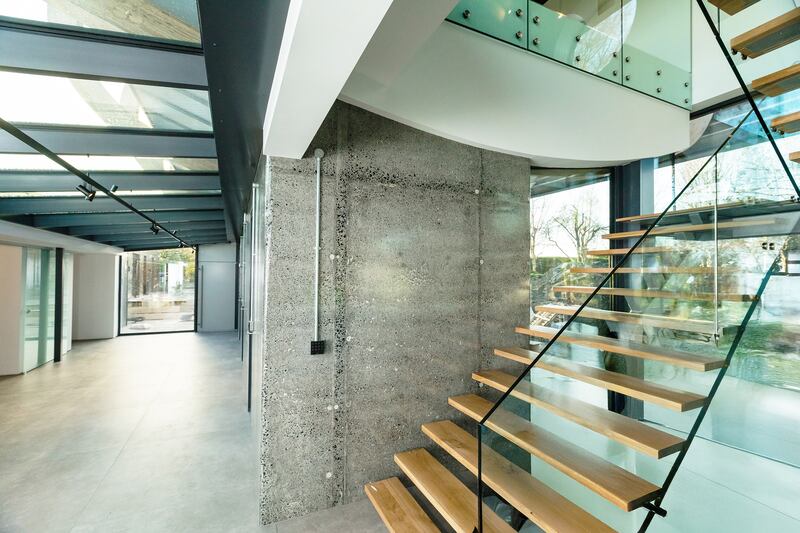
The original house, pared back into a slate box, is now the family’s sleeping quarters, while the floating airframe contains the kitchen, diningroom and sittingroom. A glass atrium joins the two buildings. The living area looks on to the estuary on one side, and the porthole windows drink in the views of the garden and woodland behind the house.
Small architectural details trace a path back to the beginnings of flight. “For example, the angel wing fabrics that stretch across the gable ends of the airframe are reminiscent of the early fabric gliders of Otto Lilienthal [the German aviation pioneer] of the 1890s,” Curran says.
Creating a sustainable building was a key priority for the architect, explaining why he chose wood-frame construction. “We want to demonstrate that we can make timber-frame structures that are just as innovative as what’s happening in Scandinavian countries and in Canada – countries with a centuries-long tradition of building in timber frame in northern climates.”


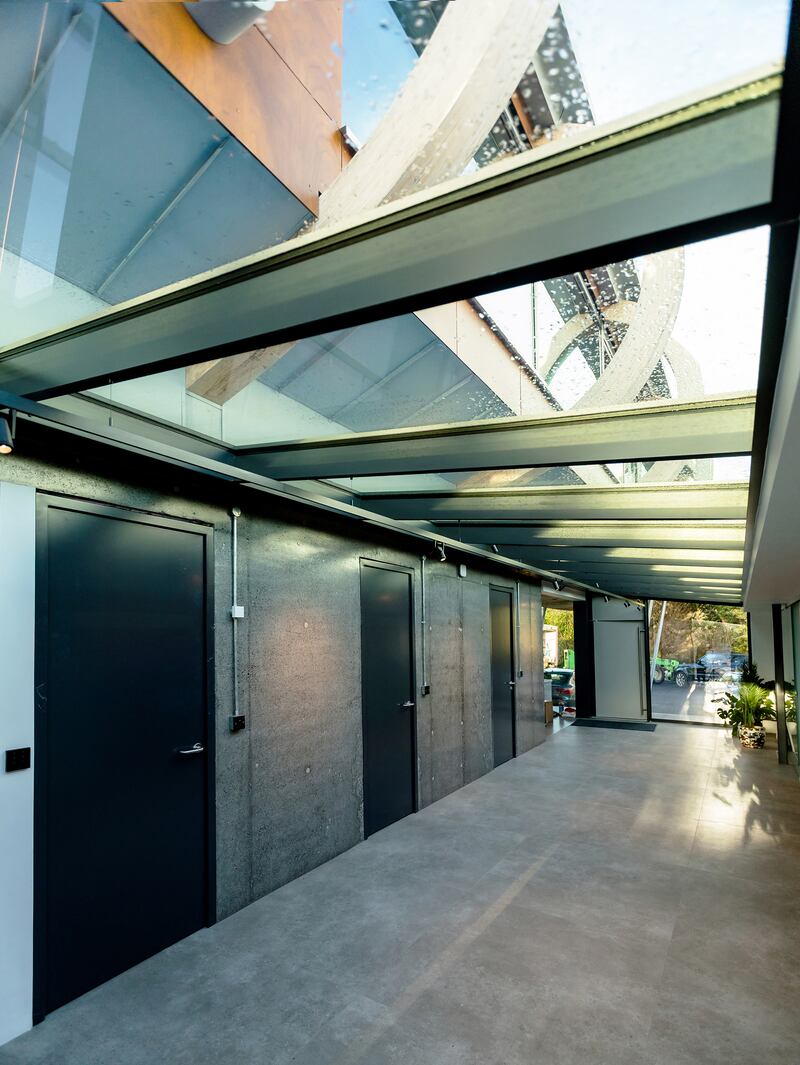
Curved glue-laminated larch ribs were clad in a matt grey zinc skin. He worked with SIP Energy, a family-owned timber-frame company in Galway, and says the industry is very fortunate to have a “coast of crafts” it can tap into along the south and west coast of Ireland.
The timber frame arrived on the back of trucks and was a weather-tight shell six weeks later. “The main challenge with this project was the retention and protection of all existing trees,” the architect says. “This restricted access. It was like playing a game of Tetris – carefully manoeuvring vehicles and plant equipment in and out on a daily basis.”
While the homeowners were aware that the architect was known for his sculptures in the landscape, they were still surprised by the design. “We thought his concept was a little bit out there at the start,” they admit. “But we decided to go for it and we love it.”.
When he presents his design to clients, Curran asks them to put on virtual reality headsets, which places them in their future home and allows them to see the views. “It gives a great feel for what the inside and the outside of the house is going to look like before planning the construction,” say the homeowners, who project-managed the build. “We were able to get the views of the estuary before the house was built.”
It may be a piece of architectural art, but the owners say it is also a very comfortable home. An air-to-water heat pump provides heating and hot water while a low energy mechanical ventilation with heat recovery system circulates fresh air and recovers heat from the outgoing air.
“We have PV solar panels which should be enough to supply all our electricity needs for the summer months and probably 35 per cent for the winter months so we are hoping it’s going to be quite economical to run,” they say. Their architect says its Building Energy Rating (Ber) of A1 is a remarkable result, considering that 50 per cent of the floor area is an upgrade of a property built in the mid-1960s.


Curran has spent the past two decades working on mixed-use projects in China, but has turned his attention closer to home in recent years. He is designing more woodcraft homes, including a homage to the currach, which has breathed new life into a 200-year-old farmstead at Whiting Bay in Co Waterford.
He accepts that his designs are not for cautious homeowners; but says he has only encountered progressively-minded clients who were on the same wavelength.
“Tapping into local storytelling and embracing natural materials, especially wood, is very compelling, and shows the heart is in the right place,” Curran says.
The Clare homeowners are certainly delighted they embraced his ideas. “It was an interesting build and a challenging build, but we learned quite a lot from it. It was a great experience overall,” they say.
Curran says delivering clients’ wish lists when it comes to rooms and layouts is the easy part of the job. “What takes a bit of time is teasing out the future life they want to step into, their dream life. As architects we are tasked with coming up with a vision that gives our clients a sense of belonging to a place – we belong here, this is our nest in nature.”
And while all projects are meaningful, he says this project was a particularly personal one for him.
“My father, who was sadly taken by cancer at the age of 36, learned to fly at the nearby Coonagh airfield,” he says. “I like to believe he would have enjoyed exploring this airframe.”
Biggest win
“The comfort of the house, and the fabulous views across the estuary,” the homeowners say.
Biggest challenge
“Co-ordinating the work of different contractors on site kept both me and the homeowners busy,” says Curran.