
In April 2024, my husband David and I stood in a field outside Eagle Pass, Texas, waiting. We knew that we were about to see something far older than ourselves.
Then the birds stopped singing. The temperature dropped. The light turned strangely metallic. And through a break in the cloud, the sun simply disappeared.
For billions of years, somewhere on Earth, the moon has cast its shadow across our planet. Long before humans were here to witness it, and long before anyone understood why it happened, eclipses came and went.
Every eclipse we see today is part of that same celestial rhythm.
READ MORE


On Wednesday, August 12th, that same celestial rhythm will play out again. This time, the path of totality crosses Iceland, Greenland and northern Spain. Ireland won’t experience minutes of total darkness, but we will see one of the deepest partial eclipses anywhere in Europe, with the moon covering almost 98 per cent of the sun in the southwest.
Unlike chasing eclipses abroad, this one asks little of us; a gap in the cloud, a clear line to the western horizon. That’s all it takes to reveal itself.
At a media briefing on the upcoming event, I asked the European Space Agency’s (ESA) director of science Prof Carole Mundell and solar physicist Miho Janvier how they viewed the eclipse. They framed it less as spectacle than a short window in which the sun shows us what it normally keeps hidden.
It seems improbable that something as small as the moon can hide something as enormous as the sun. But the sun is about 400 times wider than the moon, and also 400 times farther away, so the two appear almost exactly the same size in our sky.
A solar eclipse is simply the moon passing directly between us and the sun, briefly hiding its surface from view. “It’s a happy scientific coincidence,” Mundell said, “one that lets scientists study parts of the sun normally lost in its glare.”
[ ‘It’s beautiful’: Astronomers find atmosphere on a nearby Earth-like planetOpens in new window ]
Europe, Mundell said, is in the middle of “a lucky trio” of eclipses over the next three years: this one; a total eclipse in August 2027 crossing northern Africa and southern Europe; and another in January 2028.
When the moon blocks the sun’s brilliant surface, astronomers can briefly see what’s normally invisible above it: the chromosphere, which is the middle layer of the sun’s atmosphere, and the sun’s ghostly outer atmosphere, the corona. Sunlight leaking through valleys on the moon’s edge produces a beaded string of light called Baily’s beads. “A very human moment,” Mundell called it, as much as a scientific one.
We won’t see those phenomena here, but what we will see is remarkable in its own right.
For Ireland, the partial eclipse begins around 6.12pm, reaches its maximum near 7.10pm and ends by around 8.05pm. Coverage runs from roughly 93 per cent in the north to almost 98 per cent in Kerry and Cork, with Dublin seeing about 94 per cent.
Those percentages sound impressive but are misleading. Even at 98 per cent, the sliver of sun left uncovered is still dazzlingly bright. There’ll be no sudden darkness or stars overhead. Instead, daylight turns subtly unfamiliar, colours lose some warmth, shadows sharpen and the air may feel noticeably cooler.
One final variable: Irish cloud may not co-operate. If so, the ESA will broadcast live from Spain, with Mundell joined by science educator and BBC’s The Sky at Night presenter, Maggie Aderin-Pocock.


The last comparable eclipse here was 1999, when Dublin had 92-93 per cent coverage of the sun. The next total eclipse won’t reach Ireland until 2090, so treat this as a once-in-a-generation event. The sun sits low in the west-south-west throughout, so all you need is a clear view of the horizon.
Cloud or not, some sliver of the sun will always be exposed, so it is never safe to look at it unaided. It is bright enough to permanently damage your retina, even though you won’t feel it happening. Certified glasses marked ISO 12312-2 are the simplest way to view the sun. Sunglasses, however dark, are not safe.
Eclipses are shared experiences; for a couple of hours, people across the country will find themselves looking in exactly the same direction.
The ESA Education office here in Ireland, known as ESERO Ireland, is distributing limited free glasses and providing practical guidance on safe viewing of the eclipse. Without glasses, a pinhole in a card, a cereal-box projector, or a kitchen colander will each cast their own tiny crescent suns on the ground.
Observatories, science centres and community groups nationwide are opening their doors, and I’ll be among them, hosting a small gathering for families in Dundalk.
Dunsink Observatory in Dublin, which is not normally open to the public, is welcoming 120–130 ticket holders to view through its historic Grubb telescope. “We’re not just looking at the sun now,” says public engagement officer Sadhbh Leahy, “we’re looking at the sun always.”
At Birr Castle, up to 100 visitors will view the Leviathan telescope and solar instruments with physicist Jeremy Rigney.
In Cork, Blackrock Castle Observatory is keeping it simple. “We’re just encouraging everybody to be out and look,” says Niall Smith, head of research at Munster Technological University. Visitors can collect free glasses and join the observatory’s ‘Inspired by the Eclipse’ activity and evening of music.
Armagh Observatory and Planetarium is running a family festival with dome shows and tours, with many events already down to their last few tickets.
And Mayo’s Wild Nephin Dark Sky Park joins the national ‘Under One Sky’ programme, with astronomer Ronan Newman leading public viewing and a livestream.
For a full list of events, visit eclipse26.ie or the ESERO Ireland website.
[ Armagh space research could unlock the story of how life beganOpens in new window ]
For solar physicists, eclipses are more than spectacle and many spend their careers building artificial ones. Astronomers recreate eclipses using coronagraphs, instruments that block the sun’s glare so they can study its faint corona without waiting for the moon.
Solar Orbiter, the ESA’s sun-observing satellite, carries a coronagraph, flying closer to the sun than any previous European mission. Proba-3 takes the idea further: two spacecraft flying in precise formation, one casting a shadow on to the other to create an artificial eclipse hundreds of metres long in space. Together with the long-running SOHO (Solar and Heliospheric Observatory) mission, they’re helping improve the space-weather forecasts that protect satellites, communications and power grids on Earth.
Ireland has its own part in scientifically observing the sun on the day. Dunsink’s director, Peter Gallagher, will watch the eclipse from an Irish Air Corps aircraft, using a telescope built from spare parts of the Solar Orbiter and Proba-3 coronagraphs – a direct link between an Irish research flight and the hardware studying the sun from space.
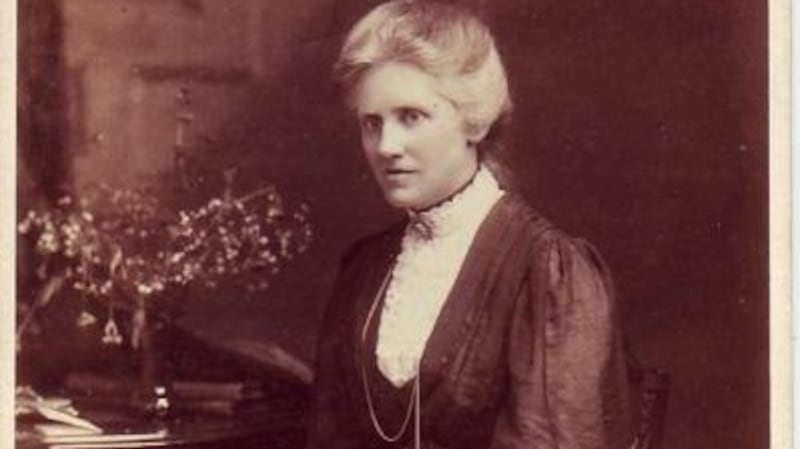
Long before spacecraft and coronagraphs, one Irishwoman spent much of her life chasing eclipses around the world. Annie Maunder, born in Strabane, Co Tyrone in 1868, worked at the Royal Observatory Greenwich in the 1890s. She travelled the world with her husband, British astronomer Walter Maunder, photographing eclipses. Their sunspot records produced the famous ‘butterfly diagram’ – the first evidence that sunspots migrate from the sun’s poles towards its equator during the sun’s roughly 11-year cycle. Their work still echoes through modern missions like Solar Orbiter.
However you choose to spend August 12th, I hope you’ll find a few minutes to observe the sun. Whether from your back garden, at a local event or simply on your way home, this is a chance to witness an astronomical event that people have watched for generations, long before any of us understood the science behind it.
For those four minutes back in Texas, what stayed with me wasn’t what I saw, but what I understood. We spend our lives feeling as though we’re standing still, yet we’re travelling through space on a moving planet, watching its moon briefly pass in front of our star.
Knowing that the same celestial event has unfolded throughout Earth’s history made those few minutes unexpectedly humbling. It reminded me how brief our own lives are, and how rarely we stop to think about our place in something so much bigger.
Niamh Shaw is an engineer, scientist and writer


