

Ireland’s global reputation in biopharma, built on world-class manufacturing excellence, is now being strategically amplified by a potent culture of collaboration between industry, academia, and the State. Stakeholders say this concerted, Government-supported effort is the critical engine driving the sector’s long-term resilience and global competitiveness.
Life sciences companies in Ireland benefit from collaboration with both multinational and indigenous firms, sub-supply providers, and a network of State-funded industry-focused research centres as well as partnership opportunities with the third-level sector.

“Collaboration between industry, including multinational, SME, FDI and indigenous, academia, Government and strong industry bodies, on shared goals has long been a hallmark of the life sciences sector in Ireland,” says Johanna McLoughlin, EY Ireland consulting partner and life sciences sector lead.
Maintaining and enhancing these collaborative relationships is expected to be a central component of the upcoming National Life Science Strategy, she adds. “The European Commission adopted the Strategy for European Life Sciences in July 2025, so this coupled with an ambitious strategy for Ireland in tandem with our EU presidency in 2026 would leave Ireland and Europe in good stead to continue to lead in global health innovation.”
READ MORE




Engagement in deeply collaborative research partnerships with industry drives innovation and helps deliver cutting-edge technologies and advancements, says Dr Aisling McEvoy, head of enterprise partnerships with Research Ireland.
“Critically, collaboration in this space specifically fosters needs-led innovation,” she adds. “That means ensuring that research aligns with real-world healthcare challenges and patient needs. The development of cutting-edge technologies leads to new products, services and treatments. This all helps to deliver sustained growth and resilience, by attracting global investment, scaling local enterprises and, in time, enhancing economic impact.”
There are a number of significant industry-academic cross-sectoral partnerships funded by Research Ireland. McEvoy explains that Precision ALS is an ambitious academic, clinical and industry research programme, providing new insights into the understanding of motor neuron disease (MND or ALS). It involves two Research Ireland Centres: ADAPT Research Ireland Centre for AI-Driven Digital Content Technology and the FutureNeuro Research Ireland Centre for AI-Driven Digital Content Technology, bringing together researchers in clinical science, data science and AI.
According to Maria Jennings of Enterprise Ireland, when companies undertake collaborations with research institutes, it can lead to the acceleration of breakthroughs in research and earlier commercialisation. “It also helps companies with talent acquisition, particularly if there is a gap in the market, bespoke training programmes can be developed by research partners to address the deficit,” she notes.
Jennings says collaboration between life sciences start-ups and healthcare providers can also provide early feedback from the clinical community on the product or service being developed; for example, the Health Innovation Hub Ireland is jointly funded by the HSE and Enterprise Ireland to support collaboration between the clinical community and early-stage life sciences start-ups. Another example is the €500 million Disruptive Technology Innovation Fund, where collaboration takes place between at least three partners – the consortiums must include one SME and one other enterprise partner.
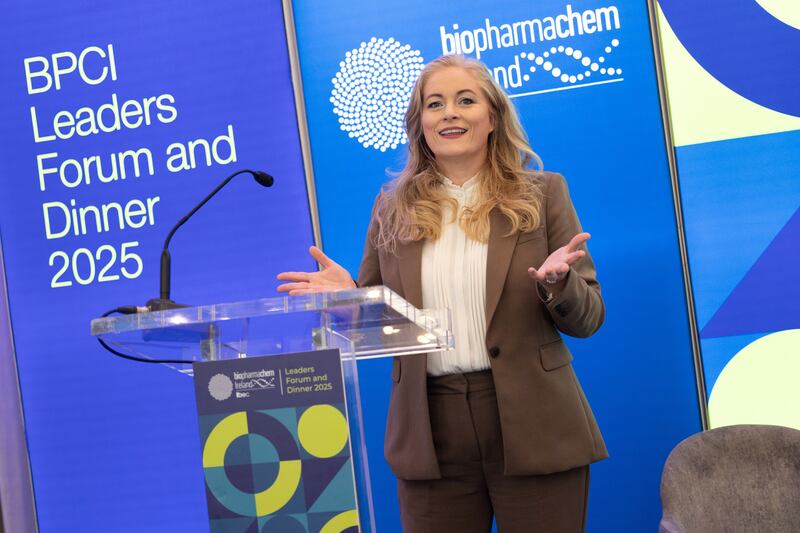
According to Sinead Keogh, director of BioPharmaChem Ireland, the cornerstone of Ireland’s collaborative research strategy in the life sciences space lies in Government-backed research centres like the SSPC (Research Ireland Research Centre for Pharmaceuticals) and NIBRT (National Institute for Bioprocessing Research and Training). “These hubs are not just academic institutions; they are magnets for FDI and accelerators for moving the sector decisively up the value chain,” she says.
Keogh points out that the economic returns of this strategic focus on collaboration are “indisputable”: the SSPC alone has been instrumental in attracting €3.7 billion in linked FDI and has delivered a remarkable €1.3 billion in economic impact since 2008, representing a stunning 26-fold return on core investment. “This collaborative model empowers major players like Pfizer, Eli Lilly, and MSD to pool resources, tackle complex, common manufacturing challenges, and drive sustainability and cost-effectiveness on a global scale.”
CÚRAM is another Research Ireland-funded centre specialising in the creation and translation of clinic-ready and patient-focused medical devices that will improve the quality of life for patients living with chronic diseases. “In a recent impact report, CÚRAM has achieved a 12-fold return on Government investment in 10 years, has collaborated with more than 47 companies and has trained over 1,000 researchers in the medical device field,” Keogh notes.

Life sciences companies also find themselves on a sustainability journey – this is one that requires extensive partnerships and collaboration between companies and technology providers, across the public and private sectors, in order to understand challenges and mutual opportunities in energy efficiency, decarbonisation and the shift to renewables. That’s according to Rhonda Doyle, country president of Schneider Electric Ireland.
“We work closely with academic institutions like Munster Technological University (MTU). We recently held an event at the MTU’s Bishopstown Campus in Cork that explored the real-world applications and opportunities of AI in the life sciences manufacturing sector,” Doyle explains.
Integral to these discussions was how companies are already collecting huge volumes of operational data from across their HVAC [heating, ventilation and air conditioning] and electrical systems to preserve energy usage. “This data is now being used to inform new AI models and intelligent systems to optimise energy management and apply a more intelligent approach to condition-based maintenance,” Doyle notes. “This data-led approach is also informing organisations on how best to decarbonise their operations, creating energy efficiencies and contributing towards lowering Ireland’s greenhouse gas emissions.”
The strategic focus on collaboration has resulted in what is a “truly globally competitive” ecosystem, Jennings says. “Collaborative relationships drive innovation, attract investment, develop talent, and position Ireland as a global leader in life sciences. They are essential for sustaining growth and competitiveness in this sector.”


