Spotting a three-up breach has become a strange obsession for those watching Gaelic football, and a breach one way or another is often a key talking point after a game.
Referee Séan Hurson missed one right before Damien Comer’s goal at the weekend. Conor Flaherty boomed a free high and long and John Maher won it around the halfway line, then offloaded to Comer, who carried 40 yards and rifled the ball into the net.
Seconds before, Comer had his hands out screaming for the breach while the possession was still being contested. Now, one could say “so what?”, since he went on to score a cracking goal from the same play. However, in an alternate universe, say one where Hurson whistled the breach and Shane Walsh went up and tapped the ball over to extend the Tribesmen’s lead to four points, would the remainder of the game have played out in the same manner?
Scoring a goal brings a huge emotional outpouring and can lead to riskier option-taking from both sides. It is also more likely that Comer wouldn’t have been targeted by Conor Carroll and Ruaidhrí Fallon on the next short kick out, which ultimately led to a two-pointer for Roscommon by Paul Carey. Who knows?
READ MORE


Back to what actually happened. As Comer rattled the net with less than 10 minutes of playing time left on the clock, and Galway in a comfortable six-point lead, you’d have expected a team who have notions of being All Ireland champions to see the game out.
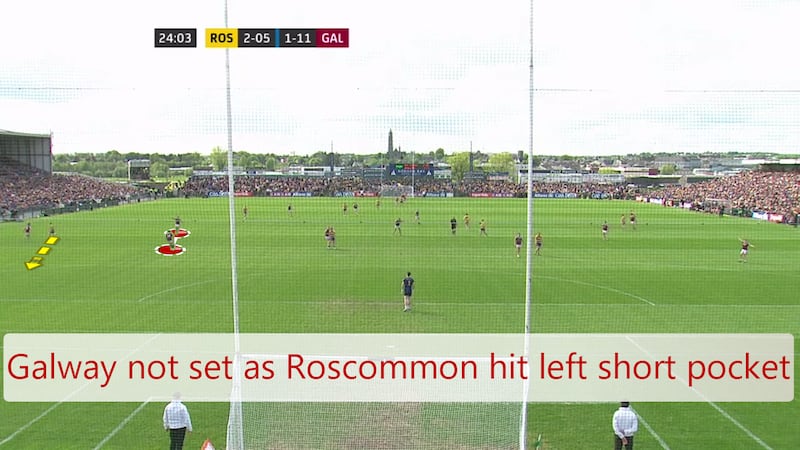
The next 10 minutes saw a failure of Galway to get hands on the ball in play. Carroll’s first kick out after the goal was hit into that pocket to his left, which Roscommon targeted all day and which really gave them an outlet in the first half of the encounter.
Carroll got the ball off there a total of 12 times across the contest. It was a massive Roscommon platform in the second quarter of the game, where they managed to get a foothold in the game, as they went short 10 times in a row, and those short restarts yielded 1-4. Over the course of the game this short kick out zone, highlighted in the image below, yielded 1-7 for Roscommon, a return of .83 points per short kick out.

It is the most comfortable place for a right-footed goalkeeper to get the ball off and it was an area Mark Dowd and his management team surely identified as a weakness in the Galway kick out defence. The images below, from over the course of the encounter, show poor set-up from the likes of Walsh, Rob Finnerty, Daniel O’Flaherty and Comer (following his goal).
There is merit in the line of thought that Roscommon looked to target players they viewed as defensively vulnerable on these restarts, and then worked the ball out through them. Both goals scored in the second quarter were run through O’Flaherty. The sole short kick out that Galway won was over on the right side of the arc. A more cohesive defence along the arc could have cut off these central and left zones and forced the ball to more contests around the middle – albeit this was an area that Roscommon also won, but not as glaringly.



Once the 61st-minute kick out after the goal was secured, Roscommon dominated possession for the remainder of the encounter. They reeled off 0-8, and clocked up a further two wides, to Galway’s solitary final desperation two-point effort. The-two point scores from substitutes Paul Carey and Daire Cregg were superb.

One of the areas of disappointment for Galway in the Pádraic Joyce era is how they have faltered on their own kick out. This must be particularly galling when Carroll, an Oranmore-Maree man, is giving a near flawless display in the goal at the other end.
Galway struggled on their kick out in the final 10 minutes as ball was sent to contests where Roscommon were hungrier. Galway only secured two from six kickouts (33 per cent) in this period and the two they won did not lead to meaningful possessions. They led to a sideline ball and a free and both times John Daly stood over the ball and, being presented with no options by his team-mates, resorted to blasting aimless long balls.
Given the lack of success in contesting ball, Flaherty attempted a short one to John Maher in the 69th minute – it had too much on it and went over the sideline. Whereas Galway lacked options from dead balls, Roscommon’s energy enabled them to work the sideline quickly and easily. Substitute Fallon got separation and showed for the ball before a slick hand-passing move finished with captain Diarmuid Murtagh tapping a point over the bar.
The move saw three subs get their hands on the ball, starting with Shane Cunnane on the sideline, then Fallon before a quick Cregg transfer gave Murtagh the easiest of scores. The energy off the bench for Roscommon was huge.

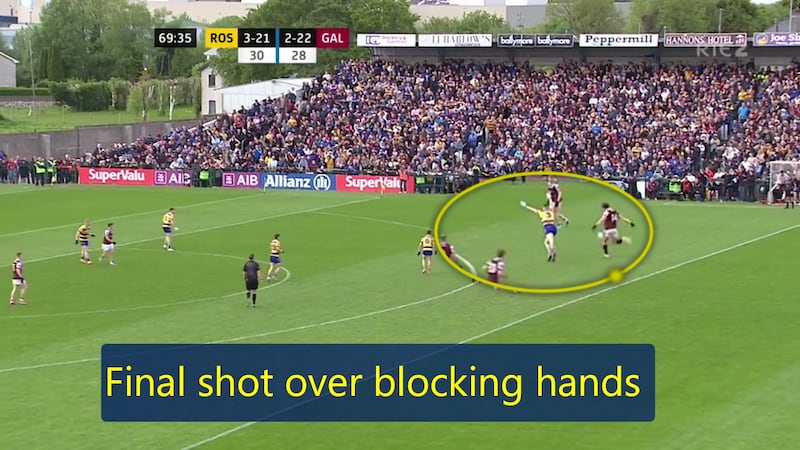
In the final play of the game, with a mere 50 seconds on the clock, Daly was finally presented with options when taking a line ball and Galway worked the ball to Walsh for a two-point attempt that, if successful, would have levelled proceedings.
This was a really interesting end game because it was very clear that only Walsh would be trusted with the shot. Everyone in Galway knew this, but so did Roscommon. John Maher travelled across the pitch in possession but Caelim Keogh stuck to his task of marking Walsh, even as Maher went right behind him at one stage. His efforts meant Walsh ended up shooting from that bit farther outside the arc, against the wind and over blocking hands. It was too much. Cue hysteria as Roscommon landed the Nestor Cup for the first time since 2019.
Paul O’Brien is a performance analyst with The Performance Process.