On your marks! It doesn’t matter if you’re trying to win it, or simply trying to finish it, at this stage all the hard work is already done for anyone running in Sunday’s Dublin Marathon.
The 44th staging of the event will effectively follow the same 26.2-mile route as last year, and remember, it’s definitely not a sprint. Each of the 22,500 runners (or walkers) will have their own different ambitions, but the same rules and guidelines apply to all.
Here’s everything you need to know to ensure the smoothest possible run on Sunday.
So, it’s effectively the same course as last year, right?
There were minor adjustments to the start and finish in 2024, with the new start line on Leeson Street Lower, shortly before entering on to St Stephen’s Green, with the finish moved to Mount Street Upper, just beyond the Pepper Canister Church. The intention is to keep this same course for the foreseeable future.
READ MORE


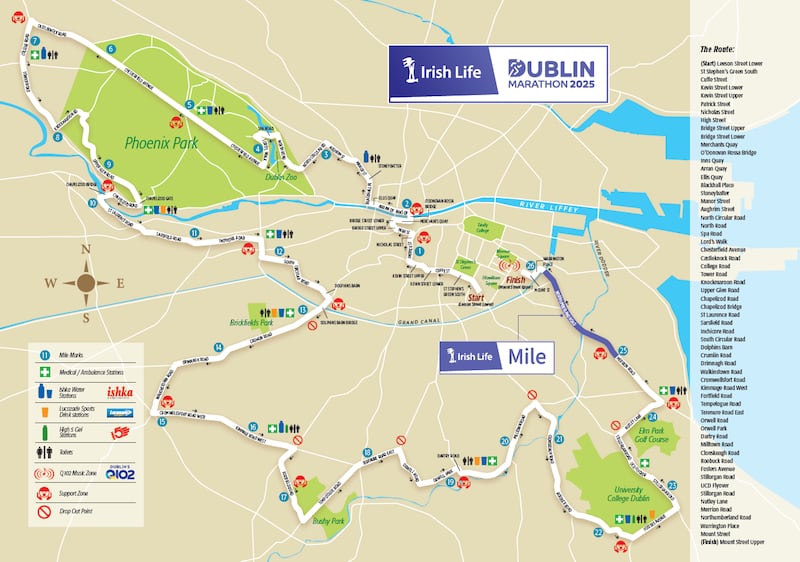
The most testing part of the course comes between miles 20 and 22, around Clonskeagh and Roebuck Roads, before a downhill along Fosters Avenue and (more or less) flat run to the finish.
What about getting to the start?
Parking anywhere near the start or finish area is off-limits, so most final approaches will be on foot. All runners and spectators are advised to use public transport where possible, with both Luas lines operating as normal.
However, Iarnród Éireann have again announced engineering works through the October bank holiday, limiting Dart and Northern Commuter services. On Sunday, the Dart will run Greystones to Connolly only.
What are the actual start times?
The event will have five start different times, beginning with the wheelchair participants at 8.40am and followed by the four different waves, each at 20-minute intervals
Wave 1 starts at 8.45am, wave 2 at 9.05am, wave 3 at 9.25am and wave 4 at 9.45am.
@theirishtimesnews The Dublin Marathon takes place this weekend. Here’s all you need to know Click the link in our bio for more #dublin #dublinmarathon #irish #ireland #marathon ♬ Run Like the Wind - Running
Plan to get to the start area about an hour beforehand, making sure all baggage is dropped off at Merrion Square.
And remember, the clocks going back in the early hours of Sunday morning also afford an extra hour in bed. Make sure you’re also familiar with the start area and race-entry routes.
The course will be open for seven hours, starting when the last person crosses the start line. When the seven hours are up, participants still on the course will be asked to move to the footpaths to allow for the roads to reopen.
What about picking up my race number?
You can do this in person at the Dublin Marathon Expo in the Main Hall of the RDS on Friday (12pm-7pm) and Saturday (9am-6pm). And remember to bring some form of ID (passport, driving license, student card, etc).
All packs must be collected by 6pm on Saturday. After all those long, hard miles clocked up in training, don’t miss out because of missing your race number collection.
And for the baggage drop-off at Merrion Square, only the clear plastic bags provided at registration are allowed.

Can I swap or giveaway my race number before Sunday?
Absolutely not. Race organisers have issued a strict warning against this, given all race numbers also act as an ID in case of any health or emergency issues. Number swapping also undermines the race results, particularly with men using women’s numbers.
Any participant found to have sold, transferred, or otherwise misused their race number will be banned (along with the recipient) from all future events organised by the Dublin Marathon, which includes other events in the Dublin Marathon race series and the Dublin Half Marathon.
Any chance of a late entry?
No chance. All 22,500 entries are long since sold out, with around 40,000 entry requests in all. There was a longer entry transfer window this year which organisers hoped would reduce the number of runners unable to make the start line.
What about moving from my designated wave start?
Wave positions are allocated by your predicted finishing time, and while moving up to a faster wave is not allowed (or recommended) runners can choose to move down a wave if they no longer feel confident about their predicted finish time.
It doesn’t make any difference in the end, as your start time only begins once you cross the start line.
How do the Dublin Marathon pace setters work?
Sticking with a pacer is a good idea for any runner confident about their target finish time. Dublin provides several different sets of pacers who run at a steady effort throughout, aiming to finish a few seconds under their given time.

Pacers are allocated to each wave as follows: Wave 1- 3:00, 3:10, 3:20; Wave 2 – 3:30, 3:40, 3:50; Wave 3 – 4:00, 4:10, 4:20; Wave 4 – 4:30, 4:40, 4:50, 5:00.
There is no requirement to sign up or commit to any pacing group in advance. Simply turn up at your wave start, look for the pace runners wearing large balloons, and follow the runner wearing your chosen time target.
Is it okay to run in fancy dress?
Like any big city marathon, Dublin welcomes runners dressed up in any outfit they like (especially those running for charity). But no matter how extravagant the fancy dress, your race number needs to be visible.
Those in fancy dress could also be subject to a search at the main entry points.

Is it better to track my progress in miles or kilometres?
It doesn’t matter what you’re counting – the 138,336ft or 60,000-odd strides for that matter – it doesn’t get any shorter, and there are certainly no shortcuts.
The Dublin Marathon is marked at every mile, every 5km, and at the halfway point. But remember, we know the marathon only really starts at 20 miles!
What about the water stations and other refreshments along the way?
Dublin has ample refreshment stations – 10 water stations in total. Look at the route map ahead of time and note their locations.
There will also be three Lucozade Sport stations, and High5 energy gels will also be supplied at two stations. But if you haven’t tried that brand before, Sunday is probably not the time to do so.
Where is the best place for family and friends to watch?
There are 14 Irish Life Support Zones along the course, as well at the Irish Life Mile, a designated support area for a one-mile stretch down Northumberland Road approaching the finish.
For those unable to attend on the day, the entire marathon will be live streamed on the Dublin Marathon YouTube channel. The Dublin Marathon app also offers live participant tracking.

What’s the weather set to be like on marathon day?
Sunday’s looking okay, cool and mostly dry, but do keep an eye out for any changes closer to the race.
The Dublin Marathon has been blessed with benign conditions in recent years, but the weather can always have a say. Last Sunday’s Cape Town marathon, a 24,000-runner sell-out, was cancelled just 90 minutes before the start due to high winds.
Whatever wind is blowing in Dublin on Sunday, may it always be at your back. Good luck to all!