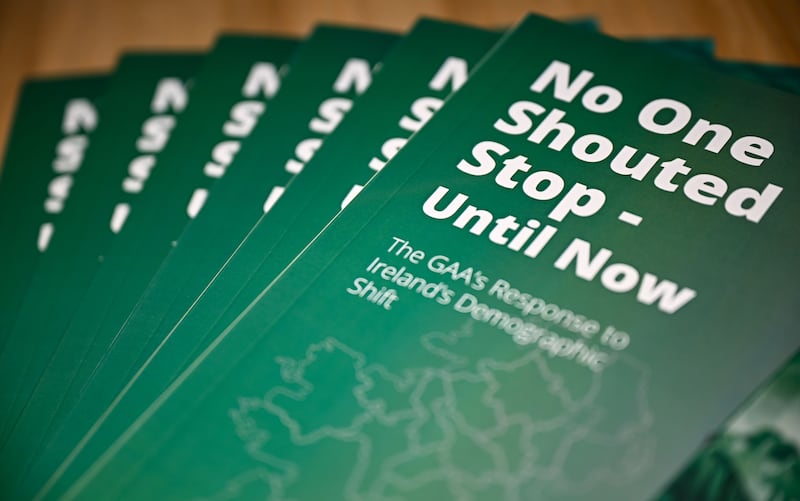
The scale of the demographic challenges facing the GAA was laid out in full at Thursday’s launch of the association’s national demographic committee report, No One Shouted Stop – Until Now.
The name was inspired by the late Irish Times journalist John Healy’s prophetic book – originally published in 1968 – on the depopulation of his native Charlestown in his Mayo.
The immense population shift to towns and particularly towards the east of the country was demonstrated on a number of graphics, particularly one narrow section, stretching from Larne in Antrim down as far as Wexford. It is home to 43.5 per cent of the population but just 25.4 per cent of GAA members and 18.6 per cent of its clubs.
“That map tells the story that our population and our clubs no longer align,” said GAA president Jarlath Burns. “Half of Ireland’s population live in this thin strip and 18.6 per cent of our clubs are located here. This mismatch is a visual warning that Ireland’s demographics have shifted dramatically, and the GAA must shift with them.”
READ MORE


Other key data points include:
• 25.5 per cent of all 0-5 year-olds in Ireland are concentrated across just 50 clubs
• 52 per cent of 0-5 year-olds are to be found in Dublin, Belfast, Down, Kildare, Galway and Cork
• 78 per cent of GAA clubs are in rural areas with declining populations
Peter Horgan, secretary to the committee, pointed out that the island’s population was now at seven million, the largest it had been since 1851 but that “the balance of population has changed massively”.
Committee chair, Benny Hurl, from Tyrone, sombrely held up a jersey. It was from Dregish, a local club that had disappeared in 2019 into an amalgamation with Newtownstewart.
“We hope that this report will go in some small way to try to ensure that no more small clubs succumb. In Gregish, the school closed and the pub closed and everything else closed.”
He added that “we’re here to focus on solutions and outcomes.”
Those solutions are divided into three areas – internal action, evidence-based strategy and external engagement.
The first includes being more flexible in assisting clubs to retain their official status, targeted growth of new and existing clubs and the activation of pilot projects in Kerry and Kildare focusing on urban centres and rural areas with declining populations in both counties.
There is also a recommendation for the support of modified games programmes where clubs struggle to field 15 players by having more blitzes or 11-a-side or 9-a-side competition, and regional competitions with clubs pooling resources.
The section on external engagement recommends: the setting up of an all-island framework to co-ordinate relationships with Government and local authorities; engaging with national Government, specifically the departments of sport, education, children, health, rural and community development and the Gaeltacht as well as housing and local Government.
Horgan outlined one line of approach.
“Can we develop a social enterprise case study within that space to provide employment, provide opportunities for people in rural Ireland, which might anchor people to those rural communities?”
The biggest social issues are also the main challenges for the island’s biggest sports organisation: housing and the availability of employment in remote areas.
As Burns encapsulated it: “Is this a satisfactory scenario for our country to be? Where children can’t build a house where they were born and can’t buy a house where they work?”
Hurl declared he was an optimist and commended the report. “Hopefully, it will become a lifeline to the small clubs and it will develop the middle-sized clubs and perhaps the really big clubs as well.
“The GAA is the glue that keeps the communities together all of Ireland. And the GAA is worth fighting for.”