

At the tail end of a breakout year with Meath, Jordan Morris was hoisted upon jubilant shoulders at Breffni Park last October – the toast of Kingscourt, a Royal king of Cavan.
Tomorrow, the Meath forward returns to Breffni where he will face several of his club colleagues – the latest in a long list of players who have melted between one of the country’s most blended county boundaries.
Along the scraggly frontier stretching approximately 47km where the drumlins of Cavan push down towards the farming land of Meath, a community of Meath and Cavan folk share an intermingled enclave where nothing really differentiates the tribes apart from football.
The Meath-Cavan rivalry remains anchored in the past – to an era when the counties contested All-Ireland finals in 1949 and 1952. The novelty of two neighbouring counties clashing in the GAA’s showpiece event fuelled the flames of identity around border posts such as Kingscourt, Mullagh, Oldcastle and Kilmainhamwood.
READ MORE


The rivalry has lost some of its heat over the years but Morris is having a moment right now. An All-Star nominee in 2025, he scored 0-9 in last year’s Cavan final to help Kingscourt Stars to victory over Gowna.
“Jordy’s a Rolls-Royce of a player to work with,” says Kingscourt manager Colin Kelly.
Morris grew up in Kingscourt and went to primary school in the town before moving just across the border to Nobber when he was about 11.

Within a few years he was called up to the Meath under-14 development squad and has remained wrapped up in green and gold ever since, making his senior debut in 2020.
His dad, Gary, a SFC winner with Kingscourt in 1993, played for Cavan up to minor level but from the moment he joined the Meath development squads, Jordan’s allegiance was to the Royals.
“No, definitely not,” smiled the 25-year-old when asked last October whether playing for Cavan had ever been on his radar.
But the possibility of playing for Kingscourt was an entirely different proposition. It pulled at the heart strings – a desire to play with his old schoolfriends and a team with strong family connections. Because if Meath was his county, Kingscourt was his club.
He won a Meath IFC with Nobber in 2019 but transferred to the Stars in 2022.
His grandfather, Jim McGovern, is a Kingscourt stalwart. A former club chairman, he has also fulfilled the role of team bus driver over the years, allowing Morris to hop aboard for Kingscourt’s 2010 and 2015 county final trips.
But last October the wheels spun full circle, with Morris on the bus as one of Kingscourt’s key players.
“Jordy is very much a part of Kingscourt life and part of the club,” says Kelly.
“His grandfather is heavily involved and a nicer man you could not meet. It was a very proud day for them.”

It has been a career-defining 12 months for Morris. After suffering a knee injury against Louth in the final game of Meath’s league campaign last March, there were fears initially that his 2025 season was done.
Scans subsequently showed a grade-two tear in his ACL and PCL but surgery wasn’t required. Morris dedicated himself to an intensive rehab programme and managed to return as a sub during the Leinster final.
And though Meath lost that game, in the weeks that followed Morris blossomed, proving to be one of the most live-wire forwards in the country.
“The work he went through to get back from his injury was incredible,” adds Kelly.
The Kingscourt boss recalls an abrasive in-house training match one evening during which the teams went at each other like rutting stags. As the exhausted players traipsed towards the refuge of the dressingroom afterwards, Morris stayed on the pitch.
“He started doing runs, 21 to 21. His attitude to training is serious. Now you can have that brilliant attitude all you want but he backs it up with a crazy amount of talent.”
In some ways, Morris is a throwback, taking on efforts that must have percentage-shot extremists furiously swiping through spreadsheets in various states of dismay. But that unpredictability, that willingness to embrace risk, is fast becoming his superpower. His x-factor.
Over the last week Morris kicked two of the most exquisite two-pointers you will see all season. The video of Wednesday’s outrageous effort for TUD is almost hypnotic.
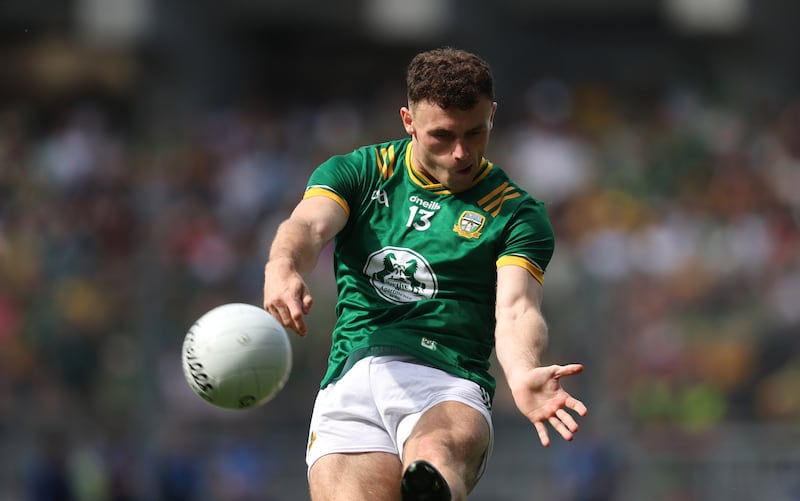
At one stage in the first half of the Cavan final, Morris had a straightforward scoring chance at the edge of the small arc. Kingscourt trailed by two at the time.
“Nine times out of 10 you’d expect the forward to just pop the ball over the bar,” recalls Kelly.
“But instead he played a crossfield pass to Joe Dillon. Joe slipped the ball to Kevin Curtis and from a situation where most teams would have put a point on the board, we had a goal.”
It turned the contest decisively in Kingscourt’s favour.
“He does the out-of-the-ordinary stuff but he also does the less glamorous stuff too, he works so hard and tackles really well. He’s just a very talented player,” says Kelly.
Many others have also moved between the counties. Those recounted in Paul Fitzpatrick’s extensively researched Cavanman’s Diary in the Anglo Celt four years ago include Connie Kelly, Brian O’Reilly, Damien Sheridan, Ray Cunningham, Micky Brennan and Oisín Kiernan.
But nothing surpasses the 1952 All-Ireland final between the counties when the Maguire brothers played against each other.
Liam and Des lined out in defence for Cavan while younger brother Brendan played at midfield for Meath.

“It’s a unique story,” says former Cavan chairman and renowned local historian George Cartwright, whose book Up The Red – The Cornafean Achievement helps chronicle one of the great GAA tales.
The Maguire family settled in Bingfield, Cornafean in the 1920s but in 1948 they moved to Oldcastle in Meath.
Brendan was only about 14 at the time and continued his education at Gormanstown, his path starting to deviate from that of his older siblings, who were already moving on with their lives away from the homestead. Des was studying to be a priest at the time of the 1952 final.
“Prior to the game, the three brothers met in the centre of the pitch and got a picture together, that’s a special photograph,” continues Cartwright.
Cavan won after a replay. Liam later joined An Garda Síochána, moved to Monaghan and became one of the country’s top referees, taking charge of the 1961 All-Ireland final.
Des continued to the priesthood, spending many years in South Korea before eventually relocating to San Diego, where he worked with the immigrant Korean community.
Brendan moved to the States where he became sheriff of San Mateo County, California. He died in 1986 midway through a second election campaign. Despite his passing, Brendan still won the vote.
Des and Liam both died in 1993 – the Maguire brothers’ remarkable All-Ireland final duel ultimately proving to be just one chapter from three vibrant life stories.
But when the latest chapter in the Meath-Cavan rivalry is written this weekend, chances are Kingscourt’s Jordan Morris will be among the storyline’s central protagonists.


