

Jack Nicklaus was 65 when he played his last competitive round at the Masters in 2005. He shot 76 and 77 to finish at nine over par, five shots outside the cut. In the circumstances it was a valiant effort, though Nicklaus had no stomach for platitudes and pats on the head. Champions don’t change their mind about failure.
“It’s great and it’s fun to play in the Masters,” Nicklaus said afterwards, “but it’s certainly no fun to play that way. It’s no fun to go out there and hack it around and struggle to try to figure out some way to break 80. That’s never been the way I’ve operated, and I don’t believe I should be out there.
“This is not a celebrity walk around – it’s a golf tournament. It’s a major golf championship and if you’re going to play in this championship you should be competitive.”
For the last few years, Tiger Woods has been grappling with that equation: pushing back against a body in revolt, trying to make time pause or slow down.
READ MORE


Before the 2024 Masters he said he believed he could win one more green jacket “if everything fell into place”. Some people were prepared to believe him. He probably believed it.
That year he made the cut for the 24th consecutive time, claiming a record for himself that he had shared with Gary Player and Fred Couples a year before. On the Friday he shot level par, the same score as the eventual winner Scottie Scheffler, which meant he sat two shots outside the top 10. Not out of it.
But in the third round he carded 82, his worst round in a Major. Over a span of 27 years Woods’ career in the Majors had amounted to 307 rounds. Twelve years earlier at the Open, Woods had shot 81 in a tempest of wind and rain, but there was an external reason for that blowout.

This time it was caused by a broken body and a game overcome by decay. He finished the tournament on 16 over par, dead last of the players who had made the cut. For those couple of days, Augusta had reduced him to the professional hacker that Nicklaus had warned himself against.
Did Woods really need to be there? What was bringing him back? A delusional sense of what was still possible? Ego?
[ Tiger Woods at 50: A legendary career of titles, surgeries and hopes for a competitive return ]
In recent weeks Woods has been answering questions about whether he will tee it up in the Masters again this year. He hasn’t given a definitive answer. By all sane reason the chances are remote, but in this case wishful thinking has many lives. The last five years of Woods’ career have been dominated by questions about speculative comebacks, some of which reached the end of the runway and crash-landed in the next field.
This time, the circumstantial evidence is ludicrously thin. His private jet was spotted at Augusta Regional Airport; on the official Masters website his name does not appear in the section for past champions, not playing; in the players’ biography section of the site it also says that Woods “is making his 27th start at the Masters in 2026”.

All of it is probably a ball of smoke. The TGL indoor golf league – in which Woods and Rory McIlroy are major stakeholders – resumed in recent weeks and Woods wasn’t even fit enough to play in that. But the faintest possibility of Woods playing in the Masters, however tenuous and fabulous, is always a story.
He turned 50 at the end of the December, which is not too old to be competitive if everything else were aligned. But how could it ever be again?
His last appearance in an official Tour event was the 2024 Open championship, where he missed the cut on 14 over par. Around this time last year, with Augusta on his mind, he ruptured his Achilles’ tendon while preparing for a comeback. Last October he underwent his seventh back surgery.
For Woods, the simple act of walking now involves conscious mechanics. What Brendan Quinn described in the New York Times as Woods’s “cocksure stride” has now been replaced by a halting, deliberate, slightly robotic gait.
None of that is surprising. After the car crash in February 2021 that nearly claimed his life, his right leg was shattered. In medical terms, he had suffered a comminuted open fracture which meant that a bone had broken in more than two pieces and had pierced the skin. He had also suffered fractures to his ankle and foot. In many ways it was extraordinary that he returned to competitive golf.
Eighteen holes around Augusta amounts to about six miles. One of the hackneyed truisms of the coverage every year is that the pictures on our TV screens fail to convey the hilliness of the terrain. For a fit player it is a demanding walk.
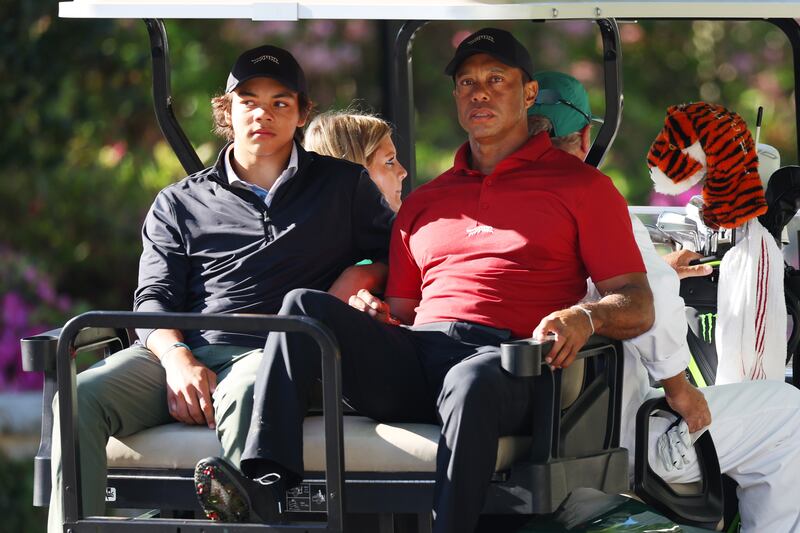
And yet it has been Woods’ focus every year since the car crash. When he played in the 2022 Masters it was his first competitive round for 508 days – since the final round of the pandemic delayed 2020 Masters.
He teed it up again at the 2023 Masters, but, having made the cut, he withdrew after just seven holes of a weather-beaten Saturday. He finished with consecutive double-bogeys, the first time he had committed such an offence against his scorecard in 1,735 holes at the Masters. His back had given in again.
But nobody is prepared to let go yet: not Woods, not Augusta, not the TV networks desperately fighting a rearguard action for eyeballs on screens.
If Woods somehow makes it to Augusta then he will be in a marquee group for the first couple of days and his good shots will get equal billing with his bad shots. That has been the pattern in the nine official Tour events he has played since he returned to competition in 2022. All of it has the demeaning quality of the circus grotesque.
Excluding the Hero World Challenge, Woods had played just 25 rounds of competitive golf in the last five years. His average score is 74.5; he hasn’t shot a sub-par round since 2023.
If he can no longer win the Masters then why would he even consider teeing it up? Champions don’t change their mind about failure.