
How do you solve a problem like Constitution Hill? Because he is a problem, and not just for his connections trying to decide what to do next, but even for National Hunt racing generally.
A lot of the sport’s ideas about itself crystalise around how the finest hurdler of his generation now can’t seem to get from one end of an obstacle to the other without ending up in a heap on the other side. It begs the question as to whether jump racing can afford the risk of letting perhaps its biggest star run over hurdles again.
On the flat there was a time when future stallion prospects were too financially valuable to race: the quandary with Constitution Hill is how he may be too reputationally costly to race. Can the sport risk him falling again and perhaps paying the ultimate price: and if he isn’t risked, what does it say about the nature of the challenge jump racing presents to every other horse?
On three occasions in just over eight months a sport has held its breath and feared the worst after Constitution Hill has fallen.
READ MORE


The first was in last season’s Champion Hurdle at Cheltenham. It could be excused as an aberration, always a potential consequence of the horse’s spectacular but high-risk jumping style. A few weeks later the same thing occurred at Aintree. If that seemed freakish, then last Saturday’s spill in Newcastle’s Fighting Fifth Hurdle verged on pathetic.
[ Constitution Hill falls again as Golden Ace storms to Fighting Fifth Hurdle winOpens in new window ]
Months of effort by trainer Nicky Henderson and his team yielded a decent jump at the first flight before a desperate lunge at the second smacked of horse suffering a crisis of confidence. Constitution Hill’s leg caught the top of the hurdle, and he crashed out, firing jockey Nico De Boinville into the ground.
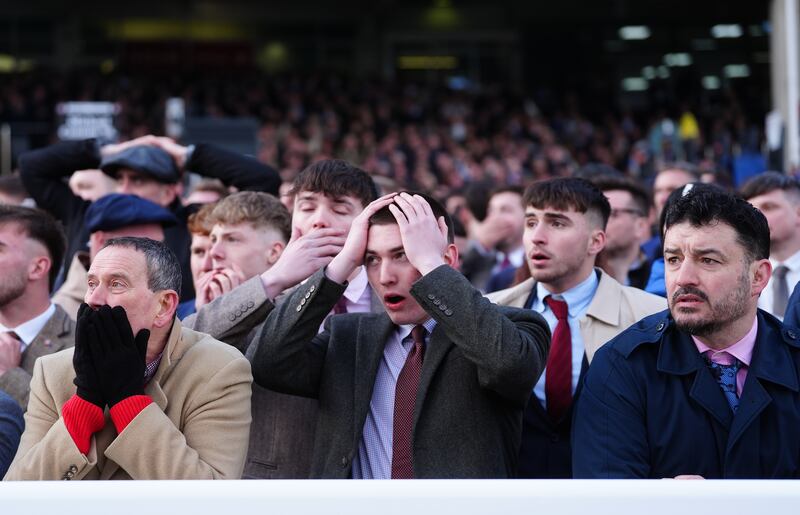
When any horse hits the turf, the seconds it takes to see the extent of any damage can feel like an age. Even if it scrambles to its feet there’s a horrible wait to see if all limbs are intact and moving. Mostly the outcome is okay. Sometimes it isn’t. Such scenarios are inevitable. About 0.5 per cent of fallers sustain fatal injuries.
It’s the nature of a sport that sells itself on thrills and spills: a tiny fraction of the spills can be catastrophic. It’s an uncomfortable reality, but a reality nonetheless, and it’s the sport’s great vulnerability in maintaining the social license that allows it to continue enjoying public trust.
It’s why the Aintree Grand National is simultaneously both racing’s greatest shop window and insecurity. Popular exposure to the potential cost of such a thrilling spectacle makes National day a fraught annual exercise. But there are over 300 other days when the game’s essence is the same, despite popular attention being elsewhere.
Racing must be able to stand over the challenge as a fair and reasonable test of horse and rider every day, no matter what the level of profile or competition involved.
Connections of Constitution Hill are in an invidious position. They’re damned if they let their outstandingly talented runner race again over hurdles and damned if they don’t.
If he runs, and God forbid is badly injured, there will be an outcry at how he was asked to perform a discipline at which he was once supreme but now looks desperately vulnerable. Three falls in four races is a stark statistic. Is it fair and reasonable to ask him to persevere? Drawing stumps on his jumping career would conveniently get ahead of any potential controversy.

It would also leave racing wide open to the charge that if the jumping challenge is too fraught an exercise for the very best, how fair can it be for thousands of less celebrated runners, including horses with just as many letters next to their names about which there’s comparatively little handwringing.
One option is to simply switch Constitution Hill to the flat. But such a move would imply a lack of confidence in the story jump racing presents. It can either stand over what it is - rather than some anodyne PR image - or it can’t. And if it can’t, what’s the point?
Each individual case is different, but if it’s three falls and he’s out for Constitution Hill, should such a measure apply throughout the sport? No such limit currently applies but it could be a move for officialdom to consider since it might prevent charges of expediency when it comes to preventing uncomfortable headlines.
Plenty of horses are hairy jumpers. Ordinarily their spills are a private agony for those closest to them, or temporary irritations for those betting on them. The stakes are much higher with Constitution Hill. Henderson & Co have to stick or twist with his jumping career and do it in the full glare of public attention.
On balance it feels like they should persevere. Maybe change tactics or the jockey but try and get an outstanding talent back doing what he used to do better than a handful of other horses in history. Admittedly, it would mean genuine anxiety rather than the usual nerves will afflict the entire sport when Constitution Hill lines up next. Failure to do so, though, will send a timid signal about the sport’s faith in its essential challenge.
Something for the Weekend
Paddy’s Milestone won at Navan last month and is back there for tomorrow’s €100,000 three-mile handicap. He is significantly ‘wrong’ at the weights though and Grimaud (1.42), who was runner up to him last month, could reverse placings if not running so keenly in the early stages. Grimaud is one of four Gordon Elliott runners. Paddy’s Milestone’s trainer Stuart Crawford has two other hopefuls.
The veteran Aintree stalwart Roi Mage lines up in tomorrow’s Becher Chase over the National fences and there would be no more popular winner. The 2023 Topham winner Bill Baxter (2.40) may prove a more likely solution after an encouraging comeback effort over hurdles last month.
[ Trainers welcome Government green light for new all-weather track at TipperaryOpens in new window ]