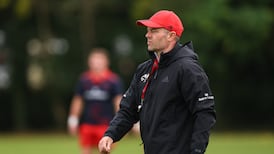
James Ryan’s return for Leinster last Friday against Leicester at Welford Road arrived a week early. The secondrow opted to go to tackle school, or World Rugby’s Coaching Intervention Programme, allowing him to shave one week off his three-week suspension.
Ryan went in high on South African hooker Malcolm Marx during last month’s November international at the Aviva Stadium, which resulted in him picking up a 20-minute red card and a try from Tadhg Beirne being disallowed.
“I was devastated to be honest,” says Ryan about the incident. “It was at such an important point in the game. We’d just scored, the try got reversed, they got a penalty, and I was sent off.

Do Leinster’s misfires matter so long as they’re winning?
“So, a big moment in the game and I felt like I let the lads down there, really. The big thing now for me is just making sure I learn from it and it doesn’t happen again because at that level, it’s such fine margins and it probably costs us in the end.”
READ MORE


Tackle school conjures up an image of an oversized player, with more than 70 Irish caps in his locker, sitting at a ill-fitting school desk being tutored on how to stop opponents. It seems, and is, ludicrous.
Still, Ryan was taken through the situation leading up to his foul on Marx. The question is, was it about technique or a player getting lost in the competitive physicality of a Test match?
Ryan knows how to tackle. As a lock, it’s his bread-and-butter action. The aim of the programme is more to change behaviour and less about the nuts-and-bolts execution.
“It was just some scenario stuff. We’d kind of mimic the ruck again and we’d put a couple of tackle pads into the back of the ruck to sort of lengthen it a little bit,” he explains.
“Then I’d talk through maybe what I should have done differently and what I would do next time. We’d record that and then send it on to them. I think I ticked off every box and they were happy with it.”

There seems to be a reluctance to hold strong opinions on the merits of tackle school. For players who are sanctioned, accepting take part in the programme is a pragmatic choice and purely a matter of getting back a week earlier.
There is another idea that the punishment should be what the illegal action on the pitch demands, and there should be fewer mitigating factors for highly competent athletes who transgress.
Players already receive reductions in sanctions if their records are clean, from which Ryan benefited. The 29-year-old’s offence was deemed a mid-range infringement, with a six-match suspension deemed an appropriate sanction.
Considering he accepted the red card, his clean disciplinary record, and other mitigating factors, the maximum 50 per cent reduction was applied to Ryan’s suspension, reducing it to three games. Tackle school knocked a further week off that, leaving the actual suspension at just two weeks.
“Look, if it means it reduces the ban for me, I was more than happy to do it,” he says of the programme. “Whether I agree with it ... I don’t know enough about it. That’s above my pay grade.
“I do think that the mitigating factors are part of it, and if you’ve got a good record, I think that should help you. The tackle school itself, I think some of the scenario-based stuff can be helpful.”

It is an issue that is unlikely to change. With matches becoming more consequential as the season progresses, Leinster will come under increased pressure to win.
That leads to players pushing boundaries harder and playing on the edge to chase margins and build percentages around the field.
However, Ryan is not persuaded that anyone but himself was at fault for his dismissal against the Springboks. He may have been in a red-hot competitive zone, but he also understands that discipline is a counterbalance to the permissible aspects of a physical contact sport.
“I’m not going to make any excuses for it because you can’t obviously tuck your shoulder or go off-feet like that.
“It was just a poor moment for me more than anything. It would be easy to say, yeah, look, we play on the edge, and these things happen. But hitting rucks for a secondrow forward is one of your primary roles. I just need to do better there really. So hopefully it doesn’t happen again.”
If it does, there will be no Coaching Intervention Programme to soften the blow. Players only get one chance to go to tackle school.