
The importance of home advantage in securing results across the leagues and tournaments is very much evident once again this season. Winning in the backyard is not a luxury or bonus outcome, but is a necessity for those who aspire to claim silverware.
Away victories or picking up bonus points on the road provide breathing space or leeway and are a down payment against the future comforts of home when it comes to the knockout stage of competitions.
It’s not a new phenomenon. It has been a defining feature of French club rugby. Away wins were rarely expected, never mind planned.

Which province is worth paying to watch?
I remember Trevor Brennan arriving in Toulouse and being openly frustrated by that mindset. Trevor was exactly the kind of team-mate you wanted beside you, someone prepared to fight, literally and metaphorically, for every inch on the field.
READ MORE


Some players inspire through words, others through lavish skill sets. Trevor’s point of difference was the physical edge he brought to every game. He imposed himself on matches, raised standards through actions – and that resonated with players and supporters alike. While the culture around him did not change overnight, his attitude highlighted the difference mentality can make.
The expanded United Rugby Championship and rejigged Champions Cup now show similar characteristics to the French Top 14. Teams target home fixtures and manage resources accordingly. If an opportunity presents itself away from home then so be it, but it won’t be chased at all costs.
As the season moves beyond midpoint, league tables carry greater import and priorities sharpen. It becomes less about ambition and more about protection, holding your position, staying in touch and nudging forward when the chance arises. Toulon’s heavy defeat to La Rochelle last Sunday underlined this perfectly.
Toulon travelled light, leaving most frontline players at home to prepare for their must-win Champions Cup pool match against Munster on Sunday at the Stade Félix Mayol. A bonus-point win would likely secure qualification for the knockout stage, thereby allowing the away trip to Gloucester to become something close to a dead rubber, particularly as Toulon have a Top 14 home game against Montpellier to follow directly.
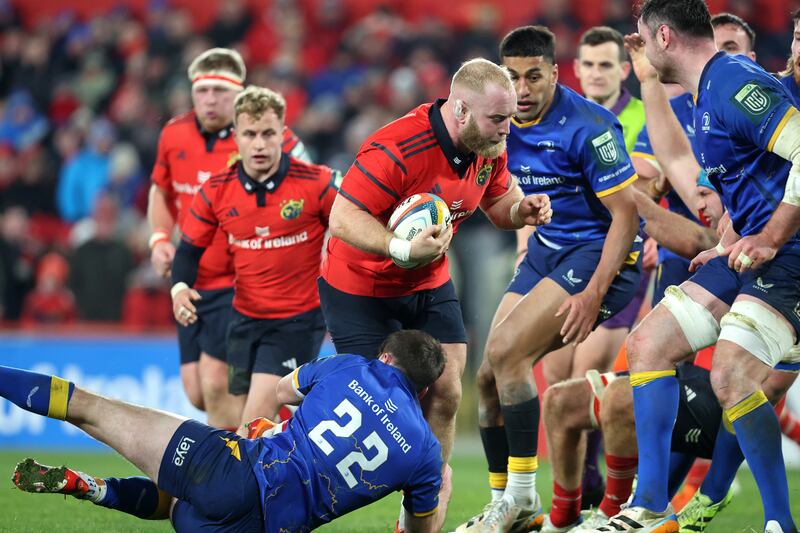
For Munster, this has become a challenging period. Back-to-back interprovincial defeats have eroded confidence and it’s visible. Leinster’s 13-8 victory in Thomond Park was described by some as a smash-and-grab raid, but the 28-3 away defeat to Ulster was altogether bleaker, the visitors comprehensively outplayed.
Ulster, in contrast, were a team with a clear understanding of how they wanted to play. Individuals thrived within that framework. There was conviction in their decision-making and an obvious trust in the game plan.
[ Champions Cup: TV details, kick-off times and team news with Leinster and Munster in action ]
Richie Murphy deserves enormous credit; a reminder of the power positive coaching can have on a group. The appointment of Mark Sexton has proved significant. Rather than pushing back against criticism of kicking strategies, the backs coach reframed the conversation entirely by asking why teams kick and what kicking gives you. The answer is transition.
Ulster have been very good in that area, particularly in how quickly they move from kick receipt into attack. The ball is shifted with purpose, often into space, and defenders are asked questions before they have time to organise, collectively.
What stands out most is Ulster’s commitment to fundamentals. This was an initial focal point when Joe Schmidt took over at Leinster. He gave everyone a clear focus that in winning enough moments, the results look after themselves.
While others are building increasingly complex attacking shapes and layered systems, Ulster have doubled down on the basics. Catch and pass, run into space, clean ball presentation and accurate rucking all feed into quick ball and momentum. It is so effective when done well.
Ulster wing Zac Ward beat more defenders on his own than the entire Munster team managed collectively. Jacob Stockdale eludes first defenders with regularity, while Bryn Ward brought a Sean O’Brien-like physicality to his carries, repeatedly winning collisions and bending the defensive line. Pressure built steadily, and Munster struggled to live with it.

Ulster are now playing with a contagious confidence. The team is beginning to reach a point where the collective output is based on the sum of its parts. Roles are not prescribed, yet players understand what is expected of them, and trust has replaced hesitation.
It is a powerful place for any team to be, particularly at this stage of the season. There is a lot to be said for a group that are clearly enjoying their rugby, and for me that makes this season already a success for the Ulster men.
Munster, by contrast, look a pale shadow of their early season promise. When confidence drains away, even simple things become laboured. Ball speed drops, the reliance on attacking shape increases, and suddenly options disappear.
The attack narrows, numbers thin out, and the much-debated kicking options are taken on the back foot rather than on your own terms. Individuals continue to perform, Alex Nankivell, Calvin Nash and Tom Ahern all fighting, as has been the case in recent weeks, but the collective output has not matched those efforts.
The threat of three consecutive defeats is a daunting one and does little to restore belief within the group. However, it is precisely at moments like this that teams learn most about themselves. Pressure has a way of revealing truths.
Ulster have found momentum, but the wider provincial picture remains unclear. Leinster, Munster and Connacht have all struggled to find sustained consistency, and the next block of fixtures will play a significant role in shaping their seasons. The schedule is kind to some and less forgiving to others, but at this point excuses are in short supply.
Home advantage may be the foundation, but mentality and fight determine what is built upon it. Opportunities are becoming scarce, and momentum is no longer something that can be waited for. Munster and Connacht each have one remaining chance over the next fortnight to use home fixtures in respective Champions and Challenge Cups as a platform to reset and rebuild.
A failure to do so, and the season will begin to define them, rather than the other way around.