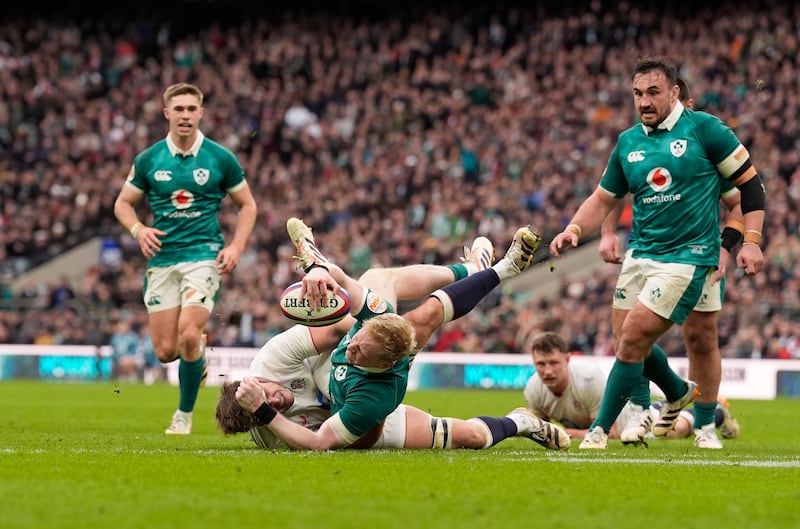
It’s remarkable how quickly narratives can change in the space of a handful of games. In Paris, Ireland looked a dire side with little hope of winning the Six Nations. Weeks later, they were two points away from being crowned champions.
Narratives are one thing. Numbers, though, are always influenced by heavy swings in small sample sizes. Regardless, there is plenty we can learn from this tournament.
Are Ireland trending in the right direction? What we learned from their Six Nations campaign
Ireland have tweaked their game plan and added new faces to their talent pool (24 matchday squad changes in one Six Nations is a joint record for the Andy Farrell era). Recent results suggest a corner has been turned. The data – coming from Opta unless otherwise stated – offers few reasons to disagree.
Case for the defence

Coached by Farrell, a man whose initial forays into international coaching were defined by his work as a defensive specialist, Ireland were never going to be a side that shirked that part of the game. Still, numbers suggest that this is a side more comfortable playing without the ball now than in previous years.
READ MORE


This year, Ireland topped all Six Nations teams for number of tackles made during the tournament (888). It was also a record for the number of tackles completed by an Irish side in the Six Nations era (from 2000 onwards).
In 2025, Ireland made over 150 fewer total tackles and ranked fifth in the competition. In 2024 and 2023, they were fourth. In 2022 and 2020, they made the fewest tackles in the tournament, while 2021 saw them make the second fewest.
Such a dramatic jump up the table of defensive workload is no coincidence; we’ve spoken at length about Ireland’s shift away from possession dominance to efficient attacks that do not require high phase counts. Scoring in a quicker fashion means more time defending.
The defensive increase has been paired with quality. Ireland were the best team in this year’s competition at stopping opponents from scoring once they entered the 22, with a red zone denial of 67.3 per cent.
Ireland don’t necessarily stop teams from getting into the 22, allowing 49 entries across the tournament (just shy of 10 per game). Call it desperation, nous or doggedness, clearly something shifts once Ireland are close to their own line. Generally speaking, a good barometer of attacking success inside the 22 is to come away with three points per entry. Only twice this season – including a tricky November window – have Ireland allowed opposing attacks to hit that benchmark; the All Blacks and Scotland.
[ How Ireland’s set-piece detail returned with a vengeance against ScotlandOpens in new window ]
Ireland led the way in a number of defensive stats in the Six Nations. They were joint top for lineouts stolen (six) and total turnovers won (42), while they were out in front on their own for successful jackals (19). It isn’t recorded how many of these defensive wins took place inside their own 22 but, what is clear, is that as Ireland’s defensive workload has gone up, so has their ability to be disruptive.
Offload ahoy
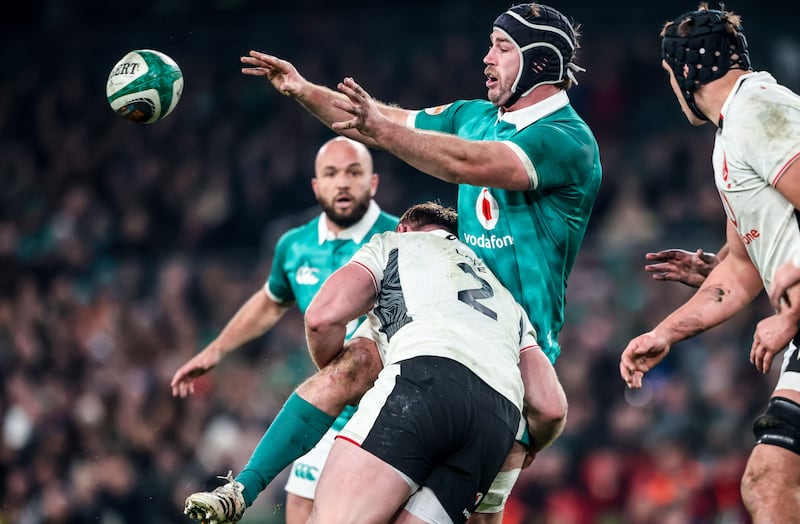
In this year’s competition, Ireland threw 45 offloads, second behind France. Last year, that figure was 25. In theory, this increase makes sense. A key part of an efficient attack is to break the line as quickly as possible, something made possible by offloading. The rise could also be at least in part explained by the consistent presence of Stuart McCloskey – a renowned offloader – in the team. He led the way with eight offloads, four more than next best, James Lowe.
In practice, explaining the sudden increase in offloads isn’t as straightforward. This is a trend that can fluctuate greatly from year to year. While Ireland threw 25 offloads last year, in 2024 the number was 46, one more than this year’s tally.
In 2023, the total dropped to 37, while 2021 brought 32 offloads. But in between those low numbers, Ireland spiked up to 57 in 2022.
That leaves this year’s increase up to interpretation. It remains to be seen if, as Ireland retool with extra layers of transition attack added to their game, this leads to a consistent offload-heavy approach. Or, is this just the latest spike in an area of the game that is difficult to explain?
Super Stu
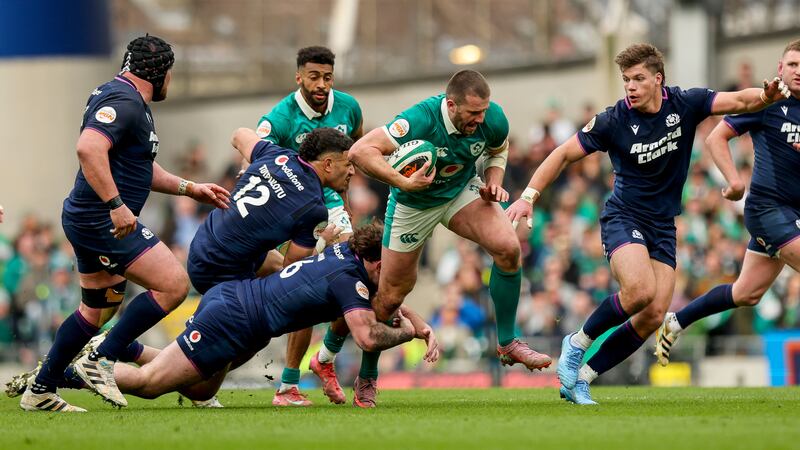
After mentioning McCloskey, it is worth highlighting just how statically impressive his campaign was. Given the centre’s size and power, it’s perhaps not particularly surprising to see that he was Ireland’s top player for metres gained (240) and defenders beaten (14). Of players from all six countries, he ranked 10th and 11th respectively in those categories.
That said, to rank so highly given his position – which demands carrying through well-stocked defences, making it harder to make ground – only adds to the positive ledger. Tommaso Menoncello was the only inside centre to beat McCloskey in these stats.
Where the Ulsterman stands out further, though, is not actually with his carrying, but his distribution. He finished level with Matthieu Jalibert for try assists in the tournament (six). He also ranked fourth for line break assists with eight, just one behind Finn Russell. The top two were Jalibert and Thomas Ramos, meaning the three players ahead of McCloskey would be regarded as more traditional playmakers than a big centre.
On the defensive side, McCloskey jointly led Ireland for dominant tackles alongside Ulster colleague Robert Baloucoune (four) and was joint second (alongside Baloucoune again, with four) in turnovers won behind Tadhg Beirne (seven).
McCloskey’s was a truly exceptional all-round campaign.
Efficiency is king

As Ireland’s defensive workload has increased, and with it the ability to repel sides close to the line, the required attacking efficiency to match has also been there.
As mentioned earlier, the gold standard for an efficient attack is to score three points per 22 entry. In the calendar year of 2025, Ireland only hit that marker twice in nine games (discounting the summer tour of Georgia and Portugal). In 2026, they have already beaten that by crossing three points per entry three times in the last five games.
One efficient Six Nations campaign is a small sample size, but what offers encouragement is Ireland’s direction of travel. Against France in round one, Ireland only notched 1.7 points per entry. The next week, that rose to 2.2 against Italy, still a low figure.
In the later rounds, Ireland hit 4.3 against England and 4.8 against Scotland. Even when playing Wales, a game that was a step back in performance, they still recorded a figure of 3.3 points per entry.
As the campaign went on, Ireland improved in an area of the game that is critical to success.
Follow our rugby WhatsApp channel