At some point in the autumn of 1993 I queued all night outside HMV on Grafton Street, waiting to buy a ticket to see Nirvana at the RDS the following April 8th.
I got the ticket, but the gig never took place. Instead, April 8th, 1994, turned out to be the day the world learned of the death of Kurt Cobain, when an electrician who had come to do a job at his house in Seattle discovered the singer’s body. The coroner’s investigation estimated he had died on April 5th.
Tickets for the April 8th Dublin show thus became a faintly macabre collector’s item, which many ended up selling for a couple of hundred euros. I can’t remember exactly the face value, but I’m sure it was around £15. That converted to €19, or the equivalent of about €38 today.
Obviously, €38 was quite a bit less than people were paying to see Oasis this summer. According to data from AIB, the average price paid for tickets to the Croke Park gigs ended up being €347.
READ MORE


The difference is that back in 1993 we didn’t have dynamic pricing. They sold the tickets on the basis of first-come first-served. It meant if you wanted to get a ticket you probably had to queue overnight, but at the age of 14 I was happy to do that. If the tickets had cost £150 that would have been me out of the running.
The ticketmaster.com site launched in 1995. For the first time, you could buy tickets from the comfort of your own home. No more queuing all night outside HMV. A clever technical innovation that would make life easier for everyone.
Hardly anybody foresaw the bot armies of the future, swarming the sales pages for every hotly-anticipated event, hoovering up tickets so they could be resold to fans at rip-off prices.
Ticketing companies realised that by offering tickets online at fixed prices, they were letting scalpers walk away with huge potential profits. The same technology that had created the bot swarm problem offered a solution in the form of dynamic pricing – introduced by Ticketmaster in 2022.
With dynamic pricing, when lots of people want to buy tickets for an event, the system raises the prices in response, and the market decides who really deserves to go. The basic concept is: what if we eliminated the scalpers by ... becoming the scalpers?
Thirty years on from the launch of the Ticketmaster website we can see that these technical developments, which were supposed to make life easier for consumers, have in fact led to large real-terms price increases for anything you want to go to. There have been few more graphic illustrations of how much worse things have got than the revised list of prices for 2026 World Cup tickets announced last week by Fifa.
Journalists like the Independent’s Miguel Delaney, reporting on the controversy, were surprised to receive responses from Americans who seemed to be taking an almost patriotic pride in the extortionate prices.
The Substacker Matt Yglesias reposted Delaney’s piece with the comment: “Hot take – World Cup tickets are expensive because the United States is a very rich country with a very large population so demand for tickets is very high.”
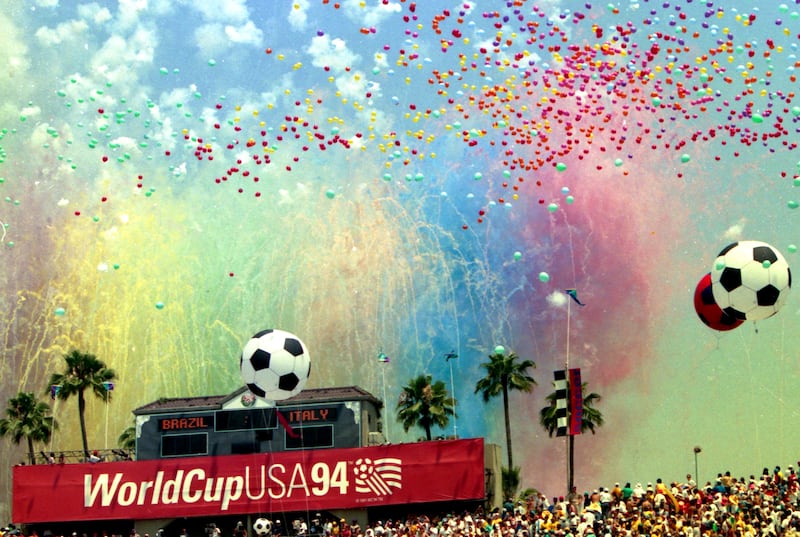
But the United States was an even richer country, relative to the rest of the world, in 1994, when it first hosted this tournament. The average ticket price at that World Cup was $58, or $127 in today’s money. That is, the average ticket price in 1994 was nearly a third less than the cheapest group stage ticket in 2026 in real, inflation-adjusted terms.
Fans behind the goals at group stage matches in 1994 were paying $25, equivalent to $54 in 2025 dollars. The cheapest Category 3 group stage ticket for 2026 is listed at $180, a 233 per cent increase, while the most expensive Category 3 (for the USA’s first match against Paraguay) is $1,120, or 20 times the 1994 price in real terms.
A Category 3 ticket for the 1994 final cost $180, equivalent to $395 today. The same ticket in 2026 will cost $4,185: more than 10 times as much, in real terms. Fifa loves the high-rollers, so they’re punishing them a little less. The most expensive tickets for the final are listed at $8,680, so a little more than eight times as much as the best final tickets cost in 1994, again in real terms.
The fact that we have got used to being abused for every in-demand live event should not numb us to Fifa’s greed. Recording artists at least can argue that since piracy and streaming services destroyed the record market, live performances are their main source of income.
Fifa can’t make that argument, not while TV rights sales continue to boom and Saudi Aramco is pumping them with cash. The game’s governing body absolutely does not have to rip off match-going fans to this extent.
They could, for example, sell tickets that are only valid with the photo ID used to buy them, which eliminates the scalping market. Of course, this slows up the process of entering the ground, but if you give people a choice between bringing ID to the match or paying 10 times as much for their ticket, most will choose the ID. (It’s America in 2026, you’ve got to have your papers in order).
And it’s not like Americans aren’t used to intrusive stadium security. The last time I went to a match in the US – Inter Miami vs NYC FC at the godforsaken Chase Stadium last February – a security guard demanded to search my bag, then confiscated an unopened pack of cigarettes he found in there.
Some people, of course, will need to sell their tickets for legitimate reasons: in which case they could easily do this through Fifa at face value. As it is, Fifa actually is running the resale market, not interfering with prices other than to take a 15 per cent commission from the seller and another 15 per cent from the buyer.
As he has made so clear, Gianni Infantino has spent a couple of years enthusiastically absorbing the culture and values of America. In the US, ticket touting doesn’t have a bad name. What could be more American than buy low, sell high?
[ Ken Early: Trump and Infantino’s maniacal new World Cup orderOpens in new window ]
My only experience of covering a football event in the US was at the 2014 MLS Cup final between Robbie Keane’s LA Galaxy and the New England Revolution. The game was at the Galaxy’s home ground, then called the “StubHub Center”. That is to say, the league championship final was being played at a venue that might as well have been called ToutWorld.
Maybe we only now realise the true import of Infantino’s slogan about “104 Super Bowls”. It’s no mere inanity, but a deliberate strategy to benchmark the World Cup against the most expensive live event in sports.
The kind of people he runs into while he’s dropping by the White House or visiting the Fifa offices at Miami or Trump Tower are probably congratulating him on his genius. For everyone else, it feels more and more like the only winning move is not to play.