I find it hard to pick my favourite anything, but I do have a favourite film: Amadeus. We had it on video when I was a child and so I must have watched it 40 or 50 times. The world of the film made such an impression on me that, to this day, I will watch not only anything starring F Murray Abraham, but almost anything with wigs and tricorne hats.
I know that on the level of strict historical accuracy, Amadeus is little short of an abomination. It uses real historical figures to tell a completely invented story. Although named for Mozart, the film is really about Antonio Salieri, portrayed here as a bitter celibate, consumed with envy, who schemes to sabotage Mozart’s career and ultimately hounds him to his death. The real Salieri was a married father of eight and his relations with Mozart seem to have been pretty standard for professional colleagues.
The thing is, this fake story also happens to be true – on the emotional level at least – because we’ve all felt some version of how Salieri feels: we’ve all experienced the horror of realising a rival is better than us, burned with envy and resentment, indulged the rush of vengeful fantasy … So this is a story everyone can relate to. If the price of telling it is trashing the reputation of an otherwise obscure composer, it’s one most of us are happy to pay.
You might object: why use these historical figures at all? Why not just invent fictional characters to tell the same story? Because it just feels more interesting when the people are “real” and you can imagine the story is “true”. The presence of the authentic genius Mozart (and his music) lends the story a glamour and substance it might not otherwise possess.
READ MORE


Those in favour of fictionalising history could even venture the view that “accuracy” is the biggest myth of all. Two people who experienced the same event can emerge with wildly varying accounts – who then is to say what “really” happened? Twentieth-century physics revealed that uncertainty goes all the way down to the atomic level. You can know that the electron is in X position, or that it’s moving with Y momentum, but you can’t know both at the same time . . .
(At which point, maybe it helps to imagine the reaction of the real Salieri if somebody had shown him Amadeus. Would he come out of it saying, well, they’ve taken one or two liberties with the details, but that was emotionally so true? I think we all know the answer to that. Rest in peace Antonio.)
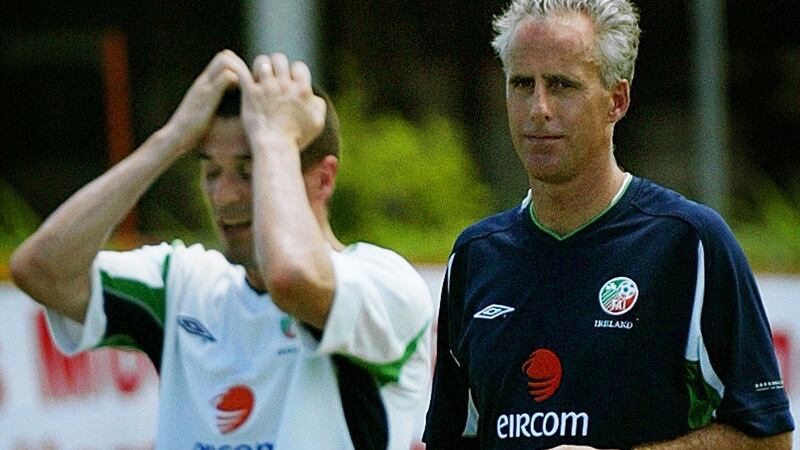
So to the film Saipan, which is released in Ireland on St Stephen’s Day. The movie is fine as a movie, with an excellent central performance from Éanna Hardwicke as Roy Keane. It’s not too long, and it’s probably reasonably entertaining to people who don’t know anything about what happened at Saipan, and can therefore watch it without being driven mad by all the things the movie gets wrong.
The list of those is too long to cover here, but from my point of view the single most annoying thing was that the film takes the debunked story that Keane had told Mick McCarthy “you’re not even Irish, you English c***” and makes this Irish-English antagonism seem like the central fault line in the whole disaster.
We get a few scenes where McCarthy is shown being a little insecure or defensive about his Irishness, including one where he tells the players “you’re representing your country,” then quickly correcting himself, “- our country”. We see Keane saying “Big Jack was an English fella who liked to pat Irish lads on the head.” We even see repeated scenes of Keane seeming unaccountably irritated by the fact that the boy who delivers his papers wears a Beckham England jersey.

Keane said a lot of terrible things to McCarthy in that meeting, but “you’re not even Irish” was not one of them. Such a barb would have been mortally insulting not only to McCarthy but to half of the squad: 11 of the 23 were English-born.
Only two players went to see Keane afterwards to express sympathy or regret over what had happened: they were Gary Breen and David Connolly. Neither would have been in the mood to do so if he’d just called them plastic Paddies.
The “you’re not even Irish” version of the story made instant headlines at the time; the denials it had happened that way by all the people who were there emerged gradually and never received the same prominence.
On a recent episode of his podcast, McCarthy revealed that he had spoken to the Saipan producers before the film’s release. When McCarthy expressed surprise that anyone would be interested in hearing more about Saipan, he was told “in our business you can tell the same story every 10 years to a new audience”. It’s frustrating to think of that new audience assuming the fake story is – more or less – what actually happened.
I flew to Japan on May 24th, 2002, by which time Keane was already flying back: my plane might have passed his somewhere over central Asia. I remember sitting in Heathrow airport that morning, reading a piece by Fintan O’Toole, who framed the row as a clash between “the new Celtic Tiger Ireland that has taken off since the 1994 World Cup . . . driven by a ruthless work ethic” and “the lingering legacy of a relatively poor society in which it made sense to be grateful for small mercies”.
“The battle of Saipan is thus a classical tragedy: the inevitable clash of two inexorable forces, each of which has right on its side,” O’Toole concluded.
The movie version instead shows us the inevitable clash of a driven hero who just wants the team to work hard and do well, and his inept antagonist, who unashamedly presides over an absolute shambles, which he somehow fails to recognise is totally unacceptable.
Nobody comes out of this well. The training camp is portrayed as one long stag party bender. The other players are, essentially, useless pissheads. At one point we see Keane doing stretches while Niall Quinn sits next to him casually slugging a bottle of beer.
The simplification makes the conflict less interesting than it was. The row split those who thought Keane was right to call out the organisational problems, which were seen as part of the FAI’s historic pattern of failure and bullshit, and those who felt it was simply unacceptable to behave and to treat others as he did, even if the pitch was bad and the training kit late.
In the movie version, the level of nonsense Keane is confronted with would be intolerable to any reasonable person. There’s no dilemma here.
Look, if you’re going to make a movie about an event like Saipan, which some of us still remember, then you expect some of those people to complain. Incidentally, I see that a new TV adaptation of Amadeus has come out this week. I haven’t seen it yet, but going by the ads I already instinctively feel that I’m going to hate it. When I ask myself why, the answer is that I’m just too attached to the Miloš Forman version to accept any heretical “reimaginings”. Saipan never really stood a chance.