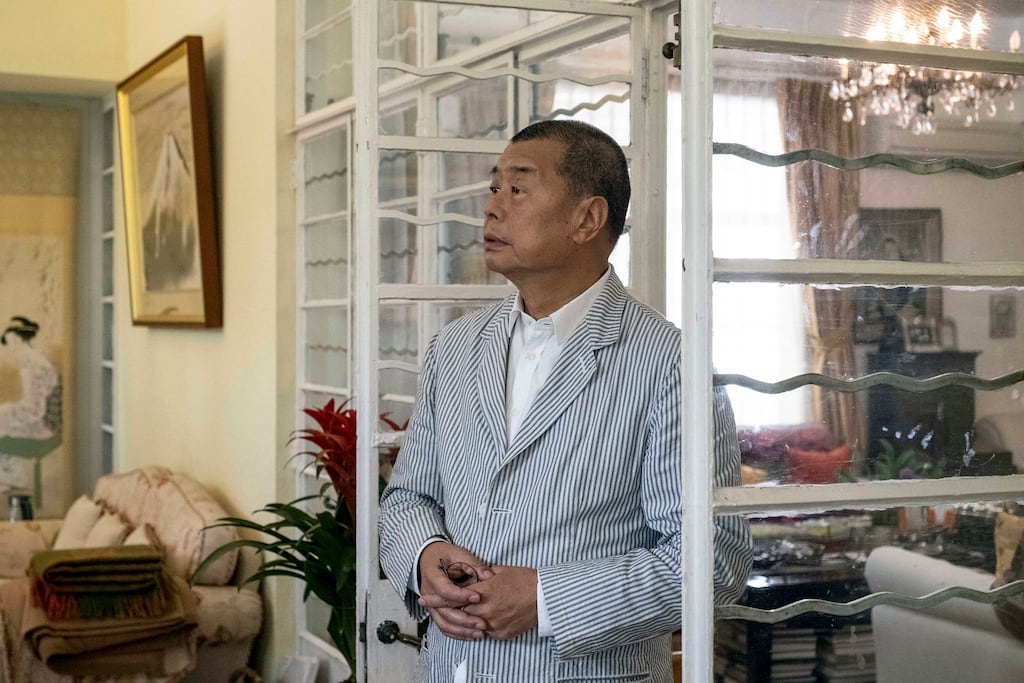


Monday’s guilty verdict for former Hong Kong media tycoon Jimmy Lai drew global attention and widespread criticism. It also highlights the emergence of a twin-track justice system in the city.
One city, two systems?
Delivering the verdict that found Jimmy Lai guilty on one count of sedition and two of foreign collusion, Justice Esther Toh said there was something that should be made clear.
“One thing has to be stressed: [Lai] is not on trial for his political views and he is free to hold whatever views he likes on politics,” she said.
But in their 855-page judgment, Toh and her two fellow Hong Kong high court judges had a great deal to say about Lai’s political views.
READ MORE


“[He] was no doubt a very savvy business man and it is unfortunate that his deep resentment and hatred for the Chinese Communist Party (CCP) led him down a thorny path leading to his trial today,” they say.
“[Lai] was obsessed with changing the CCP’s culture and values to one of western values and make China subservient to the might of the US and the West, turning China into a lackey of the West ... [His] rabid hatred of the CCP including the [People’s Republic of China] and [Hong Kong] was intense and even at the time he gave his testimony in Court it was just as intense.”
Unlike in mainland China, trials in Hong Kong are held in public and they retain the form and practice of the common law system inherited from Britain that remains in operation in the city. Judges and barristers wear wigs and gowns and argue over case law, citing precedents from other common law jurisdictions and the bench includes judges from Britain and other countries with a similar system.
But since Beijing imposed a draconian National Security Law on Hong Kong in 2020, some of the city’s judges have had to interpret a law made in mainland China and ratified by the National People’s Congress. And the judges who hear national security cases are appointed by Hong Kong’s chief executive in an opaque selection process.
National security judges are appointed for one year and can be removed at any time if they are deemed to be a threat to national security, and Beijing can assume jurisdiction in some cases and move them to courts in mainland China. The provisions of the National Security Law supersede common law procedures such as release on bail, where the presumption of innocence in bail determination is reversed.
What is emerging has elements of a parallel justice system operating under the forms and within the structure of a common law system. But because it only applies to national security cases, it does not affect Hong Kong’s appeal to international companies and investors who need a judicial system that is independent, transparent and based on the rule of law.
This helps to explain why Hong Kong’s stock exchange reclaimed the world’s top ranking for initial public offerings this year for the first time since 2019, the year of the pro-democracy demonstrations that ended with the imposition of the National Security Law.
After a number of years when thousands of banking executives left the city, buoyant capital markets and growth in assets under management mean that one global recruitment agency is predicting that hiring in Hong Kong’s financial sector could grow by as much as 15 per cent next year.
Please let me know what you think and send me your comments, thoughts or suggestions for topics you would like to see covered to denis.globalbriefing@irishtimes.com