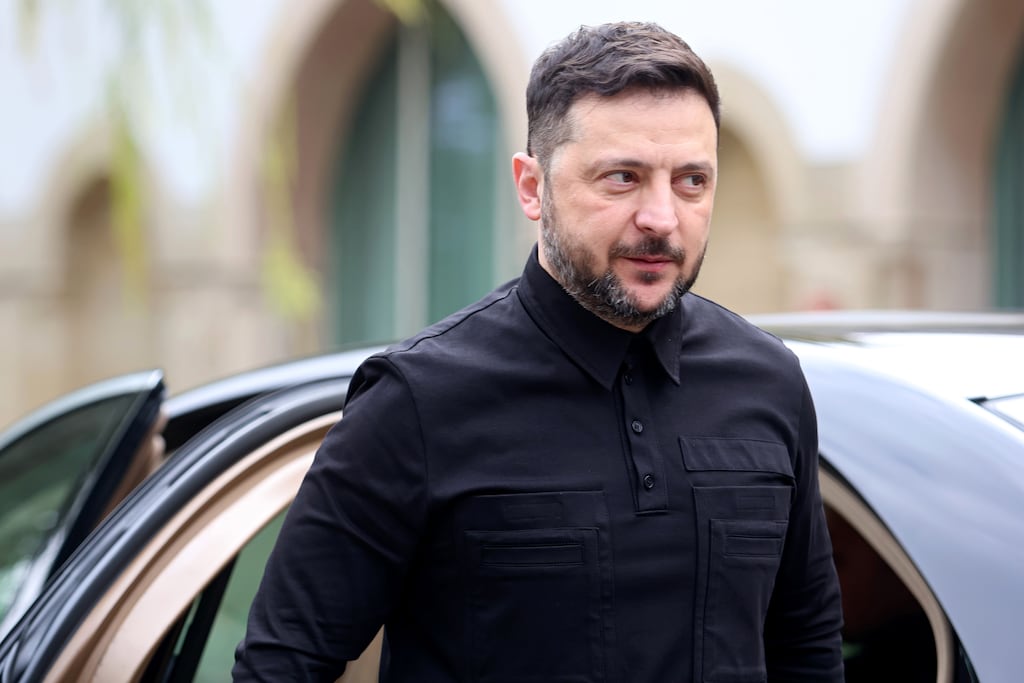


Ukraine’s president has doubts about security guarantees offered by his western partners. He is right to be sceptical.
More questions than answers on Ukraine guarantees
When a group of mostly European countries pledged in Paris on Tuesday to provide security guarantees to Ukraine after the war ends, Volodymyr Zelenskiy welcomed it as a huge step forward. But by Wednesday, he was not sure if it meant that they would protect his country if Russia attacks again.
“I am asking this very question to all our partners and I have not received a clear, unambiguous answer yet,” he said.
“I see the will, the political will, and that the partners are ready to give us strong sanctions, strong security guarantees. But as long as we don’t have such security guarantees – legally binding, supported by parliaments, supported by the United States Congress – this question cannot be answered. And even if they do, you still have to rely primarily on your own strength.”
READ MORE


The declaration issued in the name of the Coalition of the Willing committed its members to “a system of politically and legally binding guarantees” that would be activated once a ceasefire enters into force, as well as bilateral security arrangements between individual countries and Ukraine. They would also take part in a system to monitor and verify the ceasefire to be led by the United States.
They promised continued support for Ukraine’s armed forces and to establish a multinational force that would offer reassurance in the air, at sea and on land. And they said they would set out binding commitments to support Ukraine in the event of a future armed attack from Russia.
Separately, Britain and France signed a declaration of intent to station forces in Ukraine as part of a multinational force but it remains unclear how many troops will be committed or where they will be stationed. Emmanuel Macron said France could contribute “several thousand” troops but Keir Starmer has given no details of Britain’s likely contribution.
This may be because, according to the ministry of defence, Britain has fewer than 100,000 troops who are medically fit to be deployed. It is also unclear how long troops might be deployed for, and Nigel Farage suggested that Starmer could be signing up for a commitment as great as the British army on the Rhine that was stationed in Germany for almost 50 years after the end of the second World War.
Another unanswered question surrounds what soldiers in such a multinational force are expected to do if they come under attack from Russia. And it remains unclear to what extent the US is willing to act as the final backstop for the European security guarantees to Ukraine.
Donald Trump’s envoy Steve Witkoff and his son-in-law Jared Kushner were in Paris for Tuesday’s declaration and they praised the European commitment. But the final text of the declaration removed a line from an earlier draft which said the US would support the multinational force if it is attacked and help with intelligence and logistics.
How much any such promise is worth from an administration that is threatening to annex Greenland from Denmark is another question. And Trump was dismissive of Nato in a confused post on his Truth Social website on Wednesday night, saying that without his intervention, Russia would have taken all of Ukraine by now.
“RUSSIA AND CHINA HAVE ZERO FEAR OF NATO WITHOUT THE UNITED STATES, AND I DOUBT NATO WOULD BE THERE FOR US IF WE REALLY NEEDED THEM,” he wrote.
Please let me know what you think and send your comments, thoughts or suggestions for topics you would like to see covered to denis.globalbriefing@irishtimes.com