

When last September Brazil’s supreme court convicted former president Jair Bolsonaro for his failed coup attempt, it left the country’s democracy poised to finally put over a decade of extreme political turbulence behind it.
The far right’s principal leader was behind bars, the country’s institutions having held him to account for trying to overturn his defeat in 2022’s presidential election.
That election’s winner, Luiz Inácio Lula da Silva, has since gone on to oversee three competent if somewhat uninspiring years in power.
Now aged 80, but looking in great shape in the videos of his fitness regime that he regularly posts on social media, Lula appears to have a clear path to victory in October’s presidential election for what would be an unprecedented fourth term.
READ MORE


Nothing has emphasised the wily union leader’s status as favourite more clearly than Tarcísio de Freitas, his most viable challenger on the right, opting for the comforts of near certain re-election to a second term as governor of São Paulo rather than taking on Brazil’s greatest ever political campaigner for the main prize.
Of all the elections to be held across Latin America this year Brazil’s will be the most important. Its status as the region’s biggest and most populous country with its largest economy usually ensures this is the case.
This year though also represents a big chance for the left to record a large victory after a string of recent defeats in Argentina, Ecuador, Bolivia and Chile to conservative and far-right leaders that has left many observers talking of a new right-wing wave in Latin American politics.
But three years after the coup attempt was faced down the political weather is darkening once again in the capital Brasília. Even as the Bolsonaro clan engages in vicious infighting, it has launched the former president’s senator son Flávio as its presidential candidate.

Despite a corruption investigation that for nearly a decade has hung over him and involves his links to organised crime, early polls show Flávio being surprisingly competitive against Lula as Brazil’s political polarisation appears to remain obdurately intact.
The central plank of his campaign is an amnesty for all those involved in his father’s coup attempt. In pursuit of this he has become an arch critic of the supreme court which he accuses of “political persecution” against the far right. As well as the presidency, a clear goal of his campaign is to help the far right win as many seats in the senate as possible in order to try to impeach the judges who oversaw the investigation and prosecution of his father and his accomplices.

Jair Bolsonaro's conviction: Will the disgraced former president of Brazil really do time?
“The extreme right attacks the supreme court because of its conviction of Bolsonaro and these extremist forces are not going to stop. So the defence of democracy will once again be one of Lula’s principle campaign platforms because it is still very relevant,” says Humberto Costa, a senator in Lula’s Workers Party.
But just as the far right seeks to make its actions in convicting Bolsonaro père a central election issue, the supreme court now finds itself at the centre of the country’s biggest corruption scandal in years.
Just months after it was widely praised for its firmness in dealing with Bolsonaro’s gang of plotters, it now risks having its authority undermined by the revelations emerging from what finance minister Fernando Haddad says could be “the biggest bank fraud in the history of the country”.
When Banco Master was liquidated by Brazil’s central bank in November, it initially appeared to be the failure of an overly ambitious mid-sized lender that got into financial difficulties but posed no systematic risk to Brazil’s winder financial system. But the revelations that have tumbled out since then on a near daily basis have turned the case into a large political scandal.
These have shown Banco Master to have been more of a Ponzi scheme than a legitimate financial institution, causing losses that could top €8 billion. But its owner, Daniel Vorcaro, by the means of lavish financial patronage, had assiduously cultivated a network of influence at the highest levels of Brazil’s public institutions. His brother-in-law and closest associate Fabiano Zettel was the largest individual donor to Bolsonaro’s failed re-election bid in 2022.

This protection not only appears to have allowed Vorcaro to escape proper scrutiny when engaging in large fraud, but also to have given him a serious chance of benefiting from a public bailout even after it started to be exposed.
At first the focus fell on members of the Centrão, the ideologically promiscuous group of parties in congress that will lend support to governments in return for opportunities to indulge in graft.
But the supreme court was dragged into the affair with the revelation in December that the wife of Brazilian judge Alexandre de Moraes had in January 2024 signed a retainer with Master worth a potential €20 million. The value of the contract was out of all proportion to market rates, especially considering the small size and specialisation of Moraes’s office. It also appears unclear what activities she had engaged in on behalf of the bank to justify such huge fees.
The revelation, never denied, also placed a question over a series of meetings between Moraes and the head of the central bank. These took place just as Master was desperately trying to head off the central bank’s efforts to wind it up and instead allow the Centrão’s effort to save it to proceed, ultimately at the expense of taxpayers. Moraes denied the two men discussed Banco Master.

Then it was revealed that Moraes’s colleague, supreme court judge Dias Toffoli, who was controversially overseeing the Master investigation, was linked to a luxury holiday home in a high-end resort his brothers had developed alongside a fund linked to the bank. Worse, Toffoli’s sister-in-law publicly questioned whether her husband ever had anything to do with the resort, raising the possibility thejudge used his brothers as a front behind which to hide assets.
“It is a set of facts that leave the supreme court’s image on the floor,” says Bruno Brandão, executive director of anti-corruption organisation Transparency International in Brazil.
In the case of Toffoli, there has been muted surprise at the revelations involving him. He was named in the epic Car Wash investigation that shook the Brazilian establishment a decade ago, only to use his position to toss incriminating evidence provided of his involvement in the scheme.
[ Operation Car Wash: Brazil’s endemic corruption laid bareOpens in new window ]
For Moraes, the revelations are far more damaging for a judge that just recently was hailed by many as a hero for his lead role facing down the coup attempt and holding Bolsonaro to account. The far right have now seized on them to demand a parliamentary investigation into someone they have long sought to impeach. Some on the left have even aired the suspicion that the scandal is part of an operation to undermine confidence in the country’s democratic institutions just as it heads into an electoral cycle.
So far the Master affair has largely been linked to the supreme court and elements in congress. Reports of Lula’s limited involvement with the case indicate he refused to intervene in the troubled bank’s favour and instead directed Vorcaro to deal with his nemesis, the central bank.
But in recent days the scandal has inched closer to his administration. It has been revealed that the law firm of recently resigned justice minister Ricardo Lewandowski – another former supreme court judge – was also held on retainer by Banco Master. The palpable fear in Brasília is that given the web of influence across the political spectrum Vorcaro spun using his company’s fraudulent wealth more revelations could be drip-fed to the media as the country moves deeper into its election cycle.
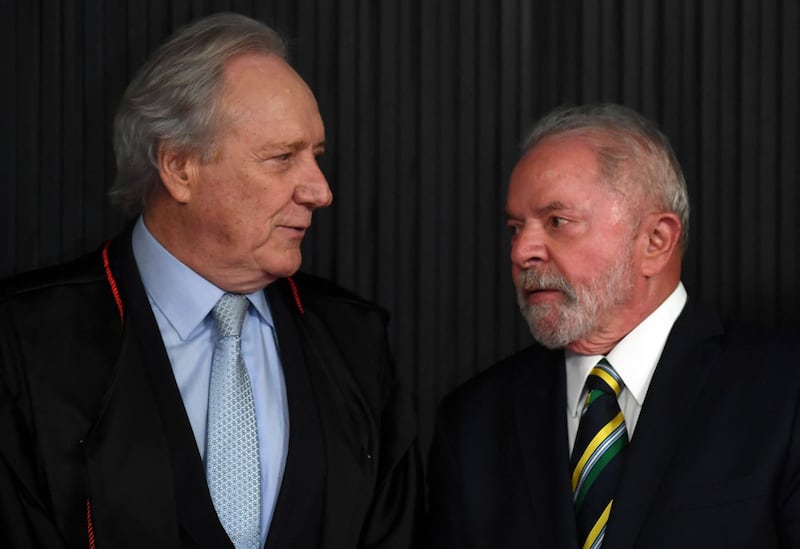
The scandal has echoes of the Car Wash affair which started in 2014 as an investigation into corruption in state oil company Petrobras and even, as in the case of Toffoli, involves several of the same personalities.
That older investigation cast a shadow over the re-election campaign of president Dilma Rousseff in 2014 and eventually created the political and social context for her impeachment in 2016 and the subsequent jailing of Lula for 580 days. But after the excesses of Car Wash’s prosecutors and judges were revealed the operation was dismantled and its convictions of leading political and business figures, including Lula, overturned.
For anti-corruption campaigners the Master affair is the bitter fruit of the Brazilian establishment’s eventual defeat of Car Wash. “These huge corruption schemes are the price Brazil is paying for having liquidated Car Wash instead of correcting its errors. The message to the corrupt was clear: ‘The place belongs to you.’ Impunity won out. This generated incentives for large-scale corruption and disincentives for the organs of control,” says Transparency director Brandão.
Now the country waits to see if the Master affair will have the same impact on politics as Car Wash. Attempts to mobilise protests about the case have so far failed to take off. But the streets are mobilising for the right where the focus remains on an amnesty. Last month the young evangelical congressman Nikolas Ferreira led a six-day march to the capital in support of freedom for everyone convicted for their role in the coup attempt. At its height 18,000 people are estimated to have taken part, generating huge engagement online, a speciality of Ferreira who though only 29 is already a rising star on Brazil’s right.

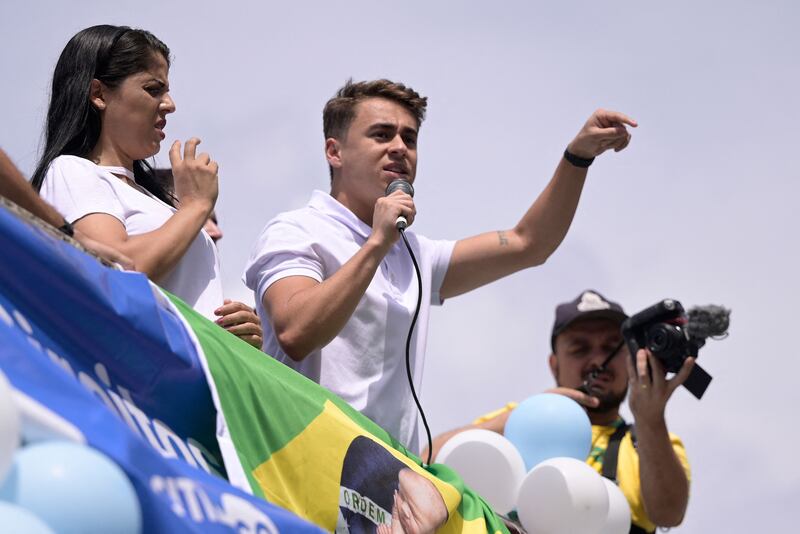
“This march is clearly designed to defy the decisions of the supreme court and defend the indefensible,” says senator Humberto Costa, who worries about the possibility of “some degree of violence” in the run up to the vote. But Ferreira rejected the charge that his march to the capital that was looted by bolsonaristas in January 2023 was a threat to public order. “We will not defeat Moraes’s tyranny by force ... We will not win by invading anywhere,” he told supporters.
Given the advantage right-wing politicians like Ferreira’s have enjoyed in the use of social media Costa also worries about the role big US technology companies will play in the campaign.
A point of tension with the US in recent years has been efforts by Brazilian authorities to prevent the spread of fake news and hate speech across US-owned social media networks, which have largely defeated efforts by Brazilian authorities to force them to show how their algorithms handle political content.
[ Brazil offers lesson in winning in Trump’s economic ‘Taco’ trade styleOpens in new window ]
But while the rapid spread of fake news was a large factor in recent Brazilian elections and a key driver of the rise of Bolsonaro to power in 2018, there is a new generation of left-wing politicians whose adeptness at using social media is eating into the right’s advantage online.
This and another emerging shift could mean this year’s election could take place beyond the peak of fake news’s influence in political campaigns. “Brazilians are also learning that not everything they find online is necessarily trustworthy. So I think the game is becoming more balanced,” says sociologist Angela Alonso, author of Thirteen, a book that tracks the prehistory of Brazil’s new right before it exploded on the national scene during nationwide protests in 2013.

Another risk that Lula seems – for now at least – to have neutralised is the risk of election interference directly by US president Donald Trump. Last year he lifted to 50 per cent tariffs on Brazilian goods entering the US in retaliation for the supreme court’s prosecution of Bolsonaro. But since then Lula’s firm handling of the crisis, first by standing firm in the face of the threat, then diplomatically schmoozing his US counterpart, has seen most of these since removed. “I only do business with people I like. And I liked him, and he liked me,” Trump said of Lula after their meeting at the United Nations.
But Lula, gearing up for what will be his seventh presidential election campaign, will know a lot of ground has to be covered between now and voting in October. The Bolsonaro clan refuses to quit the stage. Despite all the evidence of its corruption and coup-mongering, a significant portion of Brazilian society looks set to back it once more. Now the Banco Master affair has dragged into the mire one of the figures most responsible for defending democracy in 2022. And the show of bombshell revelations shows no sign of ending just yet.


