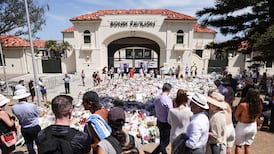
Every mourner entering the funeral home in one of Sydney’s oldest Jewish neighbourhoods received a sticker that said “Matilda” in purple script, above a smiling bumblebee holding a menorah. A woman in a long, black skirt wiped tears from under her glasses as she placed it on her black blouse.
A grandfather, carrying flowers and a cane, seemed to speak for everyone there for Matilda – a smiling 10-year-old and the youngest of the 15 victims who were killed in Sunday’s horrific attack on a Hanukkah festival by Sydney’s Bondi Beach.
“She should be alive,” he said.
Tears and wails poured forth from Matilda’s parents and family members. They stood at the front, near shiny helium balloons and a mountain of flowers. None of it could obscure the casket at the centre of a modest building, built in the 1940s by an earlier generation of Jews who had pushed Australia to become a refuge for Jewish refugees and Holocaust survivors.
READ MORE


[ Australia announces tougher hate speech laws in wake of Bondi terror attackOpens in new window ]
The pain of past and present – or just the pain of many – seemed to swirl through the room, intertwining like streams of smoke from sticks of incense.
It had only been a few days since two gunmen, who authorities said were motivated by Islamic State group ideology, opened fire on a crowd of hundreds. Witnesses said they waved bystanders away to target their fire on the Jews who had gathered for the festival of light.
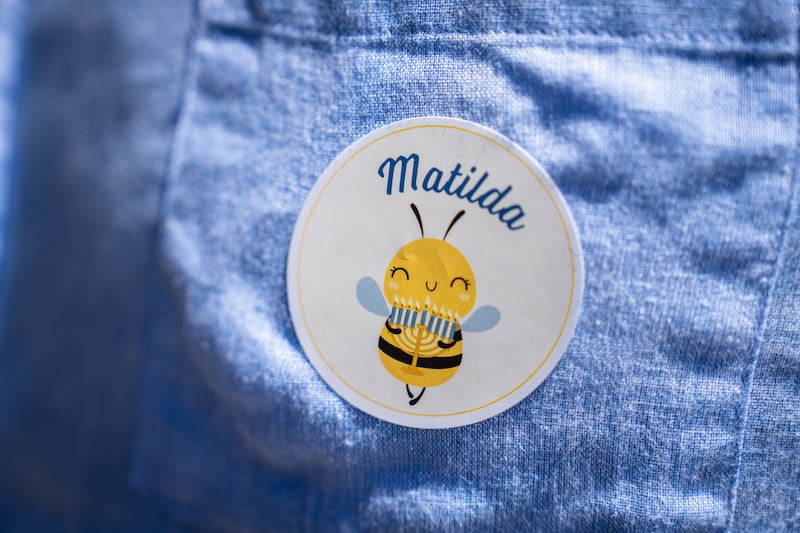
Rabbi Yehoram Ulman lost his son-in-law, Rabbi Eli Schlanger, and several close friends in the attack Sunday. On Thursday, he led the service for Matilda.
“It’s really an impossible task to be able to stand here today and try to give some words of comfort,” he said.
So he turned to the Psalms.
“Man, his days are like grass: like the flower of the field, so he blossoms,” he said, reading from Psalm 103. “For a wind passed over it ...” It took a lengthy silence before he could reach the next line – “and it is gone.”
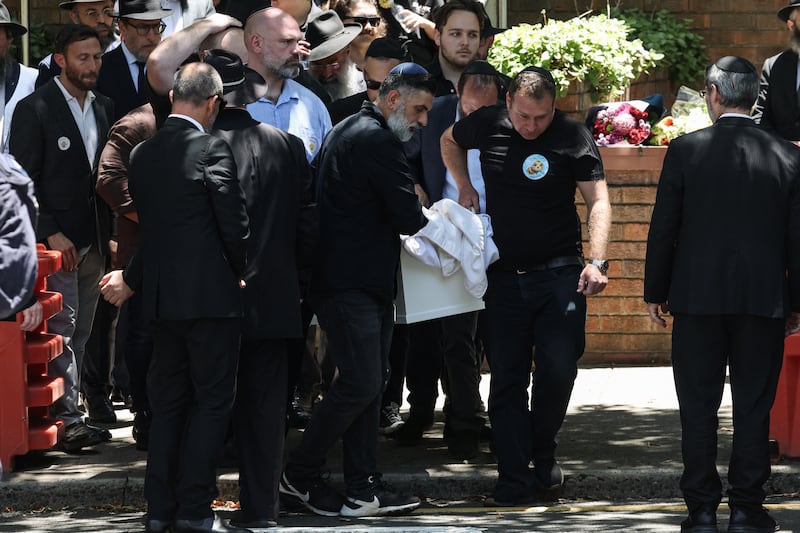
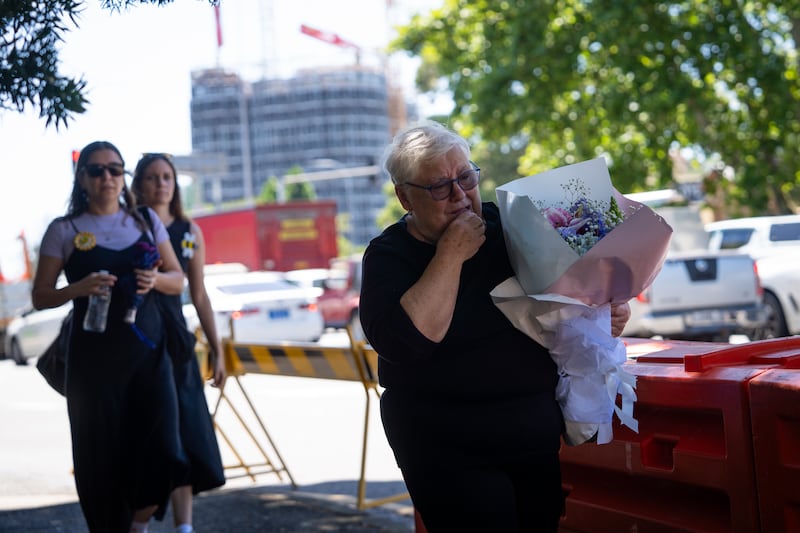
In his eulogy, Ullman emphasised the ebullience of Matilda, or “Matilda Bee” (her family asked that their last name not be used to protect their privacy). He read from a message shared by Matilda’s school that praised her compassion and said “she brightened everyone’s day with her radiant smile and infectious laugh.”
Matilda was so innocent, so beautiful, Ullman said, “So the eternal question is: Why? But you all have to know, there is no ‘because’.”
“Some souls,” he said, “come to the world and they complete the job as young children.”
He stressed that, as Jews, they must simply continue living, or else they would not be “giving respect to those who left us”.
Sussan Ley, the leader of Australia’s conservative coalition, sat in the middle rows, on the side with only women, a reflection of the congregation’s Conservative Judaism.
Chris Minns, the New South Wales premier from the Labour Party, spoke briefly, offering up a poem in honour of Matilda and her parents. They were Ukrainian immigrants who gave her what he described – in a country where the song Waltzing Matilda is an unofficial national anthem – as “the most Australian name that could ever exist.”
“From darkness they struck to where candles glowed bright, a child of celebration was lost to terror’s night,” the poem began.
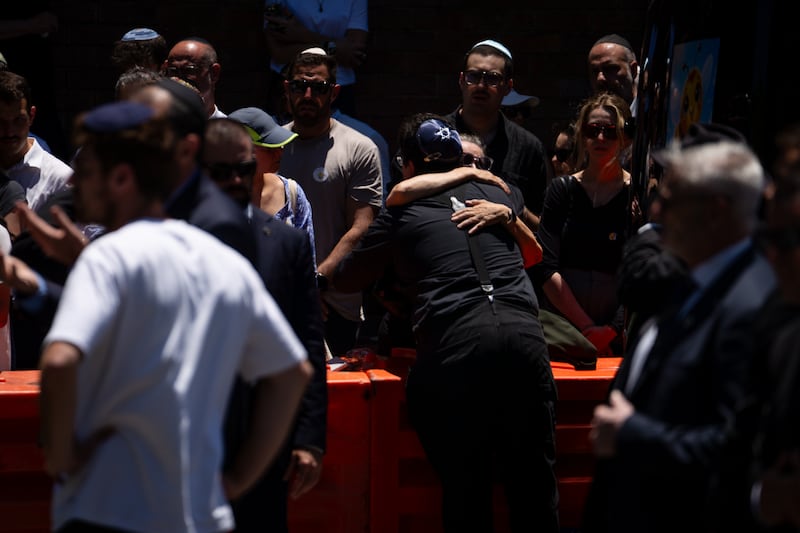
The gathered mourners hugged and cried. The mood was sombre, understated and warm. Men in black T-shirts and sneakers lifted metal chairs over each other to give women a seat. Some but not all wore yarmulkes.
As the standing room only crowd slowly departed, Russian, English and Ukrainian passed through conversations of condolence beside a dark brown donation box that said in large golden letters: “IN MEMORY OF OUR 6 MILLION MARTYRS.”
It was one of the building’s many references to the Holocaust.
For the crowd of several hundred Thursday, survival and grief dominated. Anecdotes spread through the departing procession, about other friends wounded or killed in the recent attack, or targeted in the spate of arsons last year that seemed to build toward Sunday’s massacre.
“I just can’t take it any more,” said one woman to another, noting she had just spoken to someone who lost relatives in the October 7th attacks in Israel two years ago. “It’s not normal.”
A few blocks away, I ran into Minns walking back to his car. I asked what he saw as the biggest challenge going forward to keep the Jewish community safe and to keep Sydney whole.
“I mean, you know, it’s ...” he looked up to the blazing blue sky, trying to make sense of it all.
“I mean, I think there is a before Sunday and an after-Sunday,” he said, referring to the day of the shooting. “The truth is, we’re going to have to do things differently.”
On his lapel, he was still wearing his Matilda bumblebee sticker. – This article originally appeared in The New York Times