The chance of a peace process around the Ukraine war is now closer than at any time since Russia’s full-scale invasion began in 2022, German chancellor Friedrich Merz said on Monday, adding that the US had offered “considerable” security guarantees.
“What the US has placed on the table here in Berlin in terms of legal and material guarantees is really considerable,” Mr Merz told a joint news conference with Ukraine’s president Volodymyr Zelenskiy after hours of talks with US negotiators.
“A territorial settlement remains a key question,” he added. “Only the Ukrainian people, the American president, the Ukrainian president, here defending his territory, can give an answer ... Only Ukraine can decide about territorial concessions. No ifs or buts.”
Earlier, the European Union’s foreign policy chief Kaja Kallas said pressuring Ukraine to give up the “fortress” of the Donbas region in any peace agreement would leave the rest of the country vulnerable to be conquered in a future Russian attack.
READ MORE



European leaders are desperate to avoid Washington pushing Ukraine into a shaky truce that favours Moscow and potentially undermines Ukraine and Europe’s future security.
The question of territorial concessions, a red line for Ukraine and key demand for Russia, is seen as one of the biggest sticking points in agreeing a truce in Europe’s deadliest conflict since 1945.
Ukrainian negotiators held a further round of talks with US officials in Berlin on Monday. During weekend discussions, US negotiators reportedly insisted Ukraine should give up territory in the east that Russia had been unable to take by force.
A wider group of European leaders travelled to Berlin for talks with Mr Zelenskiy.
In a statement afterwards, European leaders gave an outline of proposed security guarantees they said had been agreed with US officials.
They included a commitment Ukraine be permitted to maintain a peacetime army of 800,000 troops, which would be supported by a European-led military force securing Ukraine’s skies.
The statement said a US-led “ceasefire monitoring and verification” system would watch for signs of any future attack or breach of a ceasefire.
A peace deal should also include a “legally binding commitment” from allies to take steps to “restore peace” in the event Ukraine faced a future attack. “These measures may include armed force, intelligence and logistical assistance, economic and diplomatic actions,” the statement said.
The statement, signed by Mr Merz, French president Emmanuel Macron, UK prime minister Keir Starmer and several other EU leaders, pledged strong support for Ukraine’s bid for EU membership.
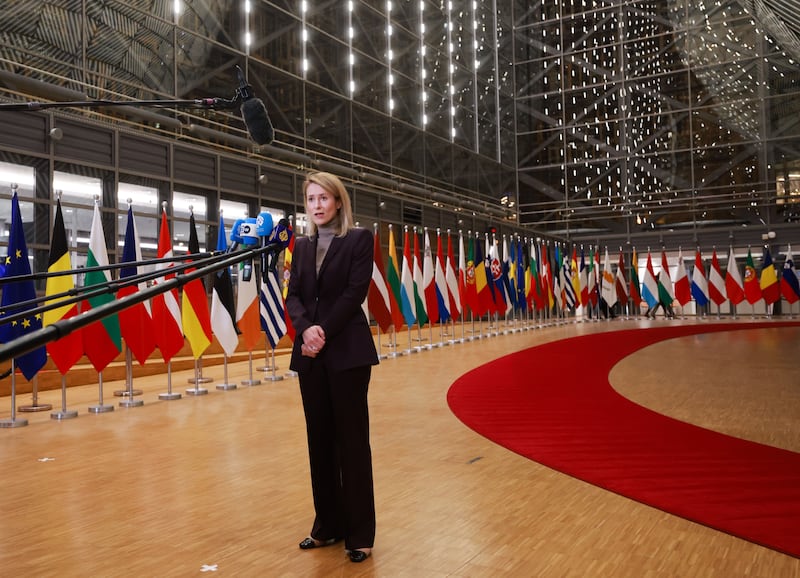
Speaking earlier in Brussels, Ms Kallas said taking the eastern Donbas region would not be Russian leader Vladimir Putin’s “end game”. The real goal was to control the entire country, the former Estonian prime minister said. “If Ukraine goes, then other regions are also in danger,” Ms Kallas said.
The US and Ukraine were making “real progress” during talks in Berlin, Ukraine’s negotiator Rustem Umerov said earlier on Monday, in a post on X. “We hope we will reach an agreement that will bring us closer to peace,” he said.
Mr Zelenskiy indicated his country might shelve its ambition to join the Nato military alliance, a key demand it had previously put forward as a condition of any peace deal.
However, Mr Zelenskiy said Kyiv would still need the US and other western allies to provide solid security guarantees, which would act as a deterrent to any future Russian attack.
Separate negotiations are continuing in Brussels to provide a significant package of financial support to Ukraine this week, to fill a shortfall expected to be felt towards the second half of next year.
The leaders of the EU’s 27 member states meet in Brussels on Thursday for what will be tense negotiations on a plan to use Russian state assets to fund a €90 billion loan to Kyiv. The Russian cash has been frozen in Europe by economic sanctions introduced in the early days of the war.
The Belgian government continues to withhold its support for the plan, which is politically seen as crucial to its success given the assets are frozen in Euroclear, a securities depository in Belgium.
The Belgian government is concerned the so-called reparations loan would draw retaliation from Moscow. It wants assurances any risk would be carried by the EU as a whole.
Alternative options, such as EU states jointly borrowing money to fund a loan to Ukraine, had not flown in the past, Ms Kallas said. “The most credible option is the reparations loan,” she said.
Joint EU borrowing would need the unanimous support of all 27 states, meaning Hungary’s far-right prime minister Viktor Orban would likely block the plan.
The loan funded by Russia’s frozen central bank assets would only require the agreement of a large majority of capitals.